Showing posts with label ANZAC Day 25th April. Show all posts

Friday, 19 April 2024

ANZAC Day Remembrance 25 Apr 2024 - The Winton and District War Memorial Gates


The Winton & District War Memorial Gate
Taken Apr 2024
[From my own collection]


The 25th of April 2024, known as ANZAC Day, will again mark that rare day each year when the two sovereign nations of Australia and New Zealand both commemorate those servicemen and servicewomen who have; 

"served and died in all wars, conflicts, and peacekeeping operations and the contribution and suffering of all those who have served."

Having been brought up in the rural district of Heddon Bush in Central Southland, being located at the southern end of New Zealand's South Island, I always found it curious that unlike many other country districts, even neighbouring Drummond, there was no "brick and mortar" War Memorial. The only reference to those who served in World Wars One and Two is a wooden "Roll of Honour" board installed in the local hall, but this only commemorates former pupils of the school so the names of many local servicemen were omitted. 

For many years I had felt that perhaps, after the misery and heartbreak of the First World War years, an absolutely crippling slump in post World War One farm returns, and also constant and prodigious wartime fundraising, that there had simply been a desire to "move on" and that the will to raise further funds had simply run out of steam. There had also been very generous monetary and personal gifts to the district's Returned Servicemen who had definitely not been forgotten. But then I became aware of the fact that the Winton War Memorial Gates in Central Southland represent not just Winton but also "District[s]".  


A Pillar of the Winton
War Memorial Gate
[Source NZ History]


A plaque on one pillar of the memorial gate does in fact read; "Erected to the Memory of Those of Winton and District" while a plaque on the other pillar reads; "Who Suffered and Died in the Great War". But which districts the Memorial Gates represent is lacking and i'm sure that if asked, most people who pass here now would have no idea that the memorial related to anywhere else other than Winton. At least I now know that those Servicemen from not only Winton but also a number of districts in the area, and who gave their lives for King and Country, were in fact not forgotten. Perhaps it was felt that with a wider geographical area a broad commemoration without names would not only be more cost effective but also a tidier option with less chance of innacuracies or omissions. Had names been added there would unfortunately have been a great many and I daresay a much larger memorial would have been required.


A Pillar of the Winton
War Memorial Gate
[Source NZ History]


Winton and surrounding districts had in fact been actively commemorating ANZAC day in local Churches from the 25th April 1916. A movement to commemorate the landing of the ANZAC Forces at Gallipoli on the 25th April 1915 had started in Brisbane, Australia in early 1916, quickly spreading to New Zealand where the Premier was asked, and agreed, to declare a National half-holiday so that Memorial services could be held. 


Heddon Bush School children
commemorating ANZAC Day, April 1917
[Watson Family collection]


From the above photo we know that in April 1917 children at the rural Heddon Bush School commemorated ANZAC Day, being photographed with a large blackboard reading "Brave ANZACS's" with a New Zealand flag.  ANZAC Day would also commonly be commemorated annually at all Winton and district churches, district schools, at Moores Hall and / or the Army Drill Hall in Winton, and in various local country halls.  

On the 3rd February 1920 Winton unveiled Memorial Plaques at the Winton School, with wreaths being laid each year thereafter. But as with the Heddon Bush School Memorial board, this only commemorated Servicemen who had been former pupils of the School. The Winton Presbyterian Church also put up a "Roll of Honour" (and later also for World War Two) for all Church members who had served in the forces.

But from late 1920, and right througout the Dominion, the "War Memorial Movement" was "being taken up by the public with great enthusiasm". That today almost every township in New Zealand has a public war memorial indicates the success of the movement and the desire to honour not only the fallen but all who had served their King and country.

Various proposals for a Southland Memorial were informally put forward, with Mr Henry R. Wilson of neighbouring South Hillend (died 1972 aged 99 years) writing to "The Southland Times" in March 1920 with some radical but interesting thoughts and suggestions of which this is only an excerpt:

"At Thursday last’s meeting of the War Funds Association, eleven country districts being represented, little sympathy was shown to the idea of the proposed [Invercargill] memorial. Can townspeople wonder why ? The wishes or sympathy of rural residents was neither asked for nor considered. ... A tablet at school or athenaeum in a country centre is very well from the local point of view to keep in memory the brave fallen, but the frittering away of, in some cases, several hundred pounds, and enthusiasm in small inadequate effigies of troopers and small monuments, seen by but few, is injudicious and to be deplored. ... If country people are to subscribe they must see something tangible as the outcome. ... failing a general Southland monument, the bulk of the country people might erect one on Forest Hill,...which is Crown lands and easily seen from Riverton, Otautau, Nightcaps, Winton, Morton Mains and elsewhere.... "

It now transpires that the rural community of Heddon Bush had in fact initially desired a memorial of their own. But in early March 1921, and after having invited Mr Walker, the Mayor of Winton, to speak to the residents, there was a quite surprising development;

“…it was unanimously decided to fall in with the Winton scheme. Winton has decided to erect a clock tower, upon which will be inscribed the names of fallen heroes from the district. The proposed site is on the Railway reserve, which would be beautified and provide a suitable environment for the structure. The cost of the memorial (without the clock) would be about £1500.”   

Choosing to join with Winton was perhaps not surprising. Being only 21 kilometres from Heddon Bush, Winton had a suitable and very visible site readily available at no cost, was undoubtedly the primary commercial rural centre for most Heddon Bush residents, a proposed railway line from Winton to Heddon Bush had been fully surveyed as long ago as circa 1875 and was, even at this late date, still expected to be constructed, and more importantly, it meant being able to share the cost of a rather more substantial War Memorial with not only Winton but other rural districts which all made perfect sense. Likewise, neighbouring South Hillend only put up a World War One "Roll of Honour" board in their local school as late as June 1936 so appear to have quickly fallen in with the "Winton scheme" - hopefully with Mr Wilson's blessing! 


The Memorial Weeping Wych Elm tree in the
Winton Oval, planted to commemorate the
ANZAC Day Landings, circa 1915.
Taken Autumn, Apr 2024
[From my own collection] 


After the initial momentum, fund raising for the Winton War Memorial appears to have progressed rather slowly. The first published reference to active fundraising and plans for the Winton War Memoral is this report dated the 5th February 1924; 

"At a public meeting in Winton to discuss the form of Soldiers' Memorial to be erected, it was stated that nearly £200 was on hand for the purpose. It was unanimously decided to erect an arch-gateway, and plant memorial trees in the vicinity." 

But it appears that there was already a "memorial tree", a weeping wych elm, in the Railway Reserve, having been planted by Mr Robert Wilson, the Mayor of Winton from 1914 to 1915, to commemorate the ANZAC Day landings on the 25th April 1915. So the weeping elm (which is now a "listed" tree) can only have been planted in 1915 unless the term "Mayor" was used retrospectively, i.e., that he was Mayor at the time of the landings although this seems rather unlikely.  

As to why a "Clock Tower" did not eventuate is unknown and we now have an "arch-gateway". The local newspaper, "The Winton Record" would have kept residents well informed of developments and Winton Borough Council business but this valuable publication has not (yet) been digitized.

A report from the 20th March 1924 states that canvassing for donations had commenced and that; 

"a generous response has been forthcoming. It is more than likely that the memorial will take the form of an arch gateway leading to the railway reserve, which will be beautified by the Town Council".

Over a year later, we note that during a meeting of the Winton Borough Council in August 1925, Councillor Gullick; "brought up" the matter of the Soldiers' Memorial. It was then; "...left in the Mayor’s hands to arrange a meeting of the collectors in order that some finality be arrived at." So obviously, plans for the memorial had still only progressed slowly.  


The Winton Memorial Gates in their original
pre-2009 location fronting the Bowling Green.
[Source : NZ History]

By March 1927 a "Sub Committee" had been constituted under the auspices of the Winton Borough Council, then meeting to discuss amended plans by Invercargill Architect Mr Edmund R.F. Wilson ;

"which provide for handsome memorial gates with two imposing stone pillars.... The gates are to be erected on the site at the stone steps leading to the railway reserve. " 

Exactly why an "arch-gateway" was no longer considered is unknown, perhaps just a modification suggested by the Architect in his "amended" plans, although the wrought iron gates when closed form an arch. The concrete pillars themselves would be substantial, each weighing between 6.5 to 7 tonnes. Interestingly, and I am sure by accident rather than by design, the chosen Architect, Mr Edmund R. Wilson, is in fact a brother of the afore-mentioned Mr Henry R. Wilson. 

The official unveiling and opening of the Memorial Gates on Great North Road, Winton, took place on ANZAC Day, being Thursday the 25th April 1929, with the ceremony being carried out by Chaplain Lieutenant-Colonel Dutton of Dunedin, a veteran of both the (2nd) Boer War and First World Wars. The Rev. Dutton had, in fact, a proud military heritage, being the son of a soldier and a Grandfather who fought at Waterloo. Dutton gave a long speech approriate to the occasion, only part of which includes these comments;     

"These tablets [of memory] will serve to tell future generations of the great sacrifices made by the young men of this generation. It has taken some years to complete the erection of the memorial at Winton and I am sure we are all very pleased that it has now been accomplished. The gates, walls and fences have been erected entirely by voluntary contributions and I wish to thank all those who have so liberally contributed to the fund....”


The Winton War Memorial Gates, taken looking west
and framing the Winton Water Tower, Oct 1958
[Photo credit : William Dykes] 


The Memorial Gate was erected with a decorative low concrete wall next to Great North Road, giving convenient access to the Winton Bowling Club grounds. Where the road curves round between the Memorial gate and the former Post Office was the 1902 Band Rotunda (in its original position beside the road before demolition in 1954 due to being a "traffic hazard"), being built to commemorate the 1899-1902 Boer War and the Coronation of King Edward VII. But in later years, with the gate being situated next to a now busy main road this proved inconvenient for ANZAC Day parades and gatherings and of course the band rotunda was long gone by then. Thus, as recorded by local Historian, the late Vince Boyle  ;

"The concrete 14 tonne twin pillars with an ornate iron gate were cut off at their bases and transported to Anzac Oval (80m south on Great North Road) and re-sited there on new foundations in time for Anzac Day 2009 at a cost of $35,928."


The Winton War Memorial pillars being moved,
January 2009
[Photo credit : Robyn Edie]


The new site further south on Great North Road is situated oblique to the road almost adjoining the former 1905 Winton Post Office building and with steps now leading down into the "ANZAC Oval". This is a small park with the centrepiece being not only the ornate Band Rotunda but also the afore-mentioned spreading Elm tree.  

And in fact, the historic old Winton Railway Station dating from 1871 (sadly demolished in 1983) had been situated at the north east corner of the park fronting a short access road, being an eastern extension of Brandon street which now leads to a soul-less car and truck park. Troops would be farewelled here prior to leaving for camp and military service overseas, many never to return. As, previously noted, which rural districts are represented by the Gates is not recorded but this was no doubt deliberately left open to include the area in general. Likewise, the amount raised by each district is not recorded and being a community effort, may never have been itemized in such a way. Comparing the photos from 1958 and today, I note that the dates "1914" and "1919" are no longer highlighted in a darker colour but otherwise the Memorial has been faithfully restored to how it was originally built. As to "1919", this was actually then considered the official end of the war as the Treaty of Versailles was only signed in June 1919. If you look closely at the wrought iron gateway (in the uppermost photo) when closed you will also notice that it also forms a Celtic style Cross.


The Heddon Bush School 
War Memorial Roll of Honour
[Photo credit : Vicki-Lynne Hubber]


And the "deficiency", if you would even call it that, of the Heddon Bush District not having their own War Memorial this was, as previously noted, partially rectified when a wooden Roll of Honour board was placed in the Heddon Bush School after World War Two but lists only those Heddon Bush School ex-pupils who had served and died in both World Wars. This board was paid for using the £39.8.0 profit from the 1949 Heddon Bush School 69th anniversary celebrations. Yes, an odd date for a celebration but as some first day pupils were still living the community wished to celebrate the occasion with them. The board would later be transferred from the school to the old Heddon Bush hall and is now in the new hall opened in 1964. I recall it hanging high up on the wall, where it still hangs to this day, but I personally never took much notice of it and I do not recall at any time that it was given any particular official ANZAC Day recognition. As to South Hillend, their school closed some years ago and they no longer have a local hall so am unsure of the location of their World War One & Two Rolls of Honour for former pupils. Unfortunately the Kia Mate Koa roll of Southland War Memorials and locations is no longer available online.

But I now know that the service and sacrifice of those from not just Winton, but also from surrounding Districts, are commemorated by the Winton & District Memorial Gates so these now hold a deeper meaning for me. Winton has, in fact, a number of war related Memorial Rolls of Honour and plaques, some being viewable in public areas. 

Last but not least, I must acknowledge the work of the late Ann Robbie (died Jan 2023) for documenting not only these but in fact all of Southland's War Memorials (around 420) as well as her work in restoring a number of memorial boards and rolls of honour. The late Iain Davidson (died Nov 2023), another Southlander, also deserves equal recognition for his work in researching and documenting the lives of a great many local servicemen as well as his invaluable and tenacious work in identifying servicemen in old photographs. I am aware that Andy Macdonald is now progressing Iain's work.    

Any further information is welcome and my email link appears in the right hand menu bar. As to which "Districts" the Winton War Memorial gates represent most likely includes the following (being districts in the immediate area who do not have their own district War Memorial) :

- Lochiel
- Oreti Plains
- Heddon Bush
- Dunearn
- South Hillend
- Kauana
- Otapiri
- Hokonui
- Springhills
- Tussock Creek


"They shall grow not old, as we that are left grow old :
Age shall not weary them, nor the years condemn.
At the going down of the sun and in the morning
We will remember them."

From "For the Fallen" by Laurence Binyon (1914)


All Rights Reserved 


Sources & Acknowledgements:

- Papers Past, National Library of New Zealand  
- New Zealand History, NZ Ministry for Culture & Heritage 
- "Tales of the Turi 1984 - 1984", by M. Cairns & F.H. Plunkett
- The Cyclopedia of New Zealand [Otago & Southland Provincial Districts] (held by the writer)
- Invercargill Public Library Reference Library (and their very helpful Librarians).
- Watson Family History, 2022 (held by the writer)
- Watson Family photo collection (held by the writer)
- Dykes Family photo collection (held by the writer)
- Personal photo collection
- Vicki-Lynne Hubber

Friday, 21 April 2017

ANZAC Day Remembrance 25th April 2017 - A Serviceman's Story


Henry George Edward Simpson 8/2132
Note the badges shown below.
Wakefield's Photo, Chiswick & Brentford
[From my own collection]

ANZAC Day, the 25th April 2017, "broadly commemorates all Australians and New Zealanders who served and died in all wars, conflicts, and peacekeeping operations and the contribution and suffering of all those who have served."

As a tribute to these men and women I am, by bringing together artefacts, photographs and information from a variety of sources, telling the story of a New Zealand World War One serviceman with a strong connection to both Otago and Southland, being Henry George Edward Simpson 8/2132.


14th South Otago Rifles Regiment Badges
The bird is a New Zealand Kea.
[From my own collection]

Being my Grandmother's cousin and with both being brought up by a mutual Aunt in the small Southland district of Wreys Bush they kept in close contact, along with my Father, Uncles and Aunt, until George's death in 1950. This means that I have a number of records relating to George (as he was known). While I do not hold his war medals or badges I do however also hold a number of photographs and postcards which he wrote to my family while overseas. Together with his digitized military record this has enabled me to built up a picture of his war service which includes, Egypt, Gallipoli, and the Western Front in France. So ANZAC Day provides me with the perfect opportunity to bring all these items together and give a brief overview, as best I can, of a soldier whose record of service to King and Country would otherwise likely continue to be forgotten. This also shows how a combination of sources of information, where little else is known, can be used to build up a useful picture of a person's life and, in this case, war service. When a detailed family history was professionally commissioned by the extended family some years ago no further information on George was discovered other than what is quoted here.

George, the son of William Henry Simpson and Agnes Brown was born at Havelock in the Hawkes Bay region of the North Island on the 13th September 1877. But in 1882 his mother died and he was then separated from his brother Albert and sent south to Wrey's Bush in Southland to live with his Aunt, attending the local Annandale Public School. Initially moving to Invercargill and working as a railways employee, George had by 1907 changed careers and entered the teaching profession working for the Southland Education Board, initially at Raes Junction School then in 1910 at Woodlands School.

On the 12th February 1915 George, and at the age of 37, enlisted as a Private with the 2nd Batallion of the Otago Infantry (14th South Otago Rifles Regiment). His overseas service commenced on the 13th June 1915 and he would spend a total of one year and 336 days overseas, returning to New Zealand in May 1917 before being discharged, his total war service being 2 years and 118 days.

His quite detailed Army Casualty Form gives the most accurate listing of his various placements in the various theatres of the war. Additionally, his postcards confirm this information and give confirmation of various dates.

We know that George was initially posted to Egypt and to Zeitoun Camp near Cairo. While the postcards may appear somewhat vague and lacking in detail one must remember that all mail had to pass a censor to ensure that no information was divulged which could prove useful to the enemy. But the frustrating thing is not having a clear record of his week to week postings, day to day life, and what specific enemy action he may have been engaged in such as at Gallipoli and the Battle of the Somme. This can only be estimated from regimental records but his own personal observations would have been invaluable.


A postcard from Zeitoun Camp,
Egypt dated 1st August 1915
and sent to my Aunt.
[From my own collection] 

"Zeitoun [Camp near Cairo, Egypt] 1st Aug 1915, We do most of our training in the mornings and evenings, as it is too hot during the day. It never rains..."

By the 9th August 1915 George had been posted with the ANZAC's to the Dardanelles during the Gallipoli Campaign but was admitted to hospital on the 2nd September due to "dysentry" before being transferred to a hospital in Malta via H.M. ship "Nile" so it must have been quite serious.

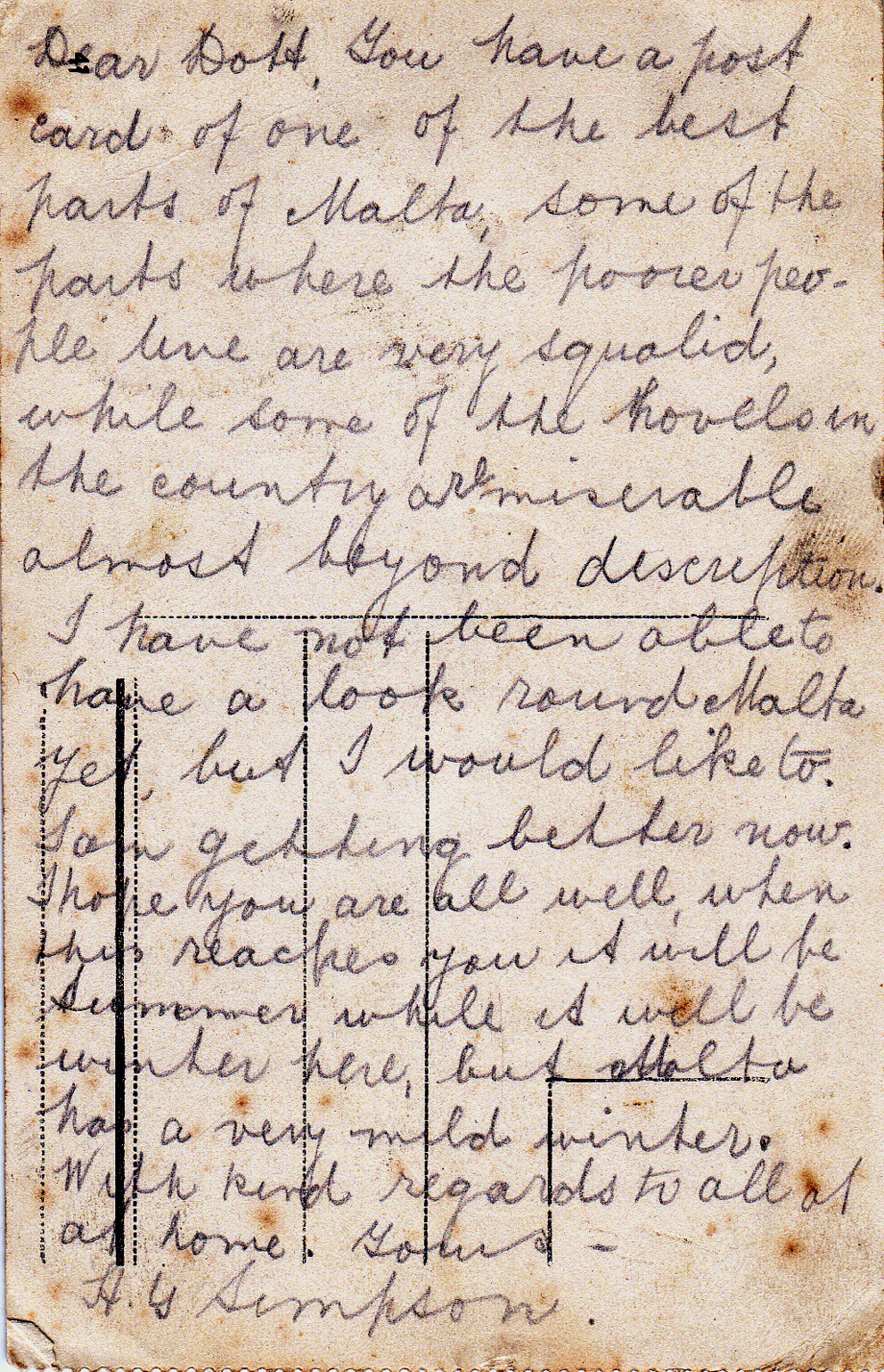
"Panorama of Floriana, Malta"

A Postcard from Malta,
and sent to my Aunt,
Sept - Oct 1915
[From my own collection]

"Dear Dott, You have a post card of one of the best parts of Malta, some of the parts where the poorer people live are very squalid, while some of the hovels in the country are miserable almost beyond description. I have not been able to have a look round Malta yet, but I would like to. I am getting better now...

Entrance to Grey Towers Barracks, Hornchurch, England
[From my own collection]

On the 8th October he was transferred by H.M. ship "Italia" to the 5th Southern General Hospital at Portsmouth in England, being classed as "slightly sick", then on the 7th February 1916 we find him at the NZ Base Depot at "Grey Towers" Barracks in Hornchurch, Essex. He left here to re-join his unit on the 1st March.

George Simpson, no date
[From my own collection]

On the 13th March George joined the 14th Company Battallion of the Otago Infantry Regiment at Moascar Camp near Ismailia on the Suez Canal. The Ottomans had attacked nearby in February 1915, hence no doubt, the strategic placement of a camp here.


A postcard sent from "The Desert, Egypt"
to my Father, dated 2nd April 1916
[From my own collection] 

"The Desert, Egypt, 2nd April 1916, ...We are out in the desert among the flies, the heat and the sand and we enjoy life immensely...".

But his time in the desert would be very brief as on the 9th April 1916 George embarked from Alexandria for France on the 'Llandovery Castle'. After the Gallipoli withdrawal the New Zealand forces had been re-organised into the newly formed New Zealand Division prior to leaving for France and the Western Front.

While serving at Houplines (near Armentieres) in Northern France, he was reported sick on the 31st May 1916 and sent to hospital but rejoined his unit on the front line on the 4th June. This was during an initial three month period where the New Zealand forces guarded a quieter section of the front in order to gain valuable front line experience.

A silk embroidered postcard sent from France, 12th July 1916
[From my own collection] 

A postcard sent from France, to
my Aunt, dated 12th July 1916
[From my own collection] 

"July 12th, 1916, France. Dear Dott, I hope you are all well, the morning note [?] and the daily strafe are tiresome at times but they will soon end..." [By "morning note" I am unsure if George is referring to a morning bugler. Any suggestions are welcome!]

But on the 13th August he fell sick again "In the Field", being attended to by the 3rd NZ Field Ambulance before being admitted to the 8th Casualty Clearing Station the same day. His affliction this time was a hernia which indicates heavy lifting. From here he was admitted to the 35 General Field Hospital in Calais on the 15th August. It is likely he was operated on here. From here he was transferred yet again, this time to the No1 Convalescent Depot at Boulogne on the 19th August but was "Discharged to Base" the following day.

On the 23rd August 1916 George joined the New Zealand forces "In the field" at Etaples on the 28th August, having been transferred from the 14th Company of the 2nd Battalion of the Otago Infantry Regiment to the 14th Company of the 1st Battalion of the Otago Infantry Regiment".

Early September 1916 had seen the New Zealand forces enter the 'Battle of the Somme', taking part in the third great push to break the enemy lines. It would be during this extended battle that George was wounded. By the end of September a decisive breakthrough had not yet been made but already at a huge cost in lives and injuries.

"Eighteen thousand members of the [New Zealand] division went into action. Nearly 6000 men were wounded and more than 2100 lost their lives. Over half the New Zealand Somme dead have no known grave".

After being "Wounded in action" on the 16th September George was attended to by the No1 NZ Field Ambulance then taken to the 38 Casualty Clearing Station the following day. On the 18th August he was admitted to the 23rd General Hospital at Etaples before embarking for England on H.M ship "Dieppe" on the 24th September. After just over three weeks at the 2nd London General Hospital at Chelsea he was then transferred to the Convalescent Camp at Hornchurch on the 17th October 1916. His service record only states "GSW [gun shot wound] elbow-severe". But from around this period George appears to have a wound to his head which may have been caused by flying shrapnel. Thus he was probably very lucky not to have been killed from this event alone.  At this point his active service was effectively over.


Servicemen recuperating from war injuries at the New Zealand
Convalescent Hospital at "Grey Towers" Hornchurch, England,
an unpublished photo taken circa late 1916 - early 1917.
George Simpson is the 3rd man from left at rear.
Unfortunately no other men are named.
[From my own collection]

A close up of the above photograph
showing George Simpson at the back

A folder of printed images of Hornchurch
sent by George Simpson in late 1916
to my Aunt in New Zealand.
[From my own collection]

On the 22nd January 1917 George Simpson was classified as unfit, "placed on NZ Roll", and transferred to Codford Camp on the Salisbury Plains before departing for New Zealand on H.M.N.Z.T. "Maunganui" on the 17th March 1917, his discharge being on the 11th June 1917. "Discharged in consequence no longer physically fit for war service on acct of pre-enlistment disability aggravated by active service." At all times during his service his rank had been that of a Private. He completed his military service with a completely unblemished record.

Henry George Edward Simpson 8/2132
Wakefield's Photo, Chiswick & Brentford
[From my own collection]

After the war, George was awarded the 1914-15 Star, the British War Medal and the Victory Medal. After George's death in 1950, and with the lack of an immediate relative, these were, with the approval of the Secretary of the NZ Army in Wellington, and indeed the Minister of Defence, sent by the Public Trustee to his niece Miss Jean Simpson. All I know is that Jean married John Dennis Daly, a veterinarian, in 1965 but had no children. It would be good to track down the current whereabouts of George's medals and to ascertain if any other records pertaining to George's military service may exist.

George Simpson,
taken at home, circa 1950
(The lady is unknown)
[From my own collection]

Returning to teaching George is known to have been at Winton Primary School in 1919, at Waitahuna Primary School in 1926, then appears to have lived in Dunedin from at least the 1930's but often visited and stayed with my family in Southland as they did with him in Dunedin. He retired to 62 Signal Hill Road in Dunedin where he died on the 14th December 1950. George appears to have been an intelligent man with, I note, a great love and appreciation of English poetry. With no immediate family of his own he requested in his will that the bulk of his estate be paid over to the Anglican Melanesian Mission. I know that at least one photo that had been in George's possession at his death came to our family as my Uncle mentions this in a letter. 

Gravestone of Henry George Edward Simpson,
Havelock North cemetery
[Image : Hastings District Council] 

Despite living most of his life in the south George Simpson chose to be buried with his parents, brother Bert, and family members in the Havelock North Cemetery. 

Copyright : 

Unless otherwise stated, all images are from my own personal collection and may be freely copied for non-commercial and academic use provided this site is acknowledged. Images may not be used for commercial purposes without my express written permission.

Sources :

- Family papers and photographs (held by the writer)
- Archives New Zealand / Te Rua Mahara o te Kāwanatanga
- Simpson Family History, 2006
- New Zealand History / Nga korero a ipurangi o Aotearoa
- Hastings District Council Cemetery Records

Monday, 18 April 2016

ANZAC Day Remembrance 25th April 2016 - The Reality of War


Military In Memoriam card for Private James Clark 29746, 
of the 18th New Zealand Reinforcements who died in action
at Meteren, 
on the 16th April 1918, aged 23 years.
[From my own collection]

This blog, which is primarily in images, highlights the harsh reality of 'The Great War' of 1914 - 1918 by way of ephemera, letters and artefacts from my own collections relating to those who made the supreme sacrifice.

This gallery is not intended to glorify any one serviceman over another but simply to highlight the fate of so many who never returned from war service. Please spare a quiet moment to remember all those who served King and Country and for their grieving families for whom there would be no happy homecoming and who would bear this burden for the rest of their lives.


A black bordered envelope used to post out
In Memoriam cards for deceased military servicemen.

[From my own collection]


"For The Empire's Cause" - Military deaths placed in
newspapers were normally printed within a black
border, and often accompanied by a photograph.
[From my own collection]


The Military Funeral cortège for Private John Watson, Winton,
New Zealand, 18th September 1915
[From my own collection]


A letter from The Southland Patriotic Committee
expressing condolences upon the death of a serviceman,
20th September 1915
[From my own collection]


An extract of a letter sent by the sister of a deceased
serviceman to her grieving mother in 1915
[From my own collection]


A small card showing the Flags of the Allied Forces.
This card was sent by a Scottish serviceman
after the death of a mutual friend.
[From my own collection]


The letter from King George V
accompanying the "Dead Man's Penny"
shown below.
[From my own collection]


A commemorative medal, known as a "Dead Man's Penny",
 for the life and service of Private John Watson
of Winton New Zealand who died in
military service, 14th September 1915.
Posted to families of deceased servicemen in 1923.
[From my own collection]


Fronticepiece of the photograph\of a
serviceman's gravestone sent to family
by the New Zealand Government
in March 1926
[From my own collection]


Formal photograph\of a serviceman's gravestone sent to family by
the New Zealand Government
 
in March 1926
[From my own collection]


Extract of a letter from Mrs Mary
MacWilliam of Crawfordjohn,,
Lanarkshire, Scotland dated 1915
[From my own collection]

"...my cousin Mrs H. Hamilton at Dalserf has lost both her sons. Charlie the elder was a captain in the Scottish Rifles and was killed at the Dardanelles in August. He had married a year before and his wife, who had gone home to her mother at Maidenhead, had a little girl on the 12th August and died a few days after. They wired to Charlie but got no reply - he had never got the message. We motored down to Dalserf and found the parents very glad to see us and wonderfully brave..."
- Extract of above letter from Mrs Mary MacWilliam, wife of the Presbyterian Minister at Crawfordjohn, South Lanarkshire, Scotland, 1915


Crosses laid out in Cranmer Square, Christchurch
in memory of those members of the Canterbury
Regiment killed in the First World War.
Taken 25th April 2015
[From my own collection]


Floral Tributes and poppies laid at the temporary
Christchurch Cenotaph in Cranmer Square in memory
of those servicemen killed in World Wars One and Two.
Taken 25th April 2015
[From my own collection] 


"They shall grow not old, as we that are left grow old :
Age shall not weary them, nor the years condemn.
At the going down of the sun and in the morning 
We will remember them."

From "For the Fallen" by Laurence Binyon (1914) 


Copyright : All images are from my own collections and may be freely copied for personal and academic use provided this site is acknowledged.


Wednesday, 16 April 2014

"Honouring Our Local Boys" - ANZAC Day Remembrance 25th April 2014


Featured in my 2013 ANZAC Day Blog, the schoolchildren of
the small Heddon Bush School commemorate the
"Brave ANZAC's", taken 1917
[From my own collection] 

The 25th of April 2014 again marks that rare day each year when the two sovereign nations of Australia and New Zealand both commemorate those servicemen and servicewomen who have served and also fallen in military operations for their respective countries. ANZAC Day 2014 will be even more significant as we lead up to the centenary of the commencement of "The Great War" of 1914-1918.

But how did local New Zealand communities personally honour those servicemen who both went to war and those who were lucky enough to return home safely after having done their duty for King and Country? For those who returned home the physical and mental scars were often patently obvious for all to see. I have no doubt that many communities wanted to give some tangible object of their gratitude for the obvious sacrifice these young men had made.    

My childhood rural community of Heddon Bush in the southern province of Southland New Zealand were no exception and may possibly have done more than most. I do suspect that some local and well established individuals also dug very deeply into their own personal pockets. But one also has to remember that farmers had personally profited from high commodity prices during the First World War period so this may have been a way for some community-minded folk to "give something back". Overall, the ability of the local community to raise funds for "Patriotic War Relief" was quite prodigious and the school children were also no exception. My own Father aged 12 years gave a "recitation" for Belgian Day in 1915 (in support of Belgian Relief Funds) with an additional  "voluntary" offering of his pocket money amounting to one shilling. He had gone onto High School (College) by the time the above group photograph was taken in 1917.  

Part of the Heddon Bush Red Cross Society Bed Cover of 1918.
I can find no record of where it was sent.
[From a glass plate negative in my own collection]

Under the New Zealand "War Funds Act" of 1915, the Government of the day sought to regulate the huge amounts of War Relief Funds being collected. It was more at the local level that problems arose where in the main the money from each district had been applied for the relief of servicemen and their dependents within that district. Thus, soldiers from districts who had sent many men into service but were unable to raise large amounts of relief funds were disadvantaged in regards to comforts received by those who came from areas where there was greater personal wealth or perhaps, in the case of Heddon Bush, an exceptionally well organised and well-supported Relief Committee. Thus War Relief Funds would now be applied uniformly over the Dominion "so that no sailor, soldier, or dependents, should be without relief". All collectors were required to hold an official collection card or be subject to a conviction with a fine of up to £20.  

So, working within the Act (which appears only to have related to actual financial support), the Heddon Bush community still wished to personally give those servicemen who left the district a tangible object of their heart-felt gratitude but also honouring those who safely returned. Reading local newspaper accounts of the period and reading the frequently published casualties and deaths, the Heddon Bush community were by mid war in no illusion whatsoever as to the risks their boys might face at the front. So an additional financial sacrifice for "their" men was but a small price to pay. But how could they show their gratitude and heart-felt best wishes for a safe return home?


On final leave in 1918 prior to leaving for
England, and in one last full family
photograph, my Uncle is pictured wearing
his gift from the local community.
[From my own collection]

The local Patriotic Committee generously decided that all Heddon Bush servicemen on final leave before departure for Europe (at least from mid-war) were to not only be given a decent send-off in the local hall but also presented with what I believe to be a very practical and well thought out gift - a good quality Swiss made silver 'Rolex' military wristwatch. The reverse was engraved "From Heddon Bush Friends" including the date of presentation.


The  silver 'Rolex' military wrist watch
presented to my Uncle in May 1918.
The card dial is damaged but the
watch is still in working order.
[From my own collection]

Mr W. Watson, after expressing pleasure at seeing such a large number present, called upon Mr J. Boyle to present the two young soldiers with a wristlet watch each…. Mr Boyle said the watches would act as a connecting link between soldiers and their homes, and as tokens of esteem in which they were held by their friends at Heddon Bush… [the servicemen] briefly returned thanks. Excellent music for dancing was supplied by Egan’s Band…” [30 May 1918]

I still hold the wrist watch presented to my Uncle at this event, being well-used but still in perfect working condition. He never had to face the full horrors of the war as the Armistice was signed while he was in training in England. Nevertheless he told me in 1982 (at age 85) that he still wished he had gotten to fight. He died later that year.

[Footnote : I have since had this watch manufactured in 1915 fully restored by a specialist watchmaker so that I can now occasionally use it]

The back of the (still working) 'Rolex' military wrist watch
a quality Swiss movement with no less than "15 jewels".
The reverse of the back cover is engraved to the recipient.
The way carried a date mark and serial number for 1915.
[From my own collection]

But what could the close-knit Heddon Bush community give their boys once they returned home? This gift, which would serve as a special thank you from the community, would be something quite unique and valuable. Again, some thought appears to have gone into this and the result was, I believe, a triumph. What could be more meaningful than a quality locally made and engraved gold watch chain fob? But additionally they would also receive the very useful sum of £10 in cash each as some recompense for their very considerable trouble. That converts to the equivalent of NZD $920.00 in today's money.   

I also proudly hold the 9ct gold fob presented to my Uncle. The reverse is personally engraved to my Uncle. This was given by the Heddon Bush community to all local servicemen who returned from service overseas, regardless of, as in my Uncle's case, if they actually fought.


The 9ct engraved Gold Fob presented to my Uncle
upon his return from "The Great War" 1914-1918
[From my own collection]

"A large enthusiastic and friendly audience gathered in the Heddon Bush Hall on Friday to bid welcome to six district boys [all named]. The function took the form of a dance... Mr Watson, as Chairman, made a speech of welcome and let the boys see that all present were very pleased to greet their soldiers back to their own home. He then called on Mr Tilley to make the presentation to each, which consisted of a gold medal, suitably inscribed, and a wallet of notes, value £10... The soldiers then had their say, thanking everyone for their kindness and welcome which would be dearly appreciated. It was an untold pleasure to be back, the war over, and peace reigning, and we are fully convinced there is no place like home. "For they are jolly good fellows" was then heartily sung, after which supper was dispensed and dancing continued." [A report of a similar presentation held on the 3rd October 1919]. 

The medal, comprising of crossed rifles, the letters "NZ" and engraved ferns, was designed and manufactured by Mr William James Wesney, a talented young Jeweller of Otautau and Riverton in Southland from 1916. How many of these were produced is unknown but other Southern communities are known to also have presented this "welcome home" present to "their boys". The local rural town of Otautau presented all returned soldiers, who at the time of enlistment had been resident in the district at least 12 months, with this medal, including to the parents of those who had died in the service of their country.

The Heddon Bush Roll of Honour
[Photo Credit : Vicki-Lynne Hubber]

Those pupils of Heddon Bush School who served and also fell in "The Great War" of 1914-1918 (including the Second World War of 1939-1945) are today commemorated in a large wooden 'Roll of Honour', having been purchased from the proceeds of the Heddon Bush School 68th Jubilee Anniversary Celebrations in 1949. This is now located in the Heddon Bush Hall. While seemingly an odd date to celebrate a Jubilee it was felt the time was opportune as a number of first day pupils were still alive and able to attend.

Footnote : I was very sorry to note that both Mr WJ Wesney, the designer of this wonderful medal, and his wife Mrs GL Wesney, died together in a motor accident at "Heenan's Corner" on the Hundred Line on the 30th November 1964, aged 76 and 64 years respectively. Both are interred in the Otautau Cemetery.

Copyright : All images, except the Roll of Honour board, are from my own personal collection. These may not be used for any commercial purpose without my express permission but may be freely copied for private use provided the images are suitably acknowledged and / or a link is given back to this page.


Bibliography / Rārangi Pukapuka :
  • Family Archives (held by the writer)
  • "Papers Past" [National Library of New Zealand / Te Puna Mātauranga o Aotearoa]
  • Museum of New Zealand / Te Papa Tongarewa

Thursday, 18 April 2013

ANZAC Day Remembrance 25th April 2013


New Zealand troops marching through Whitehall London
towards Trafalgar Square during The Victory March
on the 3rd May 1919. All these buildings survived World
War Two bombs and are still extant today.
 [From a photograph in my collection]

ANZAC Day, being the 25th of April, again marks that day when the Sovereign nations of Australia and New Zealand both commemorate those servicemen and servicewomen who have served and also fallen in military operations for their respective countries. The date itself is significant as being the anniversary of the landing of Australian and New Zealand soldiers on the Gallipoli Peninsula during "The Great War" [World War One] in 1915. My previous Blog on ANZAC Day can be viewed HERE.

The image featured above shows New Zealand troops marching through Whitehall London during the Victory March of British, Commonwealth and Allied servicemen through London which took place on the 3rd May 1919. My own Uncle appears to have taken part in this march. The route passed a dais in front of Buckingham Palace where His Majesty King George V reviewed the passing servicemen. You can view a cine film showing excerpts from the Victory March HERE.


Men of the Otago & Southland 7th Reinforcements being farewelled
at Dunedin Railway Station, June 1915. My own Great Uncle is
amongst those standing in the rain. Many of these men would
not return home. The still extant McCarthy's Building on the
corner of Castle Street and Lower Stuart Street is just
visible at upper left.
[Otago Witness Photo]

"When we got to Dunedin [from Invercargill] we were marched round several of the streets there and then halted with the Dunedin quota in front of the railway station where we were officially farewelled by the mayor and council etc. We then joined a troop train which took us straight to Lyttleton, picking up several more lots of troops at Oamaru, Timaru, and Ashburton. During the run we had lunch and tea on the train consisting of sandwiches, meat pies and tea." [Jack Watson from Heddon Bush, Southland, writing from Trentham Camp in June 1915]


The 40th Reinforcements being farewelled at Dunedin Railway Station
in 1918. My own Uncle appears 3rd from left in the centre of the
forward group. These men would all safely return to New Zealand.
[From my own collection]

"The routine of each day is something like this - Reveille at 6am, Parade for physical drill 6.30, Breakfast 7.30, Morning parade for squad drill 9, Dinner 12, Afternoon parade for squad drill 1.30, Dismiss 4.30, tea 5.30, Lights out 10.15 p.m. In the middle of the forenoon and afternoon there is always a spell for 15 minutes so you see we are not very hard worked though for a few days one feels his back a little sore.... In the way of food we are well treated. The supply is plentiful and the quality surprisingly good considering the difficulties in the way. At reveille there is coffee for those who wish it, for breakfast Porridge (without milk), stew, bread, butter and tea. Dinner : tea, bread butter cheese and jam. Tea : Roast beef or mutton, potatoes, tea, bread and butter. The meals are served in the tents and two men are detailed each day to bring them from the cookhouse wash the dishes etc...." [Jack Watson writing on the 21st June 1915]


The 'Tent City' that was Trentham Military Training Camp in 1915.
The only permanent buildings appears to be service buildings.
At left rear can be seen Trentham Racecourse.
[From my own collection]

"Until a few days ago it has been wet and unsettled here too ever since we came and things have been very disagreeable with mud and slush etc. It has also been playing the deuce with the men’s health too and almost everyone has been more or less affected with colds, sore throat’s etc. None of the tents of the 7th have been fitted with wooden floors and with men sleeping on the damp earth the surprising thing is that matters are not worse than they are. I suppose you will see that there is some commotion in parliament over the matter and we occasionally hear rumours of a fortnight’s general leave but I expect these are merely camp fables which have no foundation. At the same time the condition of the men seems to be causing them some uneasiness. On Friday afternoon, the Minister of Defence was in the camp fossicking around, yesterday Massey [Prime Minister of New Zealand], Rhodes [Minister for Public Health] and a few more were here and I understand that Massey and Allan & Joe Ward [Joseph Ward - Leader of the opposition Liberal Party] are back again today." [Jack Watson writing mid-winter on the 4th July 1915]

My Great Uncle John (Jack) Watson never fought overseas as he died of cerebro-spinal meningitis on the 14th September 1915, having contracted the disease during training when he volunteered to look after others carrying the disease. He was given a full military funeral.


Trentham Military Camp, New Zealand, c.1917.
At right can be seen part of the Trentham Racecourse track
with the Hutt River just visible in the background.
[Commercial tinted photo - From my own collection]

By 1917-18, Trentham Camp had been largely transformed from the 'tent city' we could see in the 1915 image further above to the rather more permanent camp of wooden huts we can see directly above. I myself spent some weeks "residing" in one these original huts in 1975, at that time being used as a Government Service Hostel.


Ready to Fight for King and Country - New Zealand troops in training
at Trentham Camp, 1918. My own Uncle appears 3rd from left. Fourth
from left at rear is his neighbour, Martin Patrick Forde. These men
would travel to England but be spared the bloodshed of war at the
 eleventh hour. The shorts are summer non-combat attire.
[From my own collection]

For many, "The Great War" was an adventure, but for most their desire to fight for King and country was unquestioning. Compulsory military conscription was not introduced in New Zealand until the 10th June 1916. My own Uncle commenced training at Trentham Camp in April 1918 and was completing final training at Sling Camp in England when the First World War ended at "the eleventh hour of the eleventh day of the eleventh month [1918]". He told me as late as 1982 [the year of his death] that he was sorry that he had not gotten to fight. Other than Serbia, New Zealand had the highest casualty and death rate per capita of any country involved in The Great War.


Time for a smoke on board the "SS Athenic"
[From my own collection]

"We left New York in the afternoon and steamed away out in a great hurry. We were all very sorry to leave N.Y. so soon and everyone was downhearted but towards dusk when there were still no boats in sight she turned around and the yarn soon got around that we had missed the convoy and were hopping it back to New York. Pleased! ... We got leave every day till Friday and crammed into those few days car rides, pictures, long rides on overhead and sub-way railways, theatres, & rides to the top of high buildings and could walk around on top and gaze down on the little specks of motor cars below and smaller black dots for people. On Friday we had a route march to Central Park and back headed by American Brass and Pipe bands and the Yanks were delighted. A moving cinema took is from quite close as we marched past and the picture is to be sent to all the principle towns in New Zealand so if you watch out you can hardly help seeing Fordie [Martin Patrick Forde] and I, we are right near the front." [My Uncle writing in 1918. Both my Uncle and Martin Forde were neighbours in the country area of Heddon Bush in Southland]


Sling Camp, Salisbury Plains, England, 1918
[Postcard photo from my own collection]

"We sailed into Liverpool on Saturday, the last day in August. We were not there very long and it looks a very smoky show. We were put aboard a troop train, cross compartments with a door opening out on each side, eight to each compartment, 3rd class and quite as comfortable at New Zealand first class.... We got here at 9.30 on Saturday night and were divided into our different draft, allotted our huts, given a feed - the first feed since morning - at a quarter to twelve and got to bed at 1am..." [My Uncle writing on the 4th September 1918]


The YMCA [Young Men's Christian Assoc.] Games Room
at Sling Camp, Bulford, Salisbury Plain, England.
[Postcard from my own collection]

"There are New Zealand soldiers from different reinforcements in this camp, all Otago men, some on leave, some just out of hospital and some waiting to go back to N.Z. I think we will have two or three months training here at the least...." [My Uncle writing on the 4th September 1918].   


Uniformed men and women being transported on a military
 troop transport truck, taken in England circa 1918.
[From my own collection]

The above photograph is interesting as it portrays uniformed New Zealand soldiers as well as uniformed women being carried on a troop transport truck in England. I believe the women could be members of the "Women's Army Auxiliary Corps" [WAAC], having been formed in July 1917. Can anyone confirm this? The women were however non-combatant, serving as cooks, waitresses, clerks and telephonists. They performed a valuable service by releasing able-bodied men in the forces for combat.


Two Unidentified New Zealand Servicemen
having the obligatory photo taken in 
Egypt, taken circa 1915-16.
[From my own collection]

The above photo is also rather interesting as the striking looking gentleman on the right would strongly appear to be New Zealand Māori. Could this photograph be taken after the Pioneer Māori Battalions were re-organised in February 1916 into four battalions together with the remnants of the New Zealand Otago Mounted Rifles? Unfortunately there are no visible badges however the young man on the left would almost definitely have come from Southland so a link to the Otago Mounted Rifles is certainly possible. I would be very interested in any further information concerning this fascinating photograph. A link to my email address appears at right or you can place a comment at the bottom of this page.

"Zeitoun [Camp near Cairo, Egypt] 1st Aug 1915, We do most of our training in the mornings and evenings, as it is too hot during the day. It never rains..." [H. George Simpson]  

"The Desert, Egypt, 2nd April 1916, ...We are out in the desert among the flies, the heat and the sand and we enjoy life immensely..." [H. George Simpson]

Although badly wounded, H. George Simpson, being a family relative, returned home after recuperating initially at Malta [known as "The Nurse of the Mediterranean" on account of the number of servicemen who recuperated there] then at the New Zealand Convalescent Hospital at "Grey Towers" in Hornchurch, England. 


New Zealand troops sightseeing in London -
taken at The Albert Memorial, c.1918-19.
[From my own collection]

"Grantham [England] 24 Oct 1917. Dear Friend, ...I am leaving for the front this evening, going with a large draft of machine gunners. I don't know what my luck is to be this time, just as well I don't perhaps but will consider myself lucky if I get wounded and be returned to England. The New Zealand troops have had very heavy casualties on the western front, I think the people in N.Z. will be very annoyed the way their troops have been stuck into it.... W.L.A. [William (Bill) Andrews]"

William (Bill) Lowe Andrews, also a neighbour at Heddon Bush in Southland New Zealand, survived the war.


"They shall grow not old, as we that are left grow old :
Age shall not weary them, nor the years condemn.
At the going down of the sun and in the morning 
We will remember them."

From "For the Fallen" by Laurence Binyon (1914) 


Credits :

Unless otherwise stated all images and excerpts are from my own collection and may be freely copied for personal use provided a link is given back to this page. Commercial use is prohibited without my express written permission.