|
"New Zealand Express Company Ltd.",
General Carriers & Shipping Agents,
Invercargill, 1911 |
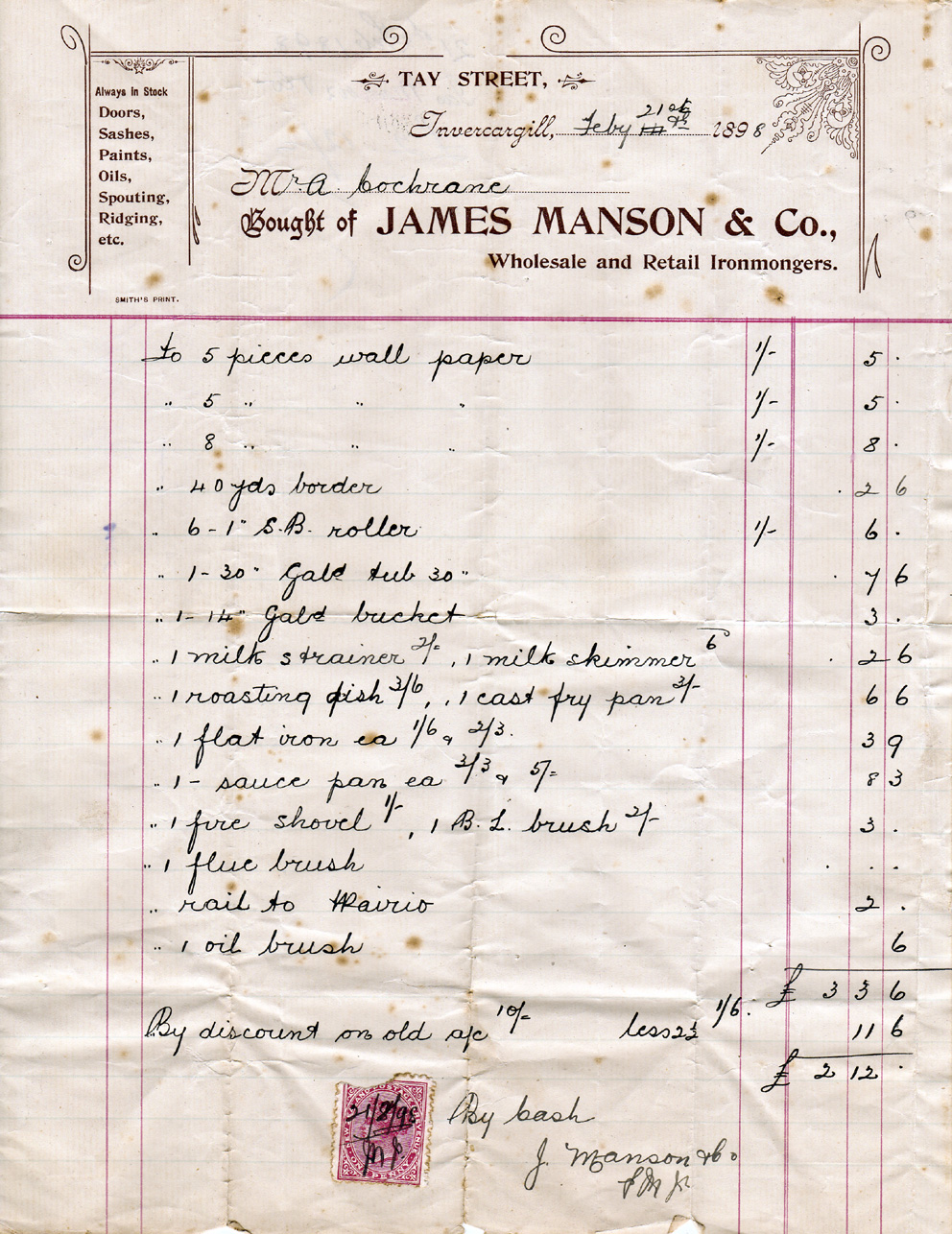
During the 19th century and the first decade or so of the 20th century it was customary for many businesses to use elaborately engraved letterhead or billhead paper for their correspondence and invoices. These attractive and now quite collectable pieces of ephemera show not only the very great skill of the artists but also frequently highlight the products and services offered by the various firms.
 |
"Campbell, Barr & Peddie", Cabinet Makers,
Upholsterers & Furnishers, Glasgow, 1881 |
Such letterheads were designed to make a bold statement about the business and their products, in other words, creating an "identity". But they also aided the recipient's perception of the business and of their products in the marketplace, plus the more elaborate the letterhead and the more products featured the greater the perception of the size and success of the business. The type "face" would however often just be chosen from the commercially produced lead type fonts of various sizes and styles held by the printer in large wooden compartmented trays stored in drawers then fitted around the image "block" in the matrix printing case.
 |
"Hordern & White", Carriage Builders,
Dunedin 1895 |
A lithographic printer, who still used this printing method in my home town until the late 1990's, commented to me that changing a letter or mis-spelt word was as easy as just replacing one line of type and away you went again. He contrasted this to modern day methods which would require the production of a whole new printing plate. Interestingly, this particular printing firm still regularly used a Linotype machine for making lead type for lithographic printing and I was able to observe this very noisy but fascinating machine in action.
 |
"Charles Affleck",
Blacksmith, Drummond, 1897 |
The letterheads I have featured were normally made into lithographic lead or copper "blocks" using the "
photomechanical half-tone" process. This process involved optically transferring a hand-drawn or stock "cut and paste" image onto a photo-sensitized metal plate by means of a "half-tone screen" which renders the image onto the block in a "dot" pattern of varying intensities. Chemicals were then used to harden the light-sensitized portions of the block coating then more chemicals would be used to etch out the metal on the still soluble portions of the unexposed plate. The etched metal plates (the image now being in negative form) were then mounted on wooden blocks ready to be placed in the flat lithographic printing presses.
 |
"A. Liddell & Sons",
Saddle Harness & Collar Makers, Winton, 1898 |
When printed, and viewed from a sufficient distance, the human eye cannot discern the resultant ink "dots", thus being rendered into various intensities of black and white (or of one coloured ink) enabling us to see a quite realistic facsimile of the original image. Photographs were also prepared for printing the same way, but with varying sizes of "mesh" as very fine printing "dots" and some cheaper printing inks were not well suited for poor quality paper and newsprint.
 |
"Herman August",
Furniture & Mattress Factory, Invercargill, 1898 |
Particularly after the First World War period the use of elaborate letterheads and billheads appears to have been on the wane, taking on a simpler form, no doubt due to increasing cost and fewer people available with the requisite graphic design skills. A new streamlined look to suit the times and new invoice book or machine invoicing methods no doubt also combined to make such work no longer cost-effective, entirely practical, or even desirable.
 |
"Reid & Gray", Agricultural Implement
Manufacturers & Importers, Dunedin, 1898 |
This form of printing (although unfortunately not the actual block creation) can still occasionally be seen in working technology museums such as (in New Zealand) at
Ferrymead Heritage Park in Christchurch and at
The Museum of Transport and Technology [MOTAT] in Auckland. As I can personally testify, the volunteer staff at these institutions delight in explaining and demonstrating the various printing methods formerly in common use. "
The Printing Museum" based in Wellington also serves to preserve New Zealand's printing technology and heritage.
 |
"A. Weir & Son"
Bootmakers and Retailers, Invercargill, 1898 |
In my previous employment in a professional Archive, we were also intrigued to note that letter heads were a fascinating way to chart the development and expansion of businesses, in this case relating to one particular local service town with extant invoices dating back to the 1860's. From small beginnings, it was, from these letterheads, possible to chart the increasing size of the businesses, the extended range of products or services they offered, the opening of new businesses to fulfill ever increasing demand for products and services, the expansion of the area they serviced, and also changes in ownership such as the sale of the business, addition of younger family members, or the addition of new business partners.
 |
"New Zealand Insurance Company",
Invercargill, 1898 |
All items show here are from my own personal collections, being sent to various family members, but primarily my Grandfather. Thankfully most of these items were overlooked during a ruthless "clean out and burn" in the mid 1970's although sadly many invoices from around 1905 to 1918 did not escape "the conflagration".
 |
"Thomas Findlay", Blacksmith,
& Wheelwright, Invercargill, 1899 |
 |
"Thomson & Beattie",
Drapers & Outfitters, Invercargill, 1903 |
 |
"Alfred Dewe",
Furnishing Warehouse, Invercargill, 1903 |
 |
"A. Weir & Son",
Bootmakers & Retailers, Invercargill, 1903 |
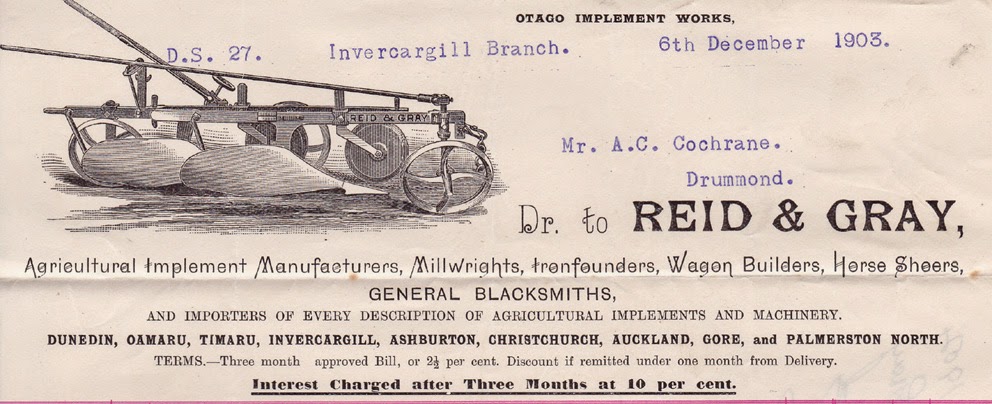 |
"Reid & Gray", Agricultural Implement
Manufacturers & Importers, Dunedin, 1898 |
 |
"Joseph Parmenter",
Saddle, Collar & Harness Maker, Otautau, 1904 |
 |
"E Matheson",
General Merchant, Otautau, 1904 |
 |
"A. Liddell & Sons",
Saddle, Harness & Collar Makers, Otautau, 1904 |
 |
"New Zealand Hardware Company Ltd.",
Ironmongers & Importers, Invercargill, 1904 |
 |
"Government Life Insurance Department",
Wellington, 1904 |
 |
"Affleck & Company",
Blacksmiths, Otautau, 1904 |
 |
"John Shearer & Son",
General Merchant, Drummond, 1904 |
 |
"William Strang",
General House Furnisher, Invercargill, 1904 |
Copyright : All images may be freely copied provided a link is given back to this page.