Showing posts with label Double Fairlie Josephine. Show all posts

Wednesday, 18 October 2017

The Forgotten Enginemen of the Dunedin & Port Chalmers Railway Coy., 1872-73 (Part One)


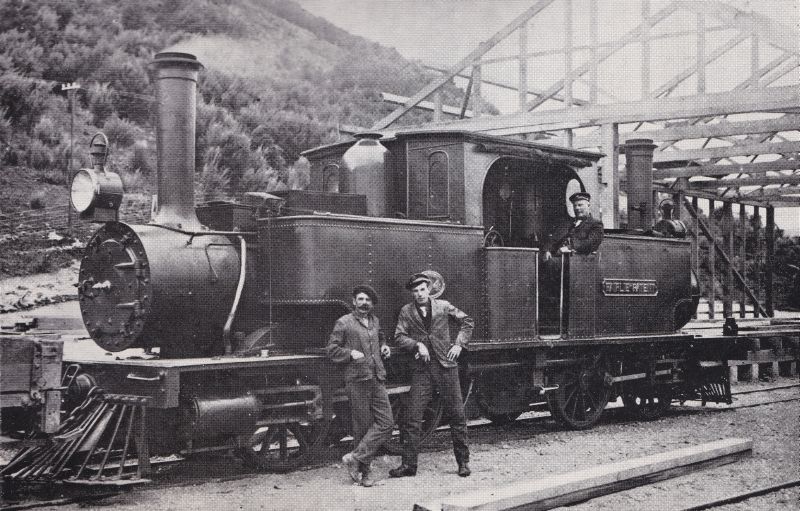
Partially Identified Men on the Footplate of Double-Fairlie 
Locomotive "Josephine" at Wickliff Terrace, Port Chalmers, 
believed taken during a trial run in Sept. 1872. 
Burton Brothers Photo.
[Source : OESA Collection, 1979]

The still extant and quite unique Dunedin & Port Chalmers Railway Company (D&PCR Coy) 145 year old double-ended Fairlie locomotive "Josephine" of 1872 now resides in pride of place in the entrance foyer of the Toitū Otago Settlers Museum here in Dunedin New Zealand. My Blog on the history of this very special and much loved locomotive can be read HERE.

But the early Enginemen of the formative D&PCR Coy., including "Josephine's" first driver and fireman, have been rather neglected. Recent contact with a family descendant of one of these men prompted me to further explore these now forgotten Enginemen. This research connected me to yet another family descendant and, as is quite often the case when I write about people, further descendants will hopefully come forward with additional information and, dare I hope, even photographs of the said people as so far we only have one identified image.

This blog is therefore an attempt to tell something of the story of these almost forgotten Enginemen or at least acknowledge their individual contribution to the railways. These men hold the great honour of having served on Otago's first 3ft 6in gauge railway then, after 1873, with the formative Otago Provincial Government Railways, and after 1876 with the New Zealand Government Railways. The three Enginemen are Messrs Amos, Thomas, and Gatwood but also including Fireman Graham. The three Enginemen appear to have all been recruited in England, coming over with "Josephine" and her sister engine "Rose" in the sailing vessel "Wave Queen" in 1872.

So, what do we know of the railway itself? A railway linking Dunedin with its port had earlier been considered when in 1864 the then Otago Provincial Engineer, Mr Swyer, costed an eight to nine mile line for the Provincial Government at around £9,500 per mile and recommended a railway rather than a "horse tramway". His objections to the latter were considered "to be quite visionary". After many amendments this proposal did not proceed.

The Line from Dunedin to Port Chalmers
[Source : "Dunedin & Port Chalmers Railway"
by Tom McGavin, NZR&L Soc. 1973]

But in October 1869 Consulting Engineer Mr J Miller F.S.A., M.P.C, and again on behalf of the Provincial Government, submitted "The Dunedin and Port Chalmers Railway Report" prepared to a new plan and costed at £7,500 per mile or just £60,000. The latter recommended the use of "Fairlie" type locomotives and various types and quantity of railway vehicles. Originally to be gauged at 4ft 8½in using 55lb rail, the gauge was later reduced to 3ft 6in to comply with the NZ Railways Act 1870 which now (and sensibly) specified a standard gauge to be used throughout New Zealand.

On the 25th January 1870 an agreement was then reached with private contractors to build the line at their expense, with the Otago Provincial Government guaranteeing a return on their investment of 8% pa. In early 1871 the promoters, now being Messrs "Proudfoot, Oliver, and Ulph", formed a private company in England called "The Dunedin and Port Chalmers Railway Company, Limited". I believe the top-hatted gentleman at centre left in the footplate photo at the top of this page to be David Proudfoot, one of the promoters.

David Proudfoot, One of the Promoters
[Source : Te Ara Govt.nz]

The Company then, as per the Provincial Government agreement, sought advice on the design and supply of the requisite locomotives and rolling stock from London based Consulting Railway Engineer, the Scottish born, Robert Francis Fairlie C.E. The "Otago Witness" of the 30th September 1871 indeed confirms that, "all the plant is being constructed under the supervision of Mr Fairlie, Inventor of the bogie engine, consulting engineer to the promoters".

The "Fairlie" engine had been designed especially for narrow gauge light railways. Already successfully in use since 1869 on the narrow gauge Ffestiniog Railway in Wales and further proven in locomotive trials in early 1871, the "famous Fairlie system" would prove admirably suited to the new 3ft 6in D&PCR Co. line. While some New Zealand railwaymen would perhaps hold a very different opinion Otago railwaymen were, as noted in a previous blog, always fiercely loyal to their unique Double-Fairlie locomotives. The quite ingenious 'double-ended' Fairlie design with two swivelling bogies, a central low firebox, and side tanks aiding traction certainly had some advantages which a conventional locomotive could not compete with.

Two locomotives of the "Fairlie" design, being named "Rose" and "Josephine", were then ordered from the "Vulcan Foundry Company" of Newton-le-Willows in Lancashire England as works numbers 636 and 637 respectively. The names were selected by Mr Richard Oliver, the Company General Manager and one of the promoters, while on a visit to England on behalf of the company. Both locomotives, being supplied in kitset form, were shipped out on the 853 ton iron clipper ship "Wave Queen", departing from Bristol England (having first called at Liverpool) on the 27th April 1872 and arriving at Port Chalmers New Zealand on the 28th August 1872 after a "fair passage" of 98 days.

The Portal of the Port Chalmers Tunnel Today.
The Key Stone is dated 1872
[From my own collection]

But prior to their arrival, and back at Port Chalmers, a contractors' "locomotive" drawing waggons was reported to have passed through the new Port Tunnel on Thursday the 27th June 1872. We then read that this "temporary" locomotive had been constructed by Messrs Easton and McGregor, Engineers of Port Chalmers, "out of a [modified English manufactured] steam crane, for the promoters of the Dunedin and Port Chalmers Railway."

The design of this decidedly "Heath Robinson" locomotive is worth relating; "They placed the boiler and machinery of a steam crane upon an ordinary waggon, to which they added a few toothed wheels to give motion to one pair of wheels which were thus converted into driving wheels; and with this novel locomotive, which would have pleased George Stephenson himself.... they have contrived to do an amount of work that would otherwise have involved a heavy cost or most vexatious delay".   

A few days later it was further reported that, "At first it worked rather stiffly but now it is in fine trim, and takes along ten tons with ease." and had, "already done good work ballasting the line and taking from the Port towards Dunedin any plant required." At a speech given in 1928, Mr W.F. Sligo Retired Railway Foreman, states that the engine "assisted in ballasting the line up to Black Jack's Point." As to performance, "Its consumption of coal for a day's work is about the price of two horses' feed". Contrary to an initial report, this was not the first "locomotive" constructed in New Zealand [link]. It was however noted that the "Wave Queen" with "the real locomotives for the line" would arrive shortly.

Accompanying the two 'Fairlie' locomotives on the "Wave Queen", along with a considerable quantity of railway plant, were the afore-mentioned George Amos, an Engineer; John Thomas, a Locomotive Driver; and Frederick Gatwood, an Assistant Engineer. All three men would play a leading role in the assembly of at least "Josephine" then the working of the two locomotives on the line before and after the official opening. Thomas Graham, an experienced railwayman, would initially be employed as a fireman.

The Port Chalmers Line emerging into the cutting having just passed
through the Port Tunnel and heading towards Blanket Bay.
[Source : Auckland War Memorial Museum Tamaki Paenga Hira]

We know that No 2 "Josephine", having been completed in a shed on the pier by Mr Amos and his team, got up steam for the very first time on Tuesday the 10th September 1872, her whistle being heard from the Port Chalmers pier at "half-past ten in the forenoon". At 5pm that same day, and with "about 30 gentlemen out of the crowd in attendance", "Josephine" made a successful trial run through the new Port Tunnel to Blanket (Sawyers) Bay and return, being accompanied by the cheers of the local populace.

The No 1 "Rose", having been fitted up by the firm of Messrs Easton & McGregor, being Engineers, Millwrights, Blacksmiths & Founderers of Port Chalmers, would be steamed for the first time the following day, being the 11th September 1872. At 3.30 pm that day she was taken on a trial trip in light steam from Port Chalmers with "Josephine" coupled on at front as lead engine, the journey to Blanket Bay and return being made at a speed of about twenty miles per hour. The cry "In Heads", being in deference to public safety, was made as the locomotives proceeded through the port tunnel. The footplate crew are not named.

On the 18th September "Josephine", being driven by John Thomas, hauled the first ever goods train on the line - a shipment of three hogsheads of beer from Burke's Brewery to Port Chalmers. Thereafter both locomotives ran daily ballasting and works trains down the line.

Double-Fairlie Locomotive "Rose" passing
Burke's Brewery with a passenger train, circa 1873
[From an old print]

Then on Saturday the 26th October, with George Amos driving and John Thomas in charge of the brake van, "Josephine" conveyed, "by invitation of the contractors" several members of the Legislative Council and House of Representatives, including promoters Messrs David & George Proudfoot & the General Manager Mr Richard Oliver, from Port Chalmers through to Dunedin in one of the first class carriages, the line now being in a sufficient state of completion but not fully ballasted. With speed restrictions and stoppages the down journey of just under eight miles took "forty and a half minutes" with the return journey being "accomplished much faster".

Due to the "liberality of Mr Proudfoot" and the non-availability of the Harbour Company's steamer, an unscheduled trip took place on Tuesday the 29th October with passengers from the "S.S. Rangitoto" being conveyed to Dunedin but neither the locomotive used or driver is noted. A train was also intended to run on the Prince of Wales' birthday, being the 9th November 1872.

No 1 "Rose", and being "gaily decorated" is recorded as holding the honour of hauling the first official train from Dunedin to the newly named Lady Bowen Pier at Port Chalmers at the opening of the line by The Governor of New Zealand, His Excellency Sir George Bowen G.C.M.G. on Tuesday the 31st December 1872 at 12 noon. A stop was made on the way at Burke's Brewery. As to whether they imbibed some of the local beer is not recorded but it was, after all, a celebratory occasion. The return journey to Dunedin was completed in 22 minutes, "the quickest journey yet made". A cold collation was then provided in the University Hall with "about 16 gentlemen" [i.e. no ladies invited!] in attendance with effusive speeches and official toasts being given.

Non-timetabled public trains appear to have then run for the rest of the afternoon as the advertisement for the opening ceremony states that, "After 2 o'clock pm the trains will run between Dunedin and Port Chalmers at frequent intervals".

The Old Dunedin Railway Station
Burton Bros. Photo, circa 1874
[From an old print]

But the No 2 "Josephine", with John Thomas driving and Thomas Graham as his fireman, would have her moment of fame the following day, being Wednesday the 1st January 1873, when she is recorded as having hauled the first scheduled public train on the line from Dunedin to Port Chalmers. This was always a matter of great pride to Mr Thomas and a fact that his descendants have never forgotten.

Thereafter a regular timetabled service of six daily "up" and "down" mixed passenger and goods trains continued until the company was taken over by the Otago Provincial Government Railways on the 10th April 1873 at a cost of £187,106

From the 1st January 1873 fares were set at 2s for a single passenger ticket or 3s return travelling First class and 1s 6d single or 2s return travelling Second class. General goods would be conveyed at 5s per ton with "Special Goods at Special Rates" upon enquiry.

Unfortunately the line met with at least three early fatalities. Firstly Robert Carr, a labourer, died in hospital on the 3rd October 1871 after being injured from a fall of earth whilst engaged in the excavation of the Port Tunnel the previous day. Another labourer, named John Long, would be fatally injured by a blast in the Port Tunnel at half past one on the afternoon of the 28th March 1872. Two powder fuses were set but only one lit. Re-entering the tunnel to set the second fuse after the first blast the 'unlit' fuse unexpectedly exploded causing a stone to fall on his head killing him instantly. The first fatality on the line itself would be Angus McPherson who, under the influence of alcohol, was run over by a train near Burkes on the 17th July 1873. 

But what specifically do we know of our railwaymen, Messrs Amos, Thomas, Graham and Gatwood? This Blog series explores these early D&PCR Co. Enginemen, including their often surprisingly peripatetic and fascinating subsequent careers and lives which proved to be both long, and sadly in two cases, suddenly cut short in the prime of their lives.

Please click on these links to read their stories :

- Mr J. George H. Amos - Chief Engineer

- Mr John Thomas - Locomotive Driver

- Mr Thomas Graham - Fireman 

- Mr Frederick Gatwood - Assistant Engineer


Copyright : This blog may not be reproduced without my specific written permission and / or that of family descendants. Excerpts may however be quoted for non-commercial and academic use provided this site is acknowledged. Please feel free, however, to publicize this Blog.

Sources :

- Papers Past / Te Puna Mātauranga o Aotearoa
- Archives New Zealand / Te Rua Mahara o te Kāwanatanga
- Heritage New Zealand / Pouhere Taonga
- "The New Zealand Railways Magazine", 1934
- Toitū Otago Settlers Museum, Dunedin
- McNab Room, Dunedin Public Library
- "Dunedin and Port Chalmers Railway - New Zealand's First 3ft 6in Gauge Line" by TA McGavin, 1973 (From my own collection)
- "Josephine and Her Friends" by JA Dangerfield, c.1994
- Genealogy.com
- Trove (National Library of Australia)
- Auckland War Memorial Museum / Tamaki Paenga Hira
- With thanks to Thomas and Gatwood family descendants for their generous assistance

Tuesday, 17 May 2016

"Saved Twice" - The Amazing Preservation Story of Double Fairlie E175 "Josephine"


"Josephine" as she appears today in the entrance hall
of
 Toitū Otago Settlers Museum, Dunedin
[Source : reefton.co.nz/the-r28-locomotive]

We have already read in my first two blog instalments [Click here for link] about the inaugural through express train from Christchurch to Dunedin led by the American built K88 "Washington", being assisted for part of the way by the English built Double-Fairlie "Josephine". After last weeks blog about the amazing discovery and preservation to working order of "K88 Washington" let us now read about the eleventh hour preservation in 1925 of the Double Fairlie locomotive No E175 "Josephine", having, like "Washington", come so very, very close to being lost to us forever. But in 1968 her fate once again hung in the balance. Who would come to her rescue a second time?


"Josephine" builders plate,
Vulcan Foundry Co. Ltd.,
Newton Le Willows, 1872
[From my own collection]

"Josephine" was - and still is - very special. She was ordered by the then Dunedin and Port Chalmers Railway Company ("D&PCR Co") from the builders, the Vulcan Foundry of Newton-Le-Willows in Lancashire England in 1872. The decision to purchase double ended locomotives and light rolling stock to the "light surface railway" design of English Railway Engineer Robert F. Fairlie had been on the advice and recommendation of the Civil & Consulting Engineer, Mr John Millar F.S.A.in his report of the 5th October 1869 to the Otago Provincial Government (who were to provide a financial guarantee).

By August 1872, both "Josephine" and her sister engine "Rose" had arrived in kitset form at Port Chalmers New Zealand from Bristol England on the sailing ship "Wave Queen". The names of the engines had in fact been chosen by Mr Oliver, one of the promoters, while on a visit to England. Accompanying the engines from Bristol were Mr Amos, being an Engineer and in charge of the plant, John ("Jack") Thomas, and Mr Gatwood.

Double Fairlie Locomotive Plans
from the Vulcan Foundry

The Dunedin and Port Chalmers Railway Company "No 2" locomotive "Josephine" would be completed first as she had been the first to be unloaded from the "Wave Queen". She then underwent a steam trial on the 10th September 1872, being moved from the shed on the pier where she had been erected and through the wharf tunnel to Sawyers Bay and return. She thus holds the honour of being the first 3ft 6in locomotive to steam in New Zealand. Until the end of the year she assisted with the completion of the line but on the 18th September 1872 hauled the first goods train on the line - a shipment of three hogsheads of beer from Burke's Brewery to Port Chalmers. The "New Zealand Railways Magazine" of August 1934 states that the locomotive was driven on this occasion by the above-named John "Jack" Thomas, "Everyone's old friend", who would go on to have a long and faithful railways career

Double-Fairlie "Josephine",
Burton Brothers Photo, believed
taken during a trial run in 1872.
[Source : OESA Collection, 1979]

On Saturday the 26th October 1872, and with the Engineer Mr Amos driving and Mr Thomas acting as brakes man, "Josephine" conveyed several members of the Legislative Council and House of Representatives from Port Chalmers through to Dunedin in one of the first class carriages, the line now being in a sufficient state of completion.

However her sister, "No 1" Double Fairlie locomotive "Rose", is recorded as holding the honour of hauling the first train at the official opening of the line on Tuesday the 31st December 1872. A public train service commenced the following day, being Wednesday the 1st January 1873. Both locomotives continued in service until the D&PCR Co. was amalgamated into the Otago Provincial Government Railways system when the latter purchased the line, locomotives and equipment on the 10th April 1873 for £187,106 "Josephine" was then renumbered as Otago Railways "No 7", being used on other parts of the railway network including the Lawrence Branch.  After the Provincial Governments were abolished in November 1876 she is now listed in the 1877 New Zealand Government Otago Railways Locomotive list as "E26".


A fanciful sketch of the 'Yankee' K88 
laughing at Josephine on the first through 
express train from Christchurch to Dunedin".
[Source : The New Zealand Railways Magazine 1934]

On the 6th September 1878 "Josephine" went on to achieve a further claim to fame when she acted for part of the journey as second (banking) engine on the inaugural Christchurch to Dunedin express train which is the subject of my second blog in this four part series.

This was accompanied by some heated Otago / Canterbury rivalry when a lengthy discussion took place as to which locomotive would take the lead. But as we now know, "Josephine" ran as second engine from Oamaru and suffered mechanical problems which necessitated her being taken off the train at Seacliff as her fitter could do no more with her. Her crew maintained that her failure was solely due to her having been forced to take an unequal load on the very steep section immediately south of Oamaru.


[From my own collection]

The "E" class Fairlie Patent engines were latterly always known to be unspectacular performers and their unique and complicated design comprising of separately powered bogies and swivelling steam and exhaust pipes fitted with expansion joints no doubt made for heavier maintenance than might otherwise be the case. But I perceive there is always two sides to the story.

The two major features of Robert Fairlie's patented design were to usefully allow the locomotive to move forward or in reverse at the same speed without always needing to be turned on a turntable, a major failing of conventional locomotives. Secondly, Fairlie strongly believed that his design provided greater traction with weight being evenly distributed and all wheels being powered. Coal and water were carried in side tanks, again assisting with traction. And a deep firebox could be accommodated between the two swivelling powered bogies. At any rate early Otago railwaymen were fiercely loyal to their unique Double Fairlies.


"Josephine" leaving the old Dunedin Railway Station
in 1885 with First Church shown at rear
[Source : The New Zealand Railways Magazine, 1934]

Sister engine "E27 Rose" by comparison had a short life and was officially written off after an unfortunate accident just north of Palmerston on the 20th Sept 1878 "and was dismantled at Hillside [railway work] shops" [Ref. O.D.T. 5 Feb 1929].

But "Josephine" continued in service with New Zealand Railways, being transferred to the Wanganui region in the North Island as "E24" in November 1883. She was given her final NZR number of "E175" in the general re-numbering which took place in 1890, being still generally known by this number today. During her time here she travelled as far as Sentry hill, Palmerston North, and Summit. On the 4th March 1899 she was officially "Written Off", then sold to the New Zealand Public Works Department for £500 to assist with works trains, thereupon becoming "PWD No. 504".


Double Fairlie "Josephine", as seen at Beaumont on
the Roxburgh branch line during her later service
 with the NZ Public Works Department, pre 1914.
[Source : G.W. Emerson]

In January 1901 "Josephine" was shipped back to Dunedin where she assisted with hauling materials for the construction of new railway lines. This is an area where her double ended construction would have proved very useful. She is known to have been at Ida Valley when that station became the rail-head for the Otago Central Branch.

In September 1903 "Josephine" made another short foray to the North Island to assist with the construction of the Main Trunk Railway around Mangaweka, Waiouru, Ohakune and Horopito. In 1909 she returned to Dunedin yet again to assist with the construction of further lines. This initially included the Lawrence to Beaumont section of the Roxburgh line, then twelve months later she moved north to Canterbury and over a period of four years assisted The Public Works Dept. with the construction of the Midland line.

In 1914 "Josephine" assisted with work on the final Houipapa to Tahakopa section of the new Catlins Branch Railway, being opened on the 4th February 1915. Her final duties sent her to Clyde in May 1915 for construction work on the Cromwell Gorge section of the Otago Central Railway.

At some point, and according to the 'NZ Railway Observer', she had become known to her crews as "Old Joss". This was perhaps a rather unflattering term for this historic locomotive and has thankfully now been consigned to history.

But in 1917 her time had come and she was now declared surplus to requirements and obviously not worth the cost of a heavy overhaul. In September 1917 she was purchased as scrap for the sum of £173 by the Otago Iron Rolling Mills at Burnside in Dunedin. But at this lowest point in her history fate played a leading role. It is recorded that sentiment delayed her being cut up as no one had the heart to scrap this historic Otago locomotive.


"Josephine" as restored for display in the New Zealand
and South Seas Exhibition, Dunedin, 1925.
Photo by Percy Godber
[Source : National Library of New Zealand]

And then when one of the company's boilers failed "Josephine" was temporarily commissioned for this purpose. She was surprisingly still "languishing" at Burnside in 1925 when, due to the generosity of "Messrs Smellie Bros." (specifically Mr Alexander Smellie), owners of the Otago Iron Rolling Mills, she was cosmetically restored by New Zealand Railways and placed beside World War One memorial locomotive AB608 “Passchendaele” in the railways exhibit at the hugely popular New Zealand and South Seas International Exhibition in Dunedin held from the 17th November 1925 to the 1st May 1926.

Prior to display her original "straight shooter" funnels were replaced with "balloon" style funnels which some members of her class had in fact carried. This appears to have only been done for aesthetic reasons. She was also repainted and "lined out" which was not part of her original livery. But still, she looked resplendent and would quickly again became an object of great public interest and affection.


The cab of "Josephine" showing the boiler
from the driver's side of the footplate.
Photo by Percy Godber, 1925
[Source : National Library of New Zealand]

While both locomotives proved of great interest to exhibition attendees my father freely told me that when a relative pulled him over to see the two shiny locomotives while enthusiastically exclaiming "Oh you must see this" he wasn't the least bit interested. I wistfully perceive that my own 14 year old son would probably have the same reaction now as my then 23 year old father had back in February 1926!

After the Exhibition closed on the 1st May 1926 "Josephine" was then donated by The Otago Iron Rolling Mills Company to The Otago Settlers Association, being placed in January 1927 in the open air in a railed off enclosure outside their museum adjacent to the Dunedin Railway Station. It is noted that this is probably the first instance of dedicated railway preservation in New Zealand.


"Josephine" as she appeared in August 1959,
from a slide taken by William Dykes
[From my own collection]

In July 1955 "Josephine" received some remedial work including replacement of some rusted platework, the work being carried out by volunteers from the Hillside Railway Workshops. But by 1963 her time spent out in all weathers was beginning to take its toll and "Josephine was looking in sad shape" and only expected to last another eight years. So once again her fate hung in the balance. The "Otago Daily Times" ran an article with the headline "No hope for Josephine" and it was believed that "This time she really would be scrapped, or maybe she would be shipped to the Museum of Transport and Technology in Auckland".  But "The Evening Star" local newspaper valiantly came to Josephine's rescue when in 1966 they ran a public appeal to raise funds so that she could again be cosmetically restored and preserved. School children were instrumental in raising the necessary funds. This was apparently over one thousand pounds.


"Josephine" as she appeared in August 1959,
from a slide taken by William Dykes
[From my own collection]

The restoration was carried out at the New Zealand Railways Hillside Railway Workshops in Dunedin, the opportunity also being taken to replace the non-standard "balloon" funnels with "straight shooter" style funnels.


"Josephine" in her post 1968 'picture window'.
[Source : Internationalsteam.co.uk]

By March 1968 she was returned to the Otago Settlers Museum, being now safely placed inside the building but behind a large glass window facing the small garden outside the museum. Sometime after 1976 she was again 'lined out' with her wheel rims being painted white restoring her non-authentic Exhibition appearance of 1925-26. Ownership of the museum and all its contents, including "Josephine", passed to the Dunedin City Council in 1991, thus now being owned and funded by the good citizens of Dunedin (and that includes myself as a ratepayer).


"Josephine" facing the Dunedin Railway Station, 2016
[From my own collection]

In 2012, and now with her non-authentic 'lined out' livery with white wheel rims painted over to restore her original appearance, "E175 Josephine" took up her new position in pride of place at the northern end of the new architecturally designed and quite stunning entrance foyer of the Toitū Otago Settlers Museum in Dunedin.

Unlike "K88 Washington" there are no plans to restore her to working order. My own opinion is that even were funding and engineering expertise readily available any restoration would be invasive and adversely impact on the original historical integrity of this precious 144 year old locomotive, some of which would need to be wholly replaced, eg, an expensive new boiler would be required. She may very well carry her original Vulcan Foundry boiler and many fittings would be worn out which would all have contributed in the first place as to why she was sold for scrap back in 1917.

That is always the trade off with any major restoration of a worn out locomotive. Sometimes it is worth preserving something that is, as much as possible, not only in original historical condition but also wholly illustrative of late 19th century engineering practices and techniques. That in itself can also be of some considerable interest as evidenced by an article I read in the English railway press a year or two back. "Josephine" has generally never been in the position of "K88 Washington" where considerable replacement or renewal of parts was in any case necessary.


The double door firebox on "Josephine", 2016
[From my own collection]

Apart from cosmetic work of necessity undertaken in 1925 and in 1968 "Josephine" is thus basically still in original 1917 "as sold for scrap" condition. A few years ago all her running gear was nicely polished up (as it would have been originally) and without being too picky that aspect of her present display condition could possibly be improved upon were this work not to be in any way invasive. But otherwise her paintwork is kept shiny and her brass work polished. While she never, like the American "K" class, carried a bell she did carry a clock "for the benefit of enginemen", the clock being donated to the Otago Settler's Museum many years later.


"Josephine"
Taken 2016
[From my own collection]

"Josephine" has led a charmed life and Dunedin is very lucky indeed to (still) be the guardians of such a rare locomotive and also an intrinsic part of Otago's early transport history. It is even amazing to think that for a period of around four years she was part of the Otago Provincial Government Railways so really is a tangible link to those formative and early pioneering years of our local history. She really does belong to Otago. Today "Josephine" can gaze out at Dunedin's magnificent 1906 Railway Station and proudly remember her own pioneering part in Otago's history. I wish I could personally thank the Smellie brothers for both their generosity and farsightedness where, to their great credit, personal sentiment won hands down over profit.


[From my own collection]

To witness a Double-Fairlie in steam today, we must go to the Ffestiniog Narrow Gauge Railway in Wales (a line I have travelled on myself) where we can see No 10 "Merrdin Emries" built in 1879 and fully restored in 1987/88, in action. The distinctive double exhaust sound of a Double-Fairlie locomotive (much like double-headed locomotives) is very evident, particularly in the sequence from about 2.40 into the video and again at 3.50. There are more footplate views near the end of the video which show the locomotive crew.


Dimensions :

Cylinders : (4) 10" by 18" x 18"
Wheels : 3' 9" diameter
Heating Surface : Tubes 759 square feet, firebox 79 square feet
Grate Area : 10.25 square feet
Water Tanks : 890 gallons
Coal Bunkers : 17 cwt
Weight (in working order) : 25 tons
Boiler Pressure : 130 pounds per square inch (lb sq. in)
Tractive Effort : 7800lb

Footnote :

It is currently hoped to restore single Fairlie R28 of 1879, being located at Reefton, to working order using the extant boiler from R22 :  http://www.reefton.co.nz/the-r28-locomotive


Sources :

- Papers Past / Te Puna Mātauranga o Aotearoa
- National Library of New Zealand / Te Puna Mātauranga o Aotearoa
- "Register of New Zealand Railways Steam Locomotives 1863 - 1971" by WG Lloyd (from my own collection)
- "The New Zealand Railways Magazine", 1934
- Toitū Otago Settlers Museum, Dunedin
- Various Internet resources


Tuesday, 3 May 2016

"Washington" and "Josephine" Open the Christchurch to Dunedin Railway, 6th Sept 1878 (Part Two)


Double-Fairlie "Josephine",
Burton Brothers Photo, believed
taken during a trial run in 1872.
[Source : OESA Collection, 1979]

Part Two : Oamaru to Dunedin Section

This is the second part of my blog featuring  the first "through" passenger express train to run on the main south line from Christchurch to Dunedin on the 6th September 1878. Click HERE to read the first part. The events described in this blog are entirely factual.

Arrival of "Josephine" and "Rose" From Dunedin

A special double- headed train comprising of the English built "No E26" Double Fairlie 0-4-4-0T locomotive "Josephine" assisted by her sister engine "No E27 Rose" and hauling four carriages and a new guards van had departed Dunedin at 7 am that same morning in order to convey dignitaries and guests to Oamaru to meet the inaugural Christchurch to Dunedin train. The former, as lead engine, was decorated with evergreens with her front plate bearing the conspicuous motto "Advance New Zealand". Both locomotives would henceforth work this section of line. The Dunedin train arrived in Oamaru punctually at 12 o'clock with the Christchurch train headed by "K88 Washington" arriving half an hour later. With Oamaru holding a "high holiday" upwards of 500 persons had gathered to welcome the arrival of the two trains from north and south.


The centrally mounted cab, firebox and controls on
the Double Fairlie "Josephine", taken 1925
[Source : Alexander Turnbull Library] 

Both "Josephine" and "Rose" had been built by the Vulcan Foundry at Newton-le-Willows in Lancashire England in 1872. Josephine had been the first locomotive used on the new Dunedin and Port Chalmers Railway during the latter part of 1872 while "Rose" had hauled the first official train on the 31st December 1872. With a distinctive double boiler and two funnels with the driver and fireman on opposite sides of the boiler in a centrally mounted cab the Double Fairlie locomotives presented a unique appearance.


The old Oamaru Railway Station
[Source : J. Dangerfield]

Some Canterbury / Otago Rivalry

After "much discussion", which in fact lasted the whole time the guests were away banqueting, and showing some strongly entrenched Canterbury / Otago provincial rivalry, it is finally decided that the English built "Josephine" would be relegated to second engine whilst "Washington", the new American locomotive, would continue the journey as lead engine.This at least saved the consist of (now) fourteen carriages from being broken up into two separate trains. With the luncheon over by 1.40 pm we again make our departure. Our driver from Christchurch, Ben Verdon, remained on the footplate of "Washington" along with a local man to show him the road, fireman Tom Scott, and the afore mentioned New Zealand Railways Locomotive Superintendent, Mr Allison Smith.


The old Oamaru Railway Station. The line at left is to the
north while that to right is to the south thus all trains had
to inconveniently reverse out of the station.
[Source : NZ Railways Publicity]

Steep and Prolongued

At this time the Oamaru Railway Station was situated further south than the present station which necessitated reversing out of the old Harbourside Station before running south again. This gave very little run up to pick up speed before tackling an almost immediate steep and prolonged two mile 1 in 50 gradient up the Waiareka Bank [click for UTube video]. This remained a serious challenge for locomotives and enginemen alike until the end of steam in 1971, double heading being the norm.


The Driver of K88 "Washington",
Mr Benjamin Verdon
[Source : The Cyclopedia of NZ]

"Look here Verdon, this won't do"

The Canterbury enginemen knew that their Otago counterparts considered the English Double-Fairlie locomotives to be the better engines and in an effort to prove them wrong "K88" Driver Ben Verdon decided "to put 'Josephine' through her paces."

So Verdon "kept his engine pretty close going up the Waiareka bank just to see what the Josephine could do, and found that she was making hard work of it. Mr Smith [New Zealand Railways Locomotive Superintendent who was riding on the footplate] noticed it, and said, 'Look here Verdon, this won't do; you mustn't play up on the Josephine.'" to which Verdon replied, "All right; I only wanted to see what she could do." But the damage to "Josephine" had already been done.

So Different to the Flat and Dreary Plains of Canterbury

While the line as far south as Oamaru had been opened in February 1878, that portion between Oamaru and Dunedin must now pass through "country of so different a formation to the flat and dreary plains of Canterbury... as contrasted with the ever recurring tussocks of the Northern Province." The line south to Moeraki covers 26 miles and cost £156,000 (£6,000 per mile) to construct while the 46 miles from there to the junction with the Port Chalmers line cost £385,000 (£8,369 per mile). "The line is all gradients and curves, and the construction, particularly in the last 14 miles, was of the heaviest nature."

1,000 Acre Paddocks

After Waiareka the line passes through a number of large estates, a notable one being the Totara Estate which is divided up into 1,000 acre paddocks, "unbroken by any fence". We are informed that this is now on the market in small blocks as part of the break up of the once great estates thus giving prospective landowners a chance to own their own block of highly productive land for sheep farming and grain. A little further on at Kakanui "a white stone quarry" is also observed with "a machine specially contrived for the purpose of sawing out blocks... which only have to be lifted into the [railway] trucks and they are ready to be carried away." The land above this limestone formation is particularly rich and is selling for between £30 to £35 an acre.

Leaving Kakanui the line then passes through a short tunnel into the valley of the Otepopo river, "...a very picturesque spot". Then through to Hampden, the line now crosses The New Zealand Land Company's estate, being characterised by heavy cuttings, the first major earthworks observed on the line south. Hampden is a little village "which some think one day will become the centre of a flourishing agricultural district."

"Such As It Is"

The character of the country "is still rolling downs sloping to the seashore backed by ridges of brown-looking hills." The seaside harbour settlement of Moeraki, "such as it is", is noted as having a jetty and just two houses. A little branch railway runs out to the jetty, being constructed for half its length upon trestles in the sea. The writer observes that two months previous, and after a severe gale, a cutter had been thrown against the jetty where it remained jammed even now.


Puketapu [Pukeitapu] Hill, Palmerston, 1898
[Source : The Cyclopedia of New Zealand]

The "Pretty" Town of Palmerston

To avoid the "precipitous Horse Range", the line now diverges to the sea shore where it runs for some miles to Shag Point. We next ascend Pukeoiti Hill at an elevation of 115 feet. Through further heavy cuttings we break into the Shag Valley and Palmerston District which affords us with a splendid view. The conical shaped Mount Pukeitapu overlooking Palmerston is a distinctive feature. Fears had been expressed that the opening of the line to Dunedin would "injure" the "pretty" town of Palmerston but it has the advantage of being situated at the junction of the main road with the road leading to the Dunstan Goldfields. Already, a ten mile branch line to Dunback is being planned.

"We Can't Stay"

We arrive at Palmerston at 3.45 pm, having covered the 36 miles from Oamaru at an average speed of 25 miles per hour. According to the official programme, there was to be another banquet here but with the Mayor of Palmerston on the train the corporation members seemed at a loss to know what to do in order to "receive" the Governor. Thus the latter remained in his carriage and did not alight. But all hopes "of escaping another speech" were dashed when the Governor was informed that the councillors were going from carriage to carriage looking for him, the vice regal carriage not having pulled up alongside them. So there was nothing for it but to be "addressed", the Governor getting out of his carriage and listening to the speech before giving a brief reply adding, "we can't stay". But after the battle of the two engines there is, according to the reminiscences of Driver Ben Verdon, a slight delay before departure while the fitter, who had travelled up with "Josephine", is required to undertake repairs and get her ready for work again.


Waikouaiti Railway Station, 1878
[Photo Credit : Waihemo Museum]

Now Behind Time

Now behind time the Railway Commisioner, Mr Conyers, insists on the train getting underway again, being farewelled at 4 pm by the usual cheers. Traversing the nine miles to Waikouaiti, the undulating countryside is much like between Oamaru and Moeraki. The tidal river lagoon here obviously proved troublesome for the contractors with no less than three bridges required to be built in the space of a few hundred yards.

And Now The Heavy Work Commenced

"We now find our passage barred by heavy looking wooded mountains, rejoicing in the uneuphoneous [pleasant or agreeable sounding] name of Kilmog. Up the sides of it we climbed and now the heavy work commenced. The curves are something dreadful, the engines often disappearing in a cutting long before the tail end of the train had come round a curve."


"The Yankee K laughs at the Josephine on the first
through train from Christchurch to Dunedin".
[Source : "The New Zealand Railways Magazine", 1934] 

Frantic Gesticulations

"At the Maori kaik [settlement], a group of Natives are assembled waving mats, sticks, meres, and anything apparently they had been able to lay [their] hands on. One man in particular caused great amusement, by his frantic gesticulations on the edge of a cutting, where he jumped about, flourishing a greenstone mere, as if anxious to execute a war dance for our special delectation [pleasure and delight]".


Double Fairlie "Josephine", as seen at Beaumont on
the Roxburgh branch line during her later service
 with the NZ Public Works Department, 1914.
[Source : G.W. Emerson]

In A Fearful State

By the time the train had reached Seacliff high above the sea "Josephine" was "in a fearful [mechanical] state. The fitter wasn't able to do her any good; so she was cut off and left behind. We [subsequently] got on very well..." Naturally the Canterbury enginemen were delighted. But for the unknown driver of  "Josephine" to have been beaten by Verdon driving a flashy American locomotive would have been very hard to stomach. Her crew felt that she had been unfairly made to take too much of the load and that this had contributed to her failing. One could also argue that "Washington" completing the journey on her own on the steep climb over the hills to Dunedin with 14 carriages, albeit at a slower speed, proved beyond doubt which was the more reliable locomotive.

It must however be said that the Double Fairlies quickly developed a reputation for being rather unspectacular performers. And with the complication of two driving mechanisms geared to separate driven axle units and the added maintenance of steam and exhaust pipes fitted with swivel and expansion joints plus wheels that "shimmy ecstatically from rail to rail, the flightiness and non-reliability of the [Double Fairlie] type is evident."


A steam train passing passing Waitati Station and Presbyterian
Church at Blueskin Bay after descending from Mihiwaka but 
before the equally difficult and twisting climb up to Seacliff. 
Taken pre 1909.
[From my own collection]

One of the Heaviest Pieces of Railway Work

Our coastal views are cut short by a short tunnel before descending some miles down steep gradients to Blueskin Bay which we reach around 5.33 pm. A point to mention here is that braking on the train was primitive and consisted of a hand brake on the locomotive and another on the guards van. It was the responsibility of the guard to apply his brake as and when the locomotive was braking. There is no mention of a specific "brakesman" on this journey but it became normal practice to have a driver, fireman and brakesman on the footplate before the advent of Westinghouse air brakes after the turn of the last century.

We now travel on the flat until we reach Waitati Station. From here commences one of the heaviest pieces of railway work in New Zealand, having only being completed at the end of 1878 at a cost of £68,000.  

The Sparks Would Fly

Our newspaper correspondent now refers to an "overheated axle box at Blueskin [Waitati] Station" which required a stop of a few minutes. Mr Conyers had apparently observed sparks and suspected an overheated axle box as being on fire and requested the train stop for an inspection. But in his reminiscences, Driver Ben Verdon refers to this as being caused by making speed down one of the steep and twisting gradients on the line to make up lost time and that "In the 'Six-Wheelers' the front carriage used to swing till the wheels touched the frame, and then the sparks would fly."

From the Waitati Station, "a fourth class passenger station with sidings and other adjuncts" we now commence "the Purakanui section" by crossing the Waitati river via a seven span bridge of 93 feet and then the Orokonui Inlet by means of a "substantial timber bridge" comprising of three 30 foot spans.


The Dunedin Railways "Seasider" service
traversing the steep cliffs high above the ocean
[Source : Dunedin Railways]

Don't look Down!

We now ascend a steep gradient to the Blueskin Cliff. "The speed is decreased, and very necessarily so, for not only is the way narrow and actually over-hanging the sea, but there is not an inch of straight rail at any point.... so long was the train that when passing through the heavy cuttings... the engines disappeared before the last three carriages had come out of a smaller cutting behind."

"The dizzy depths of the sea below which washes the foot of the rocks are enough to appal [sic] weak nerves, and I would suggest to all tremulous people who may happen to travel on this line to keep well inside the carriage doors."

"Having rounded the cliff, which is quite a quarter of a mile in extent, the dangers are not yet over, as the track has been hewn for some yards out of an almost perpendicular mountain side. To effect this, men had to be slung down from the top in ropes to hew the rock with pick and chisel; blasting could not be resorted to on account of its unreliable character."


Navvies excavating the rock face with picks
and shovels high above Blueskin Bay, 1876
[Source : NZ Railways Publicity]

Chose to go by Sea Rather than Risk Their Lives

Passengers had already speculated "a great deal" on the journey south how the train would negotiate this sheer solid bluestone cliff, Access around this seemingly impenetrable obstacle was in fact only achieved by cutting a narrow "siding" or ledge cut out of the cliff at a height of about 400 feet above the sea. A fault line through the cliff was crossed by girders under which the sea could be observed from the footplate looking down on the landward side of the engine. But danger also lay above with the risk of rockfalls onto the line or in fact onto any passing train. A strict speed limit of 10 mph had been imposed but not always adhered to. The great English railway writer, Charles Rous-Martin could recall being "...on the footplate when we have rounded the point at 25 or 30 miles an hour." Some prudent travellers in fact chose to go by sea rather than risk their lives traversing this dangerous obstacle. Just prior to 1900 a tunnel would replace this short section of line which was then consigned to history, thankfully with no record of any mishap.


The Dunedin Railways "Seasider" service
emerging from the Cliff Tunnel. The line
had originally skirted around this bluff.
[Source : Dunedin Railways]

Magnificent Views

The line above Purakanui Bay affords us with magnificent views of the bay and across the sea to the headlands of Waikouaiti and Moeraki. A large embankment constructed with 100,000 cubic yards of earth and rubble, being the largest in the Colony, carries the line at an elevation of 80 feet above a precipitous cliff. The approaches to this section are, on either side, through very heavy rock cuttings of 12 chains in extent, the highest portions of which are 60 feet.

A steam train has reached the summit at the wayside
Mihiwaka Station after having just emerged from the
dreaded climb through the tunnel, circa 1920's.
[Source : National Library of New Zealand]

The Deborah Bay Tunnel

We now enter the 66 chain long (1.33 kilometer) Deborah Bay Tunnel, being constructed at a cost of £57,000. At first we descend through the tunnel at an easy gradient of 1 in 995 before descending more steeply at 1 in 60 for the last 50 chains (1 kilometer). The time taken on the descent takes just four and a half minutes while the ascent would have taken seven and a half minutes. A marble plaque above the south end records "Commenced 8th June 1877; finished August 1877". [This tunnel is now commonly referred to as the Mihiwaka Tunnel and remained a feared obstacle by locomotive crews on northbound trains until the end of steam in 1971].


Port Chalmers with the Main South Railway
descending down the gradient to Sawyers Bay
in the foreground, taken in 1880
[Photographer : D.A. De Maus]

Under the Port Chalmers Cemetery

Emerging from the above tunnel the line now twists and turns as we travel through various cuttings and across a 60 foot embankment sloping down to the sea before travelling through the short but curved 4 chain long "McGregors Tunnel". Magnificent views of the Otago Harbour with Mansford Town below [now known as Carey's Bay] soon come into view before we enter the 10 chain long short radius "Mansfordtown Tunnel". After emerging from this tunnel [which now passes under the Port Chalmers Cemetery] we descend on a steep 1 in 50 gradient through a deep cutting across the hillside before the town of Port Chalmers and harbour opens up below us. Apart from tall ships in the harbour we will also, if we are quick, observe close to the line the distinctive and decorative bluestone bell tower of the 1872 Presbyterian Church. We continue cautiously down the gradient for about a mile before we reach Sawyers Bay, almost at sea level, being the junction with the Port Chalmers Line. We are now 6 miles distant from Dunedin.


The Sawyers Bay Railway Station and
Signal Box,,taken circa 1950
[Source : Hocken Collections]

The Final Leg of the Journey

The final leg of the journey follows the formation of the erstwhile 1873 Dunedin and Port Chalmers Railway Company line from Sawyers Bay as it first plunges into the short Sawyers Bay tunnel before meandering around the various small and very picturesque bays of Dunedin's inner harbour.


Dunedin Railway Station in the 1870's
[Hocken Collections]

Failing To See How They Would Reach Dunedin

Having earlier travelled "at [such] a comparatively slow pace" and "on many occasions the train [being] on two curves at once" left many passengers shaking their heads and failing to see how they could possibly reach Dunedin by the time fixed. Even much later in the day, and after Waitati, the probability of being up to an hour late was believed quite possible.


Inaccuracies aside, this is the only illustration of  the
arrival of the train in Dunedin. The Governor is shown
being greeted as he steps from his carriage.
[Source : "Otago Centennial 1848 -1948"]

"Snorted Loudly Up To The Platform"

With an estimated 10,000 to 12,000 people waiting at Dunedin and the train now over an hour late the crowd endured this "severe trial" with "the utmost good humour and order prevailed". A signal from Pelichet Bay indicates that the engine is finally approaching as it now runs along the causeway. Our train now has but a short distance to travel before "Washington" "snorted loudly up to the platform" of the original Dunedin "Metropolitan" Railway Station at 6.37 pm, well past the original scheduled arrival time of 5.30 pm. The original wooden passenger station lay where Queen's Gardens is now situated, facing the road of the same name. The line further south then continued along what is now Crawford Street.


The old Dunedin Railway Station at lower left,
taken from the spire of First Church.
Burton Brothers Photo, 1874
[Source : OESA Collection]

Ten Million Pounds

Waiting on the platform at the Dunedin Railway Station are "... the Volunteers with the guns, which belched forth a salute to the Governor, while the band played "Home, sweet home". The town was already illuminated, and the crowd [dense]. Rockets were whizzing through the air, Roman candles burning in every direction, and glowing above all was the dazzling electric light, which shone from four or five buildings in the principal streets of the town. Most of the large places of business were also illuminated in various ways, the best of them being the portrait of Sir J.[Julius] Vogel at the Prince of Wales' Hotel, in a sea of fire." [This is highly significant as Sir Julius Vogel had been a great promoter of railways during his tenure as New Zealand Premier during the 1870's, raising ten million pounds in London for the purposes of funding roads, railways and infrastructure].


Sister Locomotive Rogers K92 on
the new turntable at Dunedin
(not installed till after Sept 1878)
[Source : Hardwicke Knight Collection]

Such was the crush of people at the station that Driver Verdon could not manage to get the engine through the crowds of people "for about two hours", then, lacking a proper turntable, had to break the engine and tender to get the engine turned for the return trip the following day. Then both Verdon and his fireman Tom Scott were forced to sleep in chairs till 7.30 am the next morning, proper accommodation being impossible to obtain. A pit inspection the next morning showed that "Washington" had suffered no damage and made a successful trip back to Christchurch "without any difficulty".

Quite a Feat

The full journey south has taken us twelve and a half hours and but for the delay at Palmerston would have taken just twelve hours. Despite the claims by the crew of "Josephine" that they were given an unequal challenge, I feel all credit must still be afforded to K88 "Washington".

And to run a small to medium sized locomotive such as K88 "Washington" over this whole distance, including traversing a highly challenging line with tight curvature and steep gradients, for an almost continuous twelve and a half hour period was indeed quite a feat. Mr Allison Smith would have been well pleased with the performance of his "Yankee K" and of his capable locomotive crew.

The success and reliability (and speedy delivery) of the "K" class led the way to not only the ordering of further American built locomotives but also the adoption over the ensuing years of many American locomotive features and equipment into New Zealand locomotive design.    

And What of "Washington" and "Josephine"?

The third Blog in this four part series [click here for link] takes a detailed look at what became of K88 "Washington" and the final blog will feature what became of the double-ended Fairlie "Josephine". The answer is quite surprising if not unbelievable as both survive today, one being in full working order. That both survived, as we shall read, is almost beyond belief.


Sources :

- Papers Past / Te Puna Mātauranga o Aotearoa
- New Zealand Electronic Text Collective / Te Pūhikotui o Aotearoa
- The New Zealand Railways Magazine, 1934
- "The New Zealand Listener", 1983
- New Zealand Historic Places magazine
- "New Zealand Railways to 1900", by C. Rous-Marten (from my own collection)
- "Otago Centennial 1848 - 1948" (from my own collection)