Showing posts with label George Magnus Hassing. Show all posts

Sunday, 5 August 2018

The Heddon Bush School Riot of 1888

The Heddon Bush School Building and Pupils.
The old Schoolhouse is to the rear.
Taken circa 1939
[Source : "Looking Back 100 Years"]

The Heddon Bush School riot of 1888 is a story I have touched on before but considered this most unusual story worthy of some further background research in an attempt to find out more about this destructive fracas. For it would be the parents who rioted and damaged the school property and building rather than the pupils! But, as we shall read, this small country school would suffer another 'riot' and I was in fact an eye witness to the second all out fight to the death!

Our story commences on Friday the 18th February 1881 with the opening of the small Heddon Bush School in rural Central Southland. The school, being sited on a 12 acre 'glebe',  had been surveyed prior to the district being thrown open for selection under the 'Deferred Payment System' (lease to buy) only three years previous. But without doubt, one thing that mattered greatly to the new settlers was the education of their children (being a harmonious mix of both Catholic and Protestant) and they worked hard to have a school built and opened.

The opening of the school took the form of a soiree, concert and evening ball carrying on till "daylight did appear" but presumably being held in a local shed as the school itself was only a diminutive 24ft by 16ft with the public hall not built until 1897.  Still, the School Secretary, Mr JH Young; "congratulated the residents of the district on being possessed of a school, and hoped it would flourish. Many older settled districts did not possess such a fine school, and it said much for the energy of the settlers that they had succeeded in such a short time in getting a school in their midst." As the settlers had experienced "a [great] deal of trouble in getting the school" he hoped that the children would attend regularly. While a schoolhouse had not yet been built this was completed within the following 12 months. 

Heddon Bush School from the rear, showing the entrance.
The Head Teacher, Mr Samuel Jackson and Mrs Jackson
appear in this image. Taken circa 1916.
[From my own collection]

The first appointed Teacher, being from March 1881, would be Mr John Armstrong being followed by Mr John Officer. As in future years, all Teachers would be employed by the Southland Education Board but were also directly responsible to an elected School Committee formed of local settlers, generally all having children attending the school.  

The first reference to the apparently divisive Samuel ["Sam"] Rosewell Girle as Teacher at Heddon Bush is May 1882, having been appointed by the Southland Education Board, such appointments usually being renewed every twelve months. Girle would still be in residence as "Head Teacher" through 1887 but his days would now be numbered. 

George Hassing with his Wife and Daughter
outside the Heddon Bush Schoolhouse.
Taken circa 1905
[Source : "Looking Back 100 Years"]

But who was Samuel Girle? Genealogy sources confirm that he had been born in North Shields, Northumberland, England on the 8th May 1821, arriving in Tasmania on the "Boedicea" in 1836. I might add that there is no record of him as being a convict! He appears in fact to have worked here as a Teacher, would marry in 1846, but in 1850 was unfortunately forced to apply for bankruptcy. He appears to have continued teaching thereafter. The first mention of him in New Zealand is when his appointment to the Long Bush school was confirmed in 1879, and then noted as passing an elementary science examination for teachers in March 1880. 

The first hint of trouble at the Heddon Bush school would come in October 1887 with Girle being; "given three months notice of the termination of his engagement" by the Education Board. While the reason is not given one only has to look back at the School Inspector's grading marks for October 1886 so see that Heddon Bush School, at 55% of passes, rated bottom for academic achievement with, for instance, Limestone Plains at 72.3 and Riversdale as high as 76.4 This followed similar results in August 1885. 

The local community were quick to respond, with "a number of residents" petitioning the Education Board on the 4th November 1887 to have the services of their Teacher retained. The Board then referred the matter to the Heddon Bush School Committee for "an expression of their opinion".  While their reply has not been published their opinion would strongly support the Board in their original action.

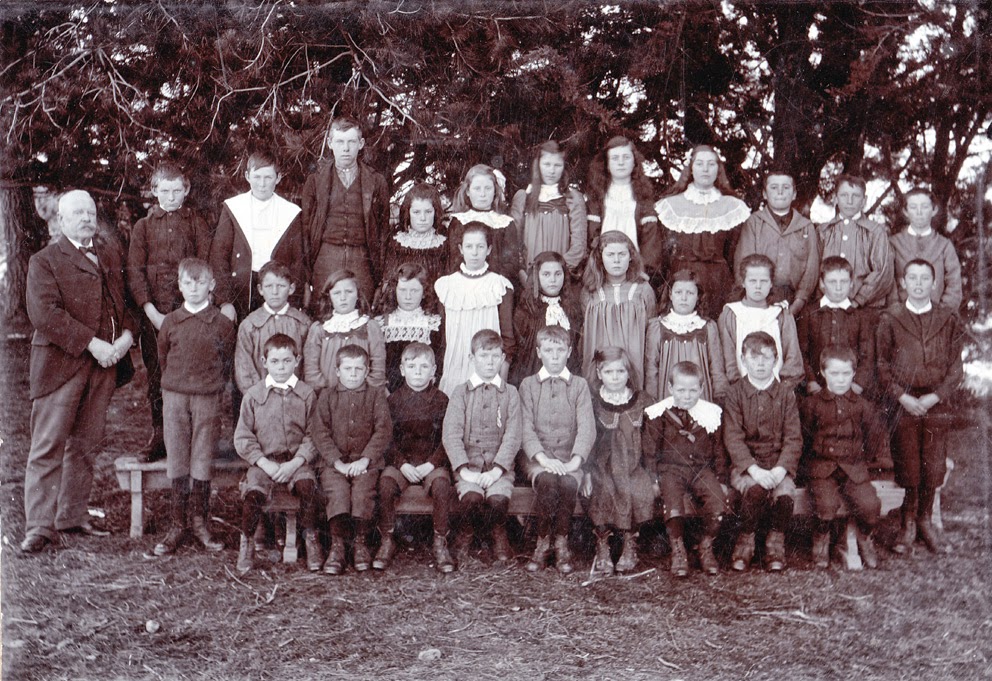
Mr George Hassing with Heddon Bush School Pupils, circa 1905.
My Aunt and two Uncles appear in the front row
(from left, 3rd, 6th, and 7th).
[From my own collection]

At the Board meeting on the 6th January 1888 it was decided to adhere to their former resolution of termination. But after a deputation of residents waited on the Board asking that any decision be deferred until a new School Board had been elected in April their request was acceded to. 

At the next meeting, being held on the 3rd February 1888, the existing School Committee and represented by their Solicitor Mr Macalister, questioned the Board as to why the notice of termination of engagement had been suspended. The Board responded that; "The object was to enable the householders to give an expression of opinion on the subject".   

On the 23rd March 1888 the Board, and after taking the unusual step of going into committee, "resolved that the committee of the Heddon Bush school be informed that the Board proposed to re-appoint Mr Girle as head teacher of their school till the 31st May next [i.e. 1889]". 

No doubt feeling considerably aggrieved and effectively sidelined, the School Committee, and obviously then wishing to be rid of Mr Girle, took the highly unusual and equally divisive step of writing to the Minister of Education asking him to intervene as they had not been consulted on the Board's decision. The Minister replied that he had not the power to intervene and that, while the committee should be consulted, it was ultimately up to the Board to appoint or dismiss. Mr Girles' re-appointment was duly confirmed on the 4th May.

George Magnus Hassing
Heddon Bush Schoolteacher 1888 to 1906
[From my own collection]

But most surprising, and considering the intransigence of the Education Board, it was publicly announced in July 1888 that Mr George Magnus Hassing would "take charge of the Heddon Bush school". While published records are now silent on the matter, the memoirs of Mr Hassing give us a fascinating glimpse of what then transpired, being written in his usual lively and entertaining style. Here is an unedited copy of his report of the proceedings and the subsequent "riot";    

"My predecessor [Girle], an old and worthy gentleman, had for years, unfortunately, made but poor progress with his pupils. He was a teacher of the 'old school', and certainly ignored the new [Education] Act, hence the stagnation. The parents divided for and against retaining him, and the local feud became very bitter indeed. Finally, after a free fight at the annual householders' meeting, a committee opposed to retaining the teacher came into office.  As the [Education] Board did not immediately grant their request to remove the teacher, they turned him out of the school and locked the building.

The teacher, however, opened the school in the residence for those who wished to retain him. But one night, under cover of darkness, he made a sortie and captured the school building. When this news reached the committee they armed and rushed for the recapture. They drove out the teacher and scholars, smashed up the table, chairs, windows, and doors. The teacher, finding himself utterly defeated, thereupon left the district, and died a few years after.

Heddon Bush School Pupils, circa 1907
My Father is seated 5th from left, 2nd row from front
beside the Teacher, Miss Minnie Hanning.
[From my own collection]

Apart from the smallness of my salary as a teacher, I worked overtime till near mid-night for the first month in repairing the broken furniture, pasting up maps, putting in panes of glass etc. I saw at once that it was absolutely necessary to create peace and harmony between the opposing factions in order to make the school a success. I therefore advised them that an important public meeting would be held in the school house. In anticipation of another free fight the meeting was well attended. I then addressed those assembled, stating to them that the unchristian and suicidal policy they had followed, showed them clearly how they were ruining the chances of their children's progress as well as their own social joy, happiness and brotherly feeling. I entreated them to look upon the matter in its most serious aspect, and called upon them as good and honest men to make friends at once.

At the close of my address a wonderful reaction set in. The whole assembly stood up and shook hands most heartily, they fell upon each other's bosoms, and shed tears of joy. After that evening we had uninterrupted friendship and brotherly love among the whole community during the many years it was my privilege to live and labour among them."    

Being written in the years prior to Hassing's death in 1928 I would discount any possibility that he had embellished the story for dramatic effect. Despite being of Danish birth he simply had a wonderful mastery of the English language. Elderly residents of the district would have quickly called him out had he been telling tall tales and there were even a number of first day pupils still living who attended the 68th Anniversary celebrations in May 1949. The unusual anniversary date had in fact been chosen because of this very fact.

My Father's Badge & Decade Ribbon from the
Heddon Bush School Anniversary, May 1949.
[From my own collection] 

As to the unfortunate Samuel Girle, and then aged 67 years, he would go on to be appointed as "Temporary Head Teacher" at the new school at Longridge, Balfour in June 1888. Thereafter his name appears at various Southland schools but always on temporary appointments, the last such appointment being in 1889. By 1890 he had moved to Invercargill where he died on the 19th July 1906, aged 85 years. Descendants placed a new headstone over the family grave site in 2016.  

Even Hassing appears to give Girle a passing compliment in referring to him as "an old and worthy gentleman" and it must be remembered that half the local residents were quite happy to retain him. But retaining old teaching methods and not being readily amenable to change he had simply had his day as an effective Teacher. By comparison, Hassing successfully taught until he was 85 years of age and was much liked by pupils and parents, being not too strict but "if a pupil wanted to learn, he provided the opportunities and the benefits available from even the best of teachers" [written by George Catto, a former pupil of Hassing].

Now, as to the second Heddon Bush school "riot", this would have taken place around December 1966 and also involved a smashed table and chairs with pupils intent on hitting each other, but let me explain. The Head Teacher, Mr Warner Lamb, had gone to some trouble to go over to Otautau to purchase a quantity of soft "Pinex" wood panels to use as props for an end of year school production. Needing to undertake some other business he left the senior room boys to make these into a makeshift table and chairs. During the play, a cast member would be pushed over the table and chairs in a mock fight and they would safely collapse. It may have been a western themed play but I cannot recall for certain. But things got out of hand when temptation became too much and a few boys were whacked with pieces of pinex. Then it became a free for all and a matter of self preservation although I recall that the girls kept well out of it saying that there would be big trouble when the teacher returned.

The Newly Extended Heddon Bush School,
Taken early 1965
[William Dykes Photographic Collection]

Naturally he was furious at his precious pinex being smashed up in such a manner and all the boys, including myself, were given a stern lecture including the strap, regardless of culpability or age. This was not the only occasion where all the mixed age male pupils in this classroom were strapped and on one occasion it turned out that none of us were at fault. But nothing was said, no apologies, no complaints from parents, these were just very different times. 

Having met this same (and now far less scary) teacher again at the 125th celebrations in 2006 he was quite blown away and perhaps, I even thought, rather emotional at the academic achievements of his former pupils so perhaps such punishment had its place after all! Having said that, my Scottish born Grandfather strongly believed in the birch as a form of punishment, perhaps having been forced to submit to this in his youth. But then he was, as was his brother, both very high achievers, a Solicitor in Edinburgh and a First Class Marine Engineer. But seriously, I believe it is always a qualified and engaged teacher who has the ability to bring out the best in and inspire their pupils onto greater things in life. Both Mr Hassing and Mr Lamb undoubtedly had these attributes.

All Rights Reserved

Sources :

- Personal Family Papers and Photographs (held by the writer)
- William Dykes Photograph Collection (held by the writer)
- "Papers Past" [National Library of New Zealand / Te Puna Mātauranga o Aotearoa]
- "The Memory Log of G.M. Hassing", 1930 (from my own collection)
- "Looking Back 100 Years - Heddon Bush School 1881-1981" (from my own collection)

Monday, 5 December 2016

William Ellacott - An Almost Forgotten Early Otago Pioneer and South Seas Adventurer


A grainy but quite striking photograph
of William Ellacott, taken in the 1870's
[Source : "The Otago Witness", 20 Aug 1913]

A very interesting email contact this year with a relative of the now somewhat forgotten English born early Central Otago pioneer and South Seas adventurer William Ellacott piqued my interest in further exploring this gentleman's decidedly varied and seemingly quite fascinating life. Over his lifetime Ellacott had been crew on a sailing vessel to India, an early Central Otago gold miner, store keeper, ferryman, river rafter and lake shipper, a Queensland gold prospector, and latterly a South Seas Island cotton and coconut plantation owner and sea trader around French Polynesia before finally returning home to live out his twilight years in Devon England. The story of his surprisingly adventurous life turned out to be even more enthralling than I had originally envisaged. While this is a slightly longer blog it is well worth the read so grab a comfy chair.

We know that Ellacott worked much of his time in New Zealand in partnership with his good friend George Hassing. In his final years Hassing touchingly describes Ellacott as "my dear faithful old partner" while Ellacott endearingly refers to Hassing as "dear boy" and "Your old friend". But it is very evident that after sharing so many adventures in life and corresponding with each other till Ellacott's death in 1912, their friendship and mutual respect ran deep.

While we know that Ellacott kept diaries of his pioneering life in Central Otago during the 1860's and 70's, these diaries, despite Hassing's best efforts to ensure they were preserved for posterity, have mysteriously and most unfortunately disappeared but more of this later. My efforts to reconstruct Ellacott's life has therefore been somewhat frustrating and I believe he would have been more widely known had the diaries been extant or at least available for research and / or published.  

To have had Ellacott's day to day account of these early pioneering days would simply have been invaluable to modern researchers and historians. So of necessity this Blog is based on references from a number of secondary sources but primarily those of his good friend and correspondent, George Magnus Hassing, whom I wrote about HERE including a few newspaper reports. Hassing was latterly a very successful schoolteacher, a good friend of my Grandfather, and in fact taught my two Uncles and Aunt. He had a quite wonderful mastery of the English language which truly bring his stories and anecdotes to life. It is at least thanks to him that we know as much as we do about Ellacott's early life.


Taking to The Sea

William Ellacott, born 1836 at Hatherleigh in Devon England, took to the sea early in his life, as did (significantly as it would turn out) his brother John. The story of William's early seafaring life is unfortunately unknown. It was, however, as crew on the voyage of the clipper 'Pride of the Ocean' from London for Bombay [now known as Mumbai] India in the summer of 1857 that William Ellacott first met a Dane by the name of Niels [George] Magnus Hassing who would then become his business partner and lifelong friend.

The Indian Rebellion of 1857

In Bombay both Ellacott and Hassing visited the soldiers' barracks "and fraternized with the troops just returned from Cawnpore after the shocking massacre at that town". Thus they heard first hand reports of this dreadful event which is best described on Wikipedia. This was the time of the rebellion against the rule of the British East India Company, being now known as "The Indian Rebellion of 1857" but in fact continued to July 1859. This bitterly fought rebellion led to the dissolution of the East India Company in 1858, the country thereafter being directly governed by the Crown under the new British Raj. Ellacott and Hassing's personal views on the rights and wrongs of the atrocities and retributions at Cawnpore [Kanpur] are not recorded but this event proved to be a turning point in hardening British support against the rebels and their cause.

The Lure of a New Adventure in New Zealand

Both returning to London in 1858, Ellacott and Hassing then parted company, the former obtaining employment in the city while Hassing sailed out to New Zealand in February 1859. But obviously having already formed a strong bond, both continued to correspond with each other. And by this fortuitous meeting and correspondence there followed a new and quite different chapter in his life. The desire for further adventure evidently got the better of Ellacott after Hassings favourable accounts of New Zealand prompted him to leave England in 1861 and join the latter in search of new opportunities and adventures.

A Happy Reunion

Hassing notes that he made his way from the West Wanaka Station up to Christchurch (a difficult journey of a few days) in the summer of 1861 "to greet the arrival of an old shipmate and subsequent business partner, the late Mr William Ellacott". This included walking the steep bridle-track over the Port Hills to reach the sea port of Lyttelton where Ellacott landed (the 2.7 km Moorhouse Railway Tunnel under the Port Hills did not open until 1867). As to which ship Ellacott arrived on is not recorded. It would have been a happy reunion with Hassing then spending "a week or so" in Christchurch, presumably with Ellacott.

Startling News

Hassing next relates that in August 1862 the Christchurch papers published a report that the prospectors Hartley and Riley had discovered a large quantity of gold on the banks of the Clutha river in Central Otago. Thereupon "my mate" [William Ellacott] rode "post haste" from Christchurch up to Waipara Station where Hassing was then working to inform him of "the startling news". Immediately packing his swag both men made their way back and over the Port Hills to Lyttelton where they left on a small vessel bound for Dunedin. We know from a published notice dated March 1863 that Ellacott had an unclaimed letter waiting for him in Christchurch. At this time we know he was in Central Otago so I wonder if he ever received it?

Gold Fever

Ellacott and Hassing found Dunedin to be bustling with activity with "hundreds eager to get away to the new [gold] rush". Along with four others who had sailed down the coast with them, they then left Dunedin by a small steamer for Waikouaiti. This coastal settlement north of Dunedin was a convenient point to head inland for the Dunstan goldfields via the Shag Valley. After procuring "tucker [food], tent and tools" at Johnny Jones' store "a merry, sanguine, and happy party of six" headed inland on foot.

A Merry Band of Men

The story of this long inland trek, being joined by others seeking their fortune on the goldfields so that the number now reached twenty five, would in itself make for an interesting blog.

Camping at Coal Creek on a beautiful calm evening dry manuka scrub was gathered to build a dozen or so great bonfires for boiling billies and cooking damper [flat bread]. With two men playing their cornets the camp resonated all evening to the sound of music and the singing of English, Scotch and Irish songs till after mid-night.

An amusing story is related of the soup served in pannikins at Mr WD Murison's Station on the Maniototo Station. The dish rag was hung by the "junior [partner]" over the crossbar in the chimney but later found to be missing. It was later retrieved from the soup pot and some asserted that it had added "a piquant flavour to the decoction".

And at "Mutton Town" the canvas store was run by a Jewish firm, "Levy & Co." which included one Philip Levy, later to be hanged as one of the notorious Burgess and Sullivan gang of Bushrangers.

Three to Four Ounces of Gold a Day

Obtaining Miner's Rights at a cost of £1 each from Vincent Pyke, the first Commissioner for the Otago goldfields, a suitable claim for six men (including Ellacott and Hassing) was found and marked off at Butcher's Gully which lies just to the south of Alexandra. The river wash averaged around half a penny weight to the dish. As Ellacott was the most expert at panning he was given this task. All the gold obtained from the claim was, for safekeeping, placed in a large cone-shaped rock rising about five feet above the river with a foot deep hollow in its centre, being on average about three to four ounces of gold a day for over a week. Some forty to fifty bags of auriferous [gold bearing] wash dirt off the river bank were carried up and stacked up by a steep bank bordering the claim and in anticipation of the river rising.

Disaster and Retreat

But one day a heavy rain set in and by the following day had caused the river to rise and eventually cover the rock where the panned gold had been stored. The next day the river was running at eight or ten feet above even this point and still rising. At this point the party of men, including Ellacott and Hassing, withdrew to the safety of Dunstan [Clyde] but not without having to ford the swollen Clutha well upstream and risking their lives by joining hands and endeavouring to ford it "though the foaming current reached our armpits". One person had earlier attempted to jump between two rocks but almost slipped to his death and a temporary bridge of manuka and flax broke its back and fell into the fast flowing river.  

Finding in Clyde that the two washing cradles they had ordered from Dunedin had arrived these were at least able to be immediately sold off for £10 apiece - around NZD$1,086.00 each in today's values. As reports from up the river were discouraging Ellacott and Hassing then decided to leave for Wanaka never again to revisit the scene of their ill-fated gold claim, all their hard work having been washed away in the great flood.


The Clutha River meanders from Lake Wanaka in upper
centre down to Cromwell at lower right where it joins
the Kawarau River, 1888
[From my own collection]

The Clutha River Ferry and Store

Hassing confirms that earlier in 1863, in the midst of the rush of gold miners to the newly discovered workings on the Arrow River and with no means to cross the Molyneux or Clutha rivers above the Dunstan township, he foresaw the advantages of setting up a river ferry service. Establishing a "whale-boat ferry" at Albertown [Newcastle] with "hundreds of diggers, packers, and loading from Oamaru arriving daily, the venture was a most profitable one". It soon occurred to Hassing that Sandy Point some 10 miles below Albertown would be a shorter and more convenient crossing point.

The store and ferry at Sandy Point opened in March 1863 and was kept "well supplied" while also purchasing gold from the miners, I would assume the gold would mostly have been used as payment for goods purchased from the store as this was the common method of payment on the goldfields. After Hassing put up 100 posters along the route from the Dunstan near Cromwell there were 40 miners and pack-horses following him. This venture was "a most profitable one".

Hassing confirms that "In the latter part of that year [1863] my partner (Mr W. Ellacott) and I sold out to the Maori chief Patu, who, with his tribe, arrived from Maori Point, Shotover River, where they had struck it heavy and accumulated a little pile."

I am therefore assuming, and I believe correctly, that Ellacott had been his business partner right from the commencement of this ferrying and storekeeping enterprise. Hassing does refer to the fact that "[he] started the first boating and rafting, both in Lake Wanaka and the Upper Clutha [and that] my dear faithful old partner, W. Ellacott, joined me in the business."

Lake and River Rafting  

In 1865 Ellacott and Hassing took out a sub-contract to raft poles being used for telegraph and railway use by the Otago Provincial Government. With the poles being cut at the Makarora Bush at the head of Lake Wanaka these then had to be built into small rafts for floating down the Makarora River then made into larger rafts for rafting down the length of Lake Wanaka to Albert Town at the head of the Clutha River. Each pole would earn them 50 shillings, the poles then being handed over to Thomas Primate [a colourful Yorkshireman known as "Yorkey" who died in the Māori Wars in 1868] and fellow employees to then raft down the turbulent and dangerous Clutha River. While the Contractor had arranged for stores to be provided at Albertown payment was entrusted to be made upon completion.


A group of early Wanaka Pioneers including William Ellacott.
Taken outside Norman's Hotel at Albert Town, Lake Wanaka
in 1866 by Mr Rich, a travelling Photographer.
Back Row : (L to R) Henry Palmer, William Ellacott,
Joe D. Ross, Henry Norman;
Front Row : Robert H. Norman, Richard Norman,
AE Farquhar, William Waterson, James Isbell.
[Source : "The Otago Witness", 3 Oct 1906, p46]

Desperate Conditions on the Rock and Pillar Range

But when it was found in June 1865 that the contractor, one Mr Henry Hill, had drawn three quarters of the contract price and then filed for bankruptcy but could not now be found Ellacott, Hassing and Yorkey were forced, in the middle of winter, to head "post haste" over the snow covered Rock and Pillar Range for Dunedin in search of Mr Hill. The conditions over the range were so desperate that one poor waggoner stuck in the snow with a load of goods for the goldfields had committed suicide the night before by hanging himself from one of the bows on his wagon. Upon all three men reaching an accommodation house on top of the ridge it was found to be deserted but the group were able to light a fire, thaw and dry out, and boil a billy of tea.

A Loss of £400

Making it safely to the low country and arriving in Dunedin the party next day called on Mr James Prendergast, Solicitor. The latter promised to do all he could to recover what was owed, Hassing stating that he (assumedly jointly with Ellacott) was owed £400 [NZD$44,387.00 in today's values]. After extracting a retaining fee of one guinea each, nothing more was ever heard about the matter. It was later ascertained that Hill had landed safely in Peru South America and had made a fortune out of railway contracts, "a smart, but very unscrupulous man".    

Nothing Daunted

Nothing daunted, Ellacott and Hassing (who were evidently not entirely pennyless) visited the Dunedin Horse saleyards, high demand for the goldfields meaning that fresh stocks of horses were arriving weekly from Tasmania and New South Wales. The going rates were from £40 to £60 for a light hack to £90 to £120 for a light draught or pack horse. So, wishing to get a horse each to return to Wanaka, Ellacott wisely purchased  "a quiet animal" but Hassing's "had a rolling eye, and seemed rather fidgety".  Buying new saddles, bridles, and cruppers and ready to depart, Hassing was told the next day that his horse had thrown off a trooper at Tokomairiro the week before and kicked him to death. Dismissing this alledged "story" he soon found his horse to indeed have a propensity for bucking. While he succeeded in calming his bucking steed other subsequent riders did not.  

In early 1867 Hassing records that he headed off to the West Coast after gold had been discovered on the Buller River inland from Hokitika. It appears that Ellacott did not join the former on this occasion and the period through to 1874 is sketchy at best. Hassing states that he returned to Wanaka around 1869.

The 42 Ton Sailing Vessel "Eureka"

Hassing mentions in his published memoirs that when he returned from the West Coast he entered into an agreement with Mr Alfred Pinn [known as "Black Tom"] to build a sailing vessel, "The Eureka", on Pigeon Island. Pinn, "an expert ship carpenter", had already laid down the keel of the vessel on the north eastern bay of the island. As a partner in this new shipping venture, Hassing took up residence with Pinn on Pigeon Island stocking it with berry fruit bushes and 200 merino sheep. But there is no mention of our Mr Ellacott until May 1872 when "Ellacott & Hassings" 42 ton "Eureka" took part in a regatta on Lake Wanaka. "Eureka" won the "Round the Island" sailing race, came second in the one mile "Sculling Race", but last in the general "Sailing Race". "Mr Campbell's Wanaka" pulled by Messrs Russell, Ellacott, and Yeldon won the "Handicap Pulling Race". Ellacott was then 32 years of age.

Ellacott must have joined the partnership sometime after 1869, perhaps buying out Pinn's share or Hassing was just rather vague in his memoirs. Pinn is known to have moved to Perth in Western Australia but no date is given. So again, the loss of the diaries covering this period is unfortunate. In March 1873 Hassing and Ellacott were granted a license for a jetty site near Pembroke on Lake Wanaka (now known as Wanaka township) by the "Waste Lands Board". In 1874 Hassing confirms that, with Ellacott, they disposed of their Wanaka "shipping business" to Messrs Grant and Kelliher of Cromwell.

The Eternal Glorious Song of Birds

Ellacott recalled in 1907 that they had often called into Pigeon Island on Lake Wanaka, a seeming paradise of flowering shrubs and vegetation right down to the high water mark;

"...Then the eternal glorious song of birds - the tui, robin, mocking bird, kaka, and parrakeet - with the coo of the beautiful bronzewinged pigeon. I fancy now I hear the buzzing of their wings as they swooped about us heeding us destructive humans. Even the wood-hens, crows, and crested greebes helped to make it a perfect paradise.  

...it is a privilege that few have, to be able to look back upon such a time amongst such grand scenery - mountain gorges, peaks clad with eternal snow, glaciers, waterfalls, and the frequent roar of avalanches from Mount Aspiring. Nature in all its beauty and grandeur and the pleasant companionship of two old chums... 

Just think of it - how a baited hook thrown into the lake at night would for certainty have a 3lb or 4lb eel on it in the morning giving us a delicious breakfast. Well, I shall never forget my time on Lake Wanaka."

But literary pursuits in the area were evidently not neglected as a committee, including both Ellacott and Hassing, were elected in April 1871 with the very commendable aim of establishing a Public Library at Newcastle [later re-named Albertown]. Like Hassing, extant letters written by Ellacott show him to be an educated man with a good grasp of the English language and a keen sense of observation and expression.

The Queensland Goldfields

Sometime in 1874 Ellacott then headed up north before sailing to Sydney Australia along with "a mate" whom he had become acquainted with in Auckland. Despite adverse reports of fever and dysentry, both decided to try their hand at "The Palmer", a Queensland goldfield. Travelling on the "Alexandra" and "after nearly being suffocated with stinks from horses, sheep, poultry, etc., on getting into the tropics" they landed safely eight days later at Cooktown. The pair now bought horses at £30 and £40 and equipped themselves for the journey of sixty miles to a creek where there had been a report of gold being found and ready for a new adventure; "You have to travel armed to the teeth, with as much tucker as your horse can carry, utensils, and the indispensable medicine chest or bag,... salts and quinine are never absent."

"15 Miles a Day with Pack Horses is Considered Big Work"

After "losing their nags [horses]" they "did not drop across them until the fifth day". Probably lucky as the native aboriginals had speared and eaten several horses. The diggings were found to be very poor with no water as the rainy season had not yet set in. So, with nothing to be gained by staying both headed off to "The Palmer" goldfields, travelling 10 to 15 miles a day but taking a spell during the hottest time of the day; "15 miles a day with pack horses is considered big work".

Fell Away to a Mere Skeleton

When about 50 miles from town Ellacott fell ill with fever but kept up with the party of men "by dint of severe struggling" with "no shanty [hut or accommodation] in 100 miles" and "fell away to a mere skeleton". At Palmerston, a real shanty town, every fourth man was sick or had been sick and deaths occurred daily. Prospecting in an area about 50 miles past Palmerston nothing of payable value was found but Ellacott fell ill again followed by his mate. Making back for Cooktown on the coast both sold horse, saddle etc at around half what they had paid as prices had fallen. After spending two weeks in a tent while both recuperated his mate left for the south in the steamer "Leichardt" and now "disgusted with the country". As at January 1875 Ellacott was still in Cooktown but advised "no one to come here, especially from New Zealand - the change of climate being too great.". And I doubt many made their fortune!

A South Seas Adventure

Ellacott now returned to "The Old Country" [England]. But after a short time spent with his English relatives and friends "he could not rest at home" and left for a visit to the United States. After visiting the "chief cities" he reached San Francisco where he unexpectedly met up with his eldest brother John (born 1833), the Captain and owner of the 62 ton three masted schooner "Hammonia" trading among the Pacific Islands. Captain Ellacott (known as "Captain John") appears to have led an equally interesting life, being based in Bora Bora in the Society Islands and marrying, in the mid 1860's, a native "well to do princess" from the island by the name of Esther Tahapia Maria Blackett.  Not having seen each other since childhood, this happy and fortuitous family meeting led to another great adventure and colourful chapter in Ellacott's life when he agreed to sail with his brother to Tahiti.

A Propitious Marriage

Arriving at Tahiti, Ellacott decided to remain ashore to explore the island while his brother John continued his trading cruise. It was at this time that Ellacott decided to make what would turn out to be a most advantageous visit to the island of Raiatea, some 234km distant, by a native vessel. Here he met an old gentleman, also a native of Devon, who, some 30 years previous, had married the daughter of an Island Chief. This elderly gentleman had but one daughter "a pretty half-caste" and touchingly, Ellacott fell in love and married her.

It was apparently not long after Ellacott's marriage that his wife's elderly father died and left his daughter and son in law William his large cotton and coconut plantation on Raiatea. Here Ellacott lived happily and prospered in trading copra etc for the next ten years before his native wife died. During these years William is noted as being now older looking but quite slim and with a big bushy beard.

The Great Comet of 1882

In 1882, William Ellacott, the "master of a small vessel trading in the Society Islands", reported sighting a great comet that "made [a] tremendous plunge round the sun, Sept 18 [1882]" This was 'The Great Comet of 1882' [Web link Here]. This very interesting reference at least proves beyond doubt that William also sailed the islands putting his seafaring and sailing skills to use trading his copra and cotton and no doubt other goods which would prove useful and profitable to himself and other island residents.

Forced to leave the Islands

After a residence of 26 years on Raiatea Island Hassing then records that Ellacott, and much to the grief of the natives of whom "he was universally loved", became seriously ill forcing him to sell up and move to Papeete on Tahiti. It was here that the Doctors urged him to leave the island for a cooler climate. I can only imagine Ellacott had suffered a tropical illness, most likely malaria, being a frequent cause of ill health and not infrequent death to early Pacific Island Christian Missionaries.

Ellacott's Death in London

Ellacott, no doubt with a very heavy heart, returned to England about 1902 where he took up his summer residence at the family home in Exwick, North Exeter in Devon but spent the winters with his sister in London. It was in London that he died on the 24th February 1912 aged 75 years and is interred in Tooting Cemetery London along with his sister Ann. One source states that he died in Devon but I am more inclined to accept Hassing's account. The gravestone is extant and records that he was "A Trader and Planter on the island of Raiatea. Much honoured and respected by the inhabitants."

His home in Exwick, which he named "The Hermitage", had once been an old monk's priory. A relative still has the painting he made of it in 1908. The building, with it's long chimney, still survives and is now split into two smaller units. His relative wonders if William may have been inspired by the name of The Hermitage at Mount Cook.

Hassing wrote in 1923 that; "He was indeed a man of sterling quality and a true, faithful friend. We corresponded regularly from the time we parted till his death."

Of the early days Hassing also writes; "I only am left. Of the whole army of brave, hardy Wanaka pioneers of the early sixties, all but myself have now passed out. Such men are the true Empire builders. they now rest from their labours, but by their courage and exertions they have left the country better than they found it." [written around 1923]


George Hassing, a great friend and long time
correspondent of William Ellacott.
[From my own collection]

A Mysterious Disappearance

It was after his death that Hassing informs us that Ellacott's "early Wanaka diaries" were generously forwarded to him by William's younger brother Joseph Abel Ellacott of Exeter. The latter notes Hassing as "My dear old friend who was shipmate with my brother William, and afterwards for some years his partner in New Zealand", both keeping in regular contact until Hassing's death in 1928. Of the diaries. Hassing states that "these interesting reminiscent books I have deposited in the Otago Settlers' Library". And herein begins the mystery of the diaries for they have simply vanished.

The very helpful Archivist of Toitū Otago Settlers Museum in Dunedin, being the new entity now administering the archives of the afore-mentioned former institution, advised me that she had spent some considerable time searching their records for these diaries but without success. An accessions register does not appear to have been kept. The Upper Clutha Historical Records Society then advised me that they were aware of the missing diaries, having searched for them over 20 years ago. Likewise, the Hocken Library in Dunedin and the Lakes District Museum in Arrowtown have no record of them. While Hassing is quite clear in stating where he placed them this was some hundred years ago and their eventual fate appears to now be hidden in the mysteries of time. Were they simply borrowed at a later date and never returned? I have no reason to doubt Hassing's account of his placing the diaries in the former OSM Library.

Hassing, who died in December 1928, commendably did his best to ensure that this early and unique pioneering account was not lost to posterity. I believe that the diaries must be somewhere but how and why is for now unresolved. I have never had contact with any Hassing family descendants as to what records they may still hold themselves but I note a Gt Gt Grandson in Southland (unfortunately now deceased) made some genealogy inquiries in 2001. If anyone can help or can add further information about Mr Ellacott - or the diaries - I would be delighted to hear from you. I will amend this blog if (and hopefully when) any further significant information comes to hand.


Bibliography :

- "Pages From The Memory Log of G.M. Hassing", 1930 (from my own collection)
- "Papers Past" [National Library of New Zealand / Te Puna Mātauranga o Aotearoa]
- "The Otago Witness", 6 Feb 1923
- McNab Room, Dunedin City Library
- Toitū Otago Settlers Museum Archives, Dunedin (Beth Rees)
- The Upper Clutha Historical Records Society (Mrs Margaret Thomlinson)
- "Origin of Celestial Species" by J. Norman Lockyer
- Personal family photographs (from my own collection)
- My grateful thanks to Mrs Priscilla Welch of Oregon USA (formerly of England and a descendant of William Ellacott)


Sunday, 15 June 2014

George Magnus Hassing - An Extraordinary New Zealand Pioneer (Part Two of Two)


George Hassing (at right) with Mrs Christina Wraytt (at left),
(Mrs Wraytt an early Teacher at Kingston before
her marriage to Mr Josiah Wraytt of Garston).
[Source : "Golden Days in Lake County"] 

This Blog concludes the story of the Danish born George Magnus Hassing. George led the most extraordinarily varied and fascinating pioneering life. From globe-trotting seaman, to bush saw miller in New Zealand, to Clutha River log raftsman, to gold rush store-keeper and ferry-man, to West Coast Explorer, to gold miner during the glory days of the Otago and West Coast Gold Rushes, to respected long-term country Schoolmaster, and not forgetting a prolific Journalist; before finally retiring in 1921 at the venerable age of 85. To view the first Blog in this two part series please click Here.


Isolated Cardrona shown at lower centre in relation
to Albertown (at upper right) and Arrowtown
(at lower left). From a map dated 1888.
[From my own collection]

The Overthrow of the Manchu Dynasty :

By 1874, Hassing was the principal owner of the Empire Gold-Mining claim at Cardrona. At this time there were around 150 European miners on the field and some 600 Chinamen, it being "a happy hunting ground for the Celestials". Hassing, "with a view to improving and elevating the moral and intellectual nature of the Chinese residents... started an adult Chinese evening school..". He notes their "keen interest and remarkable aptitude in acquiring the rudiments of English". Soon becoming affectionately known as "Mr Ah Sing", Hassing believed that his previous two years' experience in the coastal towns of China had been of much value to him. With a dry sense of humour he notes that most of his Celestial pupils made enough money to return to the "Flowery Land" but "whether the subsequent overthrow of the Manchu Dynasty was in a remote way due to my democratic teaching is, of course an open question." Hassing held the "most happy recollections of the pleasant evenings spent with my Chinese friends."  

The Catastrophic Great Flood of 1878 :  
   
In 1878, "a great flood overwhelmed the place" destroying most of the gold mining workings. This catastrophe ruined many miners, including Hassing. Thereupon he made application to the Southland Education Board for the position of Teacher of the Cardrona School, which was then vacant. He carried on this occupation at Cardrona until 1885, "... very happy days, though not without care, anxiety, and sorrow - the outstanding feature was the cosmopolitan, brotherly, charitable, and helpful spirit animating the whole community."

The picturesque main street of a much smaller Cardrona as it
 appears today, but still retaining a 19th century atmosphere.
[From my own collection]

Never Shall I Forget the... Fixed Stares of Those Children :

"Never shall I forget the rigid attitudes and fixed stare of those children as their gaze was riveted upon [the School Inspector]... He had on an Indian helmet, a large dust coat, a pair of double black goggles, and carried under his arm a heavy riding whip with an ugly brass knob on the end of the handle." On closer acquaintance Hassing found him to be "a most affable and courteous gentleman."

A Miners' Orchestra :

As Secretary of the newly formed Miners' Association, Hassing "burned the midnight oil" on many occasions in order to win concessions on behalf of the town which included "£6,000 for a mountain traffic road, 3,000 acres adjoining the town set apart for a public commonage, a fine cemetery site, telegraph connection, [and] library subsidy..." With an acknowledged gift for organisation, another of Hassing's achievements at Cardrona was to set up a "fine miners' Orchestra", comprising of men who played the piano, violin, concertina, banjo, piccolo, and drum. The social life in Cardrona would extend well beyond the bars of the four local hotels.

Rev. A. Stobo
Rev. D. Ross


Clergymen Prohibited From Entering the School :

Hassing latterly encountered a vivid example of the fervent emotion still generated today by what we now know as "Bible in Schools" Religious Education. An Anglican clergyman was politely told to distribute his religious literature after school hours but, replying that this was not possible, proceeded to walk round the class placing a circular on each desk. But that evening the Chairman of the school committee accosted Hassing in a fury, "I have always respected you... but to permit a black Protestant to proselytize my children., I shall never forgive." Many of the local miners would have been Catholic or Presbyterian. Thereafter a notice prohibited all Clergymen from entering the school during school hours. But this did not deter the Presbyterian Ministers, the Rev's Andrew Stobo and Donald Ross, who duly entered but left "after a pleasant inspection" of the children. This violation incensed the School Committee who imposed punitive actions on Hassing, and resolved to appoint a Teacher "of the right [religious] persuasion" to start a denominational school in a hut below the township. Shortly after commencing work the newly appointed teacher broke his neck falling off a bridge.

It was no accident that prohibition era
"Hokonui Moonshine" was distilled in
the bush-covered Hokonui hills.
[Source : Moonshinefest] 

A Strong Leaning Towards Their National Beverage :

"The impossibility of carrying on the school under such conditions" prompted Hassing to seek a Teaching position elsewhere. Thus, in 1885, he moved, with his wife, whom he had married in 1876, to the small "Highland community" of Hokonui in Central Southland, "a kind, generous, sociable people, anxious for the education of their children, but with a strong leaning towards their national beverage." Even today, the colourful heritage of "Hokonui Moonshine" [illicitly distilled whisky] during the years of prohibition in Southland from 1905 to 1943 / 1954 is renowned - and celebrated.


George Hassing with his Wife and Daughter
outside the Heddon Bush Schoolhouse.
[Source : "Looking Back 100 Years"]

Think, and Ponder Over It, Ye Modern Teachers! :

By August 1888 the Hassing family had moved to the small country school of Heddon Bush, also in Central Southland. The poor attendance had meant that the salary had reduced to £42 per annum or 15 shillings a week so he was initially disinterested in the position. But he was assured that within a month of his taking the position the roll would double, then increasing his salary. But roll numbers were slow to increase so for the first three months it actually cost Hassing £1. 5s for the privilege of teaching 35 State school children; "Think, and ponder deeply over it, ye modern teachers!"

Heddon Bush School from the rear, showing the entrance.
The Head Teacher, Mr Samuel Jackson and Mrs Jackson
appear in the image. As with Mr & Mrs Hassing, both
also ran the Public Library, the Heddon Bush Post
Office, and the only telephone in the district was
connected to the Schoolhouse. Taken circa 1916.
[From my own collection]

The Committee Armed and Rushed for Recapture :

Hassing's predecessor, Mr Girle, and being of "the old school", had engendered a bitter and divisive feud in the community over his outdated teaching techniques and the children's education naturally suffered. Half the community wished to retain him, the other to see him gone. Finally, after a "free fight at the annual householders' meeting", the teacher was turned out of the school. He then countered by setting up school in his residence for those who still wished to retain him, "But one night, under cover of darkness, he made a sortie and recaptured the [locked] school building." Hearing this news, "the committee armed and rushed for recapture." They drove out the teacher, smashed up the table, chairs, windows, and door. So for his first month, Hassing worked till near mid-night repairing broken furniture, pasting up maps, putting up panes of glass, etc. At a public meeting Hassing gave the community a stern talking to which evidently soothed lingering ill feeling as an atmosphere of reconciliation immediately set in.

The 1902 New Zealand Education Department Souvenir
commemorating the Coronation of King Edward VII
and Queen Alexandra in 1902, being hand annotated
 by Mr George Hassing and presented to all
children then attending the school.
[From my own collection]

The Presentation of a Rabbit to Avert His Wrath :

A former pupil, Mr George Catto (1893-1993) recalled that Mr Hassing wrote in a "copperplate hand", also that he was "a man who was not too strict, but if a pupil wanted to learn, he provided the opportunities..." The strap would only be used "about once a year", but any pupil deserving such a punishment could expect a "hammering". He recalled that the next teacher was rather more strict, ending the "big boys" being able to extend their lunch hour to two, "knowing full well that the presentation of a rabbit to the teacher would serve to avert the wrath which might have been called down on them for their misdemenours." A two hour lunch break was however the norm on Tuesdays so that Mr Hassing had time to read the weekly "Otago Witness" illustrated newspaper, to which he was a regular contributor.

Teacher, Mr George Hassing with Heddon Bush School
 Pupils, circa 1905. My Aunt and two Uncles appear in
the front row (from left, 3rd, 6th, and 7th). My Father
did not commence school until 1907.
[From my own collection]

An Act So Despicable :

Known to celebrate important occasions with a nip of whisky, Hassing would hide a bottle in a bag in the hedge during functions in the local hall, repairing at intervals for a nip and a yarn with his friends. But upon finding a slit in the bag and the bottle gone, a very angry Schoolmaster stormed into the hall, held up the bag, and told the no doubt astonished crowd "that in all his travels round the world he had never experienced an act so despicable as the theft of his whisky." I believe a replacement bottle was purchased for the good teacher.


The Leaving Testimonial to Mr GM Hassing, dated the
9th Dec 1906 & being signed by John Catto, James Ryan,
Charles Clarke, William Watson, and my Grandfather.
[From my own collection]

An Honourable & Industrious Career :

Here at Heddon Bush, George Hassing remained until after the early death of his wife in 1906 when he retired on superannuation. During his latter years at Heddon Bush he taught my own Aunt and two Uncles. As Secretary of the School Committee, my Grandfather knew Hassing well and wrote the testimonial to him dated December 1906 which I still hold, along with a first draft; "We can testify that you have done your duty nobly and well as a teacher and that you have taken an active part in every movement having for it's object the welfare of the district as well as the happiness of all around you.... we sincerely trust that under God's blessing you may be spared to enjoy in peace and happiness the reward of an honourable and industrious career."

A Christmas New Year Greeting, sent to
my Grandfather after George Hassing
left the Heddon Bush district.
[From my own collection]

The Teacher's True Reward :

Hassing ends his "autobiographic notes" musing on how he had played many parts on life's stage but teaching was his crowning achievement :

"I little learnt at that time [when his gold mining claim was destroyed in 1878] that teaching would be my future life's work, or that I could ever learn to love a profession that holds out so few worldly advantages. Yet now I recognize that those poor advantages are as nothing compared with the high responsibility involved in training the young so that disciplined characters and good citizens may be the finished product of the school."   


Above Images : The grave of George Hassing and his Wife Lavinia in the Old Winton Cemetery in Central Southland. [From my own collection]

"The Sailor Home From the Sea, The Sailor Home From the Hill" :

Unable to fully retire, Hassing offered himself to the Southland Education Board as a relieving teacher. Fully retiring in 1922 at 85 years of age, he spent the last years of his life residing with his Grand-daughter at Aparima :

"In that retreat one found him a hale, hearty old man of unclouded mind and bouyant soul, browsing among New Zealand and Danish newspapers, attending to correspondence, helping his little great-grandsons with their lessons."

George Magnus Hassing, aged 92 years, died at Riverton Hospital on Christmas Day 1928, being interred with his wife Elizabeth Lavinia Hassing (who predeceased him after "long and painful suffering" in 1906) in the old Winton Cemetery. While the vast majority of those passing the cemetery today would have no knowledge of Geoge Hassing most would however know that the convicted "child murderer" Minnie Dean, the only woman hung for murder in New Zealand, is interred here.


Bibliography / Rārangi Pukapuka :
  • Watson Family Photographic Collection (held by the writer)
  • Personal Family Papers and Photographs (held by the writer)
  • "Papers Past" [National Library of New Zealand / Te Puna Mātauranga o Aotearoa]
  • "The Memory Log of G.M. Hassing", 1930 (from my own collection)
  • "Looking Back 100 Years - Heddon Bush School 1881-1981" (from my own collection) 
  • "Golden Days of Lake County", by FWG Miller, 1962 (from my own collection)
  • "The Flame Unquenched", By G. McDonald, 1956 (from my own collection)
  • "The Interior Cold Lakes of Otago", NZ Survey Map, 1888 (from my own collection)

Thursday, 5 June 2014

George Magnus Hassing - An Extraordinary New Zealand Pioneer (Part One of Two)


George Magnus Hassing
1837 - 1928
[From my own collection]

The Danish born George Magnus Hassing led the most extraordinarily varied and fascinating pioneering life. From globe-trotting seaman, to bush saw miller in New Zealand, to Clutha River log raftsman, to gold rush store-keeper and ferry-man, to West Coast Explorer, to gold miner during the glory days of the Otago and West Coast Gold Rushes, to respected long-term country Schoolmaster, but not forgetting a prolific Journalist; before finally retiring in 1921 at the venerable age of 85.


The notation on the reverse of the above photograph
[From my own collection] 

This two-part resumé will highlight the incredibly diverse life of this capable and adaptable Danishman. While Hassing's name and varied exploits are little known today, we are at least left with his many autobiographical "journalistic vignettes", later being published as a whole in 1930. Hassing's very descriptive first-hand eyewitness accounts of his pioneering years in the Gold Field towns are in fact often the primary testimony available to historians today, particularly of early Cardrona and Bendigo. Hassing additionally rubbed shoulders with many now well-known, if even infamous, individuals. His wonderful grasp of the English language and descriptive manner of writing truly brings these colourful characters to life. This two part Blog is but a small edited fraction of those many stories.


The Lure of the Seven Seas :

Having been born in Denmark in 1837, well educated, and upon reaching the age of 15 years and anxious to see the world for himself, the lure of the seven seas called George Hassing to exotic and lonely far-flung shores. Serving on merchant sailing ships for seven years he truly criss-crossed the globe from such far-flung ports as exotic Canton China and Yokohama Japan in the Orient, to the isolated Cocos Islands in the Indian Ocean, to lonely Elephant Island off Antarctica where Shackleton's crews were later hold up, to bustling San Francisco where he took time off to indulge in the "California gold rush fever". In 1852, and off the Cape of Good Hope, he observed Brunel's great steamship, the "S.S. Great Britain" [which his vessel "spoke" to], while on her first voyage to Australia and carrying 630 emigrants. In 1859 he sailed to Port Cooper [now Lyttleton] New Zealand on the "Ambrosine", then taking "french leave" (i.e., jumped ship) with two ship-mates. With the law hard on their heels, they safely made good their escape via the whaling station at Kaikoura to Wellington.

The Indian Rebellion, 1857 :

But arriving at Bombay [Mumbai] India on the "Pride of the Ocean" in the summer of 1857, Hassing and his ship-mate William Ellacott visited the British Army Barracks "and fraternized with the troops just returned from Cawnpore [Kanpur] after the shocking massacre at that town." It is believed that 120 British women and children were killed and up to 7,000 locals were executed in "retaliatory counter-atrocities". Hassing makes no other comment on what he may have been told nor does he lay blame on any one party involved in this incredibly brutal massacre. It was in fact Hassing's glowing description of New Zealand that encouraged the English born Ellacott to also come out to New Zealand, then joining Hassing on most of his adventures through the 1860's. After Ellacott's death in England in February 1912 Hassing deposited Ellacott's diaries of his early Wanaka adventures in the [then] Otago Settler's Museum but despite best efforts they cannot now be located which is a great loss.   

This Britain of the South :

Hassing returned to the sea but obviously not before seeing enough of New Zealand and the opportunities it offered to interest him to return - without the law hard on his heels! An able seaman would be paid £2.10/- a month, the food was mainly "sea horse and weevily biscuits", accommodation was a less than comfortable bunk alongside the windlass, and the hours were long. But one could earn £1 a week "with an unlimited allowance of damper [campfire bread] and mutton in this Britain of the South".

West Wanaka Station, of around 30,000 acres, includes
the area marked "Wanaka West" on the left hand shores
of the lake in the above map. From a map dated 1888.
[From my own collection]

Back-Breaking Work :

In 1860 his first job in New Zealand, along with a close mate, Bill Atkins, was pit-sawing timber, posts, rails and shingles for the West Wanaka Station in the rugged back-blocks of the South Island, back-breaking work requiring tremendous physical strength. As we shall read, George was an extremely adaptable individual.

Rats, as White as Millers :

Setting up a camp at the mouth of Minaret Burn [shown in upper centre-right of the above map], some three miles above West Wanaka Homestead, and being surrounded by precipitous mountains and having just one cockleshell boat, they were effectively "imprisoned in the bush for six months". But with plenty of food, they soon "tumbled down the giants of the forest and made the sawdust fly". The bush teemed with plump pigeons and kakas which provided them with fresh food. But one night, they had a visitation of rats, "which swooped down from the mountains in thousands". Hassing and his mate "killed hundreds of them with forks tied to the end of sticks", including those that ventured under the wooden platform which partly covered the floor of their accommodation. Anxious to secure their precious supply of flour, this was hoisted up a tree. But a couple of nights later, when the need to obtain some flour required the sack to be lowered, "a dozen or more rats, as white as millers sprang out of various holes before it reached the ground. However we had to make the best of it till the boat arrived with a fresh supply." Within a fortnight every rat had disappeared as suddenly as they had arrived. 

The Makarora River Valley and Forests, shown at the
head of Lake Wanaka. From a map dated 1888.
[From my own collection]

One Unbroken, Seething Ocean of Flame :

In early 1861, Hassing, accompanied by Mr H.S. Thomson of West Wanaka Station, set off up the Makarora Valley at the head of Lake Wanaka to examine the pine forests some seven miles up the valley. In the valley they discovered a ruined Māori village dating from a raid in 1836. Further access up the valley was only possible by following the river beaches and fording the river wherever necessary, the valley being "covered with an impenetrable mass of cabbage trees, flax, and fern, growing to a height of 8ft to 10ft and the ground a jungle of dried and decayed vegetation, over which it was impossible to make any headway". So to assist in clearing a path, the pair started a fire at the head of the lake. Unfortunately "this soon developed into one unbroken, seething ocean of flame from hillside to hillside, and fanned by a southerly wind, it raged for three days and nights, travelling up the valley 20 miles". Ironically, by 1865 Hassing found that the fire had transformed the valley into "a beautiful carpet of luxuriant grass over which it was a pleasure to travel".   

Dunedin, pictured from Bell Hill in 1862
[Source : National Library of New Zealand]

25 Jolly Adventurers :

In August 1862, while killing wild pigs on the Waipara Run in North Canterbury, and hearing of Hartley and Riley's discovery of gold on the Molyneux, Hassing immediately packed his swag and took a passage on a vessel for Dunedin. Here he found the place bustling with activity with hundreds of men eager to get away to the new "rush". Joining four others, they then took a small steamer for Waikouaiti, calling at the well-known Johnny Jones' store for provisions, tent and gold mining tools. On the journey through the hinterland others joined the merry group, now numbering "25 jolly adventurers" off to seek their fortune. The picture of that jovial group singing round the blazing camp fires at Coal Creek reminded Hassing of similar scenes he had witnessed on the Californian goldfields in the fifties. And what of the enterprising fellow who laid a long plank across a creek and charged 6d each to cross? All willingly paid the "toll". And of the "cute business acumen" of an enterprising and isolated Station cookhouse which not only sold mutton quarters to their passing trade but also offered them boiled mutton, the resulting hot soup with barley and onions, and freshly baked scones... "All enjoyed a merry feast".  

The Burgess & Sullivan Gang, 1866.
Philip Levy appears at bottom.
[Source : National Library of NZ]

Three to Four Ounces of Gold a Day :

Having arrived at "Mutton Town", a canvas town of 30 to 40 tents, already complete with a canvas store run by a Jewish firm, "Levy & Co." which included one Philip Levy, later to be hanged as one of the notorious Burgess and Sullivan gang of Bushrangers. The group first set up camp then all obtained Miner's Prospecting Rights issued by the well-known Vincent Pyke, the first Commissioner of the new goldfields. Prospecting was then carried on up the Clutha River to where Clyde is now situated however nothing of any consequence was found. But upon travelling along the Fraser River to Butcher's Gully, "a splendid prospect" was found on a steep high bank of the river which averaged around three to four ounces of gold a day. The river claim was quickly pegged off.    


An example of a Prospecting [Miner's] Right
issued by the Province of Otago in 1862
[Source : NZMuseums]

Disaster and Retreat :

Concurrent with panning, the wash dirt from the claim was carried back up from the beach and stacked close to the steep bank, "some forty or fifty loads of auriferous gravel-wash". Their panned gold was "stored" in a crater like hollow of a large rock across the river. Then one day a heavy rain set in which continued all day and all night. By noon the following day the rock now lay across a raging and impassable river, being at least 8 to 10 feet under water and the carefully stored wash dirt would have been swept away. The party decided that the river had won and left for Dunstan [Clyde] which had now replaced Mutton Town. Surprisingly, Hassing never returned to the scene and pondered later if the panned gold remained in that hollow rock.     


The Clutha River meanders from Pembroke / Newcastle
(upper right), and down to Cromwell (lower right)
where it joins the Kawarau River, 1888
[From my own collection] 

Thank God it is Safely Over :

In 1862, the great drawback to gold mining and construction in Central Otago was the complete absence of wood in the surrounding area which had to be brought in my bullock teams. Thus even simple wooden hand cradles for slicing the river wash retailed at £10 each. Wooden gin and brandy cases (even minus the contents) were in hot demand! Thus Hassing, along with others, took on the risky and perilous task of rafting logs of timber lashed together from forests at the heads of Lakes Wanaka and Hawea some 50 miles down the rough and turbulent Clutha River. Hassing noted that some lost their lives at this work through not having the requisite qualifications, i.e, a strong nerve, capable of swimming in rough water, and possessed of a thorough knowledge of the river. Parts of the river, such as "Snake Point", "The Devil's Nook", and "The Boiling Pot", were very aptly named. Hassing's last river trip was in 1876 when he brought Mr Deans, the Curator of the Otago Acclimatisation Society with his tin cans from Wanaka down to Cromwell, after having released the first trout ovum in the lake. Deans described the river trip as "the most exciting experience of my life, and I can only say, thank God it is safely over".


A group of early Wanaka Pioneers including William Ellacott
who shared many of George Hassing's Wanaka adventures.
Taken outside Norman's Hotel at Albert Town, Lake Wanaka 
in 1866 by Mr Rich, a travelling Photographer.
Back Row : (L to R) Henry Palmer, William Ellacott,
Joe D. Ross, Henry Norman;
Front Row : Robert H. Norman, Richard Norman,
AE Farquhar, William Waterson, James Isbell.
[Source : The Otago Witness]

It Pays to Advertise :

But by 1863, and in the midst of the rush of gold miners from the Dunstan and Gabriel's Gully to the newly discovered workings on the Arrow River, Hassing foresaw the advantages of setting up a ferry and his own store at Sandy Point, thus providing a convenient crossing of the the Clutha River some 10 miles below Albertown to the east of Wanaka. It pays to advertise, and after putting up 100 posters along the route from the Dunstan near Cromwell there were 40 miners and pack-horses following him. Later in 1863, Hassing and his partner sold out to the Māori Chief Patu and his tribe who had "accumulated a little pile" at Maori Point on the Shotover River, the Chief then inviting most of the Māori's from Moeraki, to join him.

The Cardrona river flowing from lower left to
Pembroke [Albertown] at upper right centre.
[From my own collection]

The Boiling, Seething Torrent :

From July to September 1863 the disastrous"Old Man Flood" swept through the district, claiming the lives of upwards of 63 miners. Crossing the Cardrona River at Albertown in June 1863, and already "then roaring down in high flood", his horse was swept off its feet while the rider was "plunged headlong into the boiling, seething torrent". Despite wearing "a big top-coat and a pair of long nugget boots", luck was evidently on his side this day and he made it to the bank while his horse had to be dragged out with ropes but later died.

The Sanctimonious Shepherd :

In the early 1860's, Hassing observed a stranger arriving in Albertown, "A strange looking individual, dressed in a peculiar garb, lean, tall-featured, with a stubble of grey beard, and keen restless eyes... He wore a shabby-looking brown frock coat, a a Scotch bonnet, and carried a large carpet bag." Introducing himself as "McKay McKenzie", he stated that he had been engaged as Shepherd on a run at Roy's Bay on Lake Wanaka. Assigned to a hut at Glendhu Bay with a young man named Ned Poole, Hassing often heard, when he had occasion to row up or down the lake, "their voices pouring forth in scared song across the placid waters of the lake of a calm evening". But the fear of McKenzie becoming demented forced the manager to discharge him, eventually having to be taken under an escort of diggers to the Dunstan, thence to Dunedin. But his old brown coat and carpet bag remained at Glendhu, the latter being opened by the Station Manager, "Imagine the surprise... when Scottish bank notes to the value of £800 were unfolded." 

The Origin of the "Loot"? :

McKenzie later returned to the station, apparently now sound of mind. Inquiring as to his coat and bag, he was advised these were still in the hut at Glendhu Bay. But "the country was then overrun with gold-seekers" and McKenzie was disconsolate to find the coat had been taken by persons unknown. Hassing surmised that it contained hidden papers sewn into the lining. In fact, the carpet bag, which remained, appeared to be of secondary importance to him. The "contents" were counted out to him, and being all in order, he left for new employment at Morven Hill's Station. But upon Hassing later relating this tale to an intelligent young man at Albertown named McLeod, the lad replied, "I was born and brought up in Sutherland, in Scotland, and I have been in New Zealand only a few months. I remember a cattle dealer in Sutherland named McKay McKenzie answering exactly to the description you have just given. He was trusted by the local farmers and crofters to collect all the cattle they had to dispose of, and drive them to the periodical sales, and there dispose of them to the best advantage... After each sale McKenzie would return and settle up fairly with the respective owners of the cattle... But on his last trip, when he had collected a larger mob than ever before, he did not return with the proceeds... but he disappeared to parts unknown".      

Exploring the Haast River and West Coast Passes :

In 1865, Hassing accompanied the Explorer and Prospector, William Docherty, on a 90 day expedition from Makarora up the Haast River and across to the West Coast. They not only negotiated very difficult terrain, but also dangerous river and mountain crossings, an unexpected "flash flood" almost trapping them in a river cave, a rapidly rising river threatening to wash away their camp overnight, relying on their dog "Spriggins" to catch kiwis, kakapos and wekas for their meals, and unexpectedly discovering 10,000 acres of open grass land which they decided to apply for as a run. But being Winter in June, and camped beside "a mountain lagoon" [tarn] atop a mountain plateau heading to the West Coast, they were subjected to "a blinding snowstorm which continued without intermission for 48 hours". Only the top of the tent remained visible. Their almost buried tent had to be left behind as it was "frozen hard as iron and buried in frozen snow", eating only "raw oatmeal and salt".

Swearing, Tearing and Skull-Cracking :

In early 1867, Hassing, who was then in Hokitika on the West Coast, heard of gold being discovered in the Buller River. With 40 or 50 other goldminers he left on a coastal steamer for the Buller. They were quickly followed by "several hundreds" eager to get up the river on small ferry-boats and stake a claim. But, arriving on the Sabbath, and as it was illegal to peg out claims on a Sunday, the miners merely pitched camp close to where they would stake their claim come Monday morning. Expecting a tussle, the other miners were true to form, Hassing describing "the swearing, tearing and skull-cracking... on that Monday morning as something to be remembered." In less than a fortnight over 1,000 men were on the field. The claim staked by Hassing and his friends proved unsuccessful, digging a "slabbed" shaft down 25 feet whence they struck a rush of water which filled the shaft. As his friends were without funds, Hassing stood the cost of this fiasco which amounted to several hundred pounds, "but such losses were borne without flinching". After some unsuccessful prospecting Hassing returned south again.

A Young Looking Richard J. Seddon.
In 1877 he become Mayor of Kumara.
[Source : Teara.Govt.nz]

The Fenian Riot of 1868 :     

With a quite uncanny ability to be the "the man on the spot" during significant events in the very eventful history of New Zealand, Hassing, along with an old mate, then set up a terrace gold claim at Waimea next to that worked by one Richard John Seddon (later becoming Prime Minister of New Zealand). It was only two months later that the 'Fenian Riot' took place in Hokitika, taking possession of the cemetery, and holding a mock funeral in commemoration of the Manchester martyrs, Larkin and O'Brien. Hassing joined the 'Waimea Contingent' which then, under the leadership of the one-armed Lawyer "Button", marched to Hokitika, scattering the rioters and, amidst much rejoicing, restored order in Hokitika.   

A Celebrated and World-Renowned - Imposter! :

At this time, a German National by the name of Christian Friedrich Schäfer landed in Hokitika, Hassing staying in the same hotel where he took lodgings. Hassing described him as "long, wiry hair, a very short body, but abnormally long legs and arms... He resembled an orang-utang or an overgrown baboon more than a human" [Note : period newspapers make mention of his having been a cripple with a damaged back, having been run over by a carriage when young and was thus only 4ft 9in]. Being taken as "an unprincipled imposter, [he] did not take on in Hokitika." But arriving in Dunedin, Schäfer had a public reception as "the celebrated and world-renowned German traveller". But he eventually landed in gaol for his escapades up north. Hassing notes (post 1918) that as remarkable as it may seem, it was esteemed a high honour to be a German and thus Schafer was accordingly treated as a distinguished personality.

Please click Here to read the final part of this Blog.


Bibliography / Rārangi Pukapuka :
  • Watson Family Photographic Collection (held by the writer)
  • Personal Family Papers and Photographs (held by the writer)
  • "Papers Past" [National Library of New Zealand / Te Puna Mātauranga o Aotearoa]
  • "The Memory Log of G.M. Hassing", 1930 (from my own collection)
  • "Looking Back 100 Years - Heddon Bush School 1881-1981" (from my own collection) 
  • "Golden Days of Lake County", by FWG Miller, 1962 (from my own collection)
  • "The Flame Unquenched", By G. McDonald, 1956 (from my own collection)
  • "The Interior Cold Lakes of Otago", NZ Survey Map, 1888 (from my own collection)