Showing posts with label Grandfather Clocks. Show all posts

Monday, 16 January 2017

An 1860's Scottish Grandfather Clock by James Peat, Carluke


Grandfather Clock by James Peat,
Carluke, Lanarkshire, Scotland, c.1860's

Having already featured two Grandfather [longcase] Clocks in my possession this is the third and final one, being sold by Watchmaker and Jeweller James Peat of Chapel Street, Carluke in Lanarkshire Scotland around the 1860's. This blog features not only a video of the clock and melodious bell chime [at the bottom of this page] but also a delightful poem which I stumbled across quite by accident in a local paper and dates, rather appropriately, from 1861. "The Old Eight Day Clock" very aptly reflects how I feel about this lovely old timepiece (which has an eight-day brass mechanism) so I am pleased to bring the clock and poem together in this blog.

This clock, which is now around 150 years old, has probably been in family ownership since 1872 when my Gt. Grandfather took out a nineteen year lease on the farm of 'Candermains' near Stonehouse in Lanarkshire. While I note a family loan of £250.0.0 to James Peat "Watchmaker of Carluke" and his wife Agnes Shirlaw in November 1875 I cannot make any direct link with the clock so can only assume that my family purchased it second hand. Whether the connection to James Peat (also possibly a family connection by marriage) played any part in my family choosing this clock I could not say. 

Although James Peat is known to have been in business in Carluke from at least July 1871 we cannot, from surviving records, accurately determine an earlier date. The style of this clock would however strongly indicate that it dates from the 1860’s. The mechanism and enamelled face plate, most likely both made in Birmingham, would have been bought in with the mahogany and veneer case being manufactured by or for the Watchmaker in Carluke. Peat died in Carluke on the 24th April 1910 aged 62 years so working on his own by the mid 1860's is certainly plausible. Peat's wife Agnes died on the 29th August 1894 aged 42 years.


A "Watchpaper" from James Peat of Carluke
placed inside a double-pair case pocket watch
for cushioning and as advertising
[From my own collection]

My late Great Aunt knew at the very least that this clock was in her parent's possession at "Candermains" by 1883. But an accurate timepiece such as a Grandfather clock was then practically a necessity which leads me to believe that it would most likely have been purchased nearer the start of the tenancy. The clock eventually came to New Zealand in early 1911 when my family emigrated from Scotland and it passed into my ownership upon my Scottish born Great Aunt's death in 1978. I am now the fourth generation in my family to own this clock.

I find the sound of a grandfather clock chiming a comforting sound, especially during the night. The plate glass on the face door, being slightly wavy, is certainly original and very thin. Considering the moves the clock has witnessed (around seven), plus additionally being shipped half way around the world, it is probably a miracle that it has not been broken. The enamel painting could be considered somewhat näive in style, especially in the arch, and no doubt reflects the mass produced nature of such items in the mid Victorian era, but is nonetheless charming. With an annual clean, oil and occasional full service by a qualified horologist this clock will easily see out another 150 years and spare parts are even now fairly readily available. 

Here is the poem I referred to (I have omitted one verse), being published as "Original Poetry" in the "Otago Witness", Dunedin, New Zealand on the 17th August 1861, the author being "Robin" which is possibly a non de plume. I will add detail relating to the painted enamel clock face under each image (click images for full size) :  

"The Old Eight-Day Clock

The old eight day clock
That stands by the wall,
Proclaiming the hours
From morn to nightfall,
With its gentle click, click,
And musical strike,
Cheering the gloom
Of the shadowy night. 


The theme is "Commerce" showing "Britannia"
with a Trident Surveying the Continents.

The old eight-day clock
Is a family heir-loom;
It witnessed our birth,
And youth's rosy bloom;
It has clicked while fond hearts 
Did in wedlock unite;
It has clicked while the spirit
Has taken its flight.


"Britannia" with her Trident and Laurel headdress in a
Harbour Scene representing Commerce and World 
Trade Incl. a world globe, an anchor, a sailing vessel, 
steamship, bales of cotton, coconuts(?),
 a barrel, and a Steam Locomotive.

The old eight-day clock
It heralds the morn,
Invites us to labour,
And calls our return;
With its homely click, click,
And bell sounding clear,
Bids our toil-wearied spirits
Take comfort and cheer. 


The East(?) with a Camel and Headdress

The old eight-day clock,
In youth's early day,
Fixed the hours for the task
And the hours for our play -
When we frolicked about,
Like a kit on the earth,
Till it chimed the late hour,
Bade us cease from our mirth,


The Middle East (?)

The old eight-day clock,
When with sickness oppressed,
How I longed for the click
That lulled me to rest!
Or if sleep was denied,
How I longed for the morn
In beauty sublime!


The Americas (?)
with headdress, bow, and alligator

The old eight-day clock
Like a sentinel stands
Keeping watch over time
With its spear-arm'd hands
No hour can go past,
No seconds can slip,
But it rings out a challenge
And warning click, click.

Africa (?) with a black woman and Elephant

The old eight-day clock,
Its beauty doth fade,
It's gilding is dim
And its varnish decayed;
But (like old age in man, 
Tho' beauty doth wane
The pulse still keeps time)
Its click is the same.

Grandfather Clock by James Peat,
Carluke, Lanarkshire, Scotland,
The door is "flame" mahogany
circa 1860's

The old eight-day clock
That stands by the wall
may teach us a lesson,
A moral for all,
To improve fleeting time
As its minutes fly past,
And live every hour
As if it were but our last

(By "Robin")


A three Minute Video of the Clock 
Working and Bell Striking

Copyright : All images are from my own personal collection and maybe freely copied for non-commercial and academic use provided this site is acknowledged. 

Sources :

- Robert S. McLeish, Carluke Parish Historical Society 
- Papers Past [National Library of New Zealand / Te Puna Mātauranga o Aotearoa]
- The "Otago Witness", Dunedin, New Zealand, 1861
- "Scottish Clockmakers" by Felix Hudson
- Edinburgh City Central Library Reference Reading Room
- Scotland's People website

Video produced with Windows Live Movie Maker, Virtual Dub cropping and Xvid Codec compression.

Tuesday, 23 February 2016

A 1779 English Longcase Clock by Thomas Woodruff, Salop


My 8 Day Longcase clock by Thomas Woodruff,
of Salop, Shropshire, England, 1779

My 18th century eight day brass faced clock by Thomas Woodruff of Salop (now known as Shrewsbury) in Shropshire England is a good example of a classic Georgian era English provincial longcase (Grandfather) clock.

While the provenance of ownership of this clock is unfortunately unknown I have been able to find a reasonable amount of information about this provincial clockmaker including uncovering (literally) some interesting and very conclusive evidence of when it was made.


Detail of the face plate and silvered dial
(my apologies for the reflections)

Shrewsbury itself is an historic and pleasant old Tudor town located in a loop of the Severn River and contains many half timbered and historic old homes and churches among its narrow streets and wynds. I have myself visited twice, once staying in the centre of the old town in a listed 16th century house with plastered walls and beautifully exposed beams, some of which one had to "duck" under to avoid hitting.


A view looking up Wyle Cop, Shrewsbury
[Source : Google Streetview]

The first reference to the Woodruff family as Clockmakers in Salop [Shrewsbury] is 1762 when G.H. Baillie notes in his "Watchmakers and Clockmakers of the World" a 30 hour long case clock made by James Woodfruff, presumably Thomas' Father. The next reference is to be found in "Shropshire Clock & Watchmakers" where Thomas Woodruff is recorded as being a Clock and Watchmaker in Wyle Cop, Shrewsbury from 1767 until his death in 1801. Obviously the business passed from father to son. Legal records held in the Shropshire Archives and dated 1767 record him as being a "watchmaker [and] bondsman [indentured servant] of Salop".


A view looking down Wyle Cop, Shrewsbury
[Source : Google Streetview]

Wyle Cop lies in the old part of the town, running close to the "English Bridge" up a rise towards the High Street and the town centre. It now contains predominately 17th and 18th century dwellings with shops at street level. An historic half-timbered three story building survives at the lower end of Wyle Cop with the 12th Century St. Julian's Tower at the upper end. As to where in Wyle Cop Woodruff's premises were located is unknown.


Two examples of Longcase Clocks by Thomas Woodruff

A number of longcase clocks by Thomas Woodruff come up for sale occasionally, some being in a similar or identical classically styled Georgian case or hood similar to my own and additionally some with a brass arch and adornments. This similarity confirms that my clock has not been a "marriage" of mechanism and case. Unscrupulous dealers have often been known to place a good brass movement in a better quality case to hopefully increase its value. This is always something to watch out for as often the mechanism will not properly fit the hood or the dial face and / or case will be a mixture of time periods or styles. While I have not personally discovered one, GH Baillie notes a late 18th century bracket clock by Thomas Woodruff which shows that he was a reasonably versatile clockmaker.


The trunk with the door open
and showing the very heavy
lead weights and brass bob

I am assuming that, as with so many other provincial clocks, the mechanism parts and brass face were brought in fully machined or at least made to the clockmaker's specific order so only assembly would be required. While Woodruff's name has been ornately inscribed on the brass face there appears to be no conclusive proof that James Woodruffe himself would have manufactured anything other than the oak case. But this would certainly not be impossible were he to have manufactured and sold a reasonable number of clocks to make the purchasing of cutting and machining equipment financially worthwhile - and had the requisite skills to undertake this highly specialised but expensive work. I would imagine that his watches were similarly inscribed with his name but I have never located one.


Detail of the brass mechanism, large cast
iron (?) bell and rear of the face plate
showing theareas of cut out brass


The face plate is made from one piece of polished and lacquered brass with an overlaid silver plated chapter ring and a date ring behind the face plate. Cast decorative gilt scroll spandrels are screwed onto each corner of the face plate. Due to the high cost of brass, areas of metal have been carefully cut out from behind the chapter ring. This work caused a slight crack in the edge of the plate which was then expertly riveted together at the back. Only the small crack is visible from the front.


The oak case and door with
mahogany cross-banding,
an expert piece of joinery

This case is of dark stained oak with fluted columns on the case and hood, with mahogany cross-banding around the edge of the trunk door. Unfortunately a previous owner has applied a few screws to some parts of the case which must have come loose but these are thankfully not too obvious. Sturdy iron brackets have been inserted inside the case where the base joins the trunk containing the pendulum but these are not visible unless the case door is open. This was probably a wise move as the mechanism and iron weights are exceedingly heavy and had obviously been placing pressure on the old and now creaky oak case. Upon opening the case door one can still perceive a smoky smell which indicates that the clock spent many years in the vicinity of a fireplace.


The etched details "J May 79" which I found under a layer
of grime on the rear of the face plate. While it looks like "99"
 in the image it is definitely "79"


Since purchase at auction in the year 2000, I always believed  the design of the clock and brass face to be commensurate with the period circa 1760 to 1790. But while once having removed the brass face plate in order to clean the mechanism, I could just, under two centuries of grime and in a good light, make out some unusual scratches on a back bottom edge of the plate. After carefully polishing this area to get a clearer view, I could then make out the details "J  May 79" etched in scrolling copperplate. This therefore usefully confirms that the brass face plate itself was manufactured in May 1779 by someone with the initials "J". The dial, which is in Roman numerals as well as numbers, includes a subsidiary second hand and a date aperture which moves every 24 hours. The weights are of lead suspended by catgut (fibre) cables.


The remains of Old St Chad's Church with
the cemeteryin the foreground.
[Source : Darwin Country]

Thomas Woodruff married his wife Ann sometime prior to 1767 and went on to have nine children. He died on the 5th October 1801, aged 65 years, and is buried at "St Chad's". This could be the church yard adjoining the new St Chad's Church built in 1792 or in the grounds of what remained of the old St Chad's Church which largely collapsed in 1788. The latter would likely have been used if there had been an old family burial plot. I walked around the new churchyard in 2003 but there was no sign of a named gravestone. Surprisingly, his wife Ann lived on for a further 54 years and died as late as 1855 aged 99 years, being buried in the Abbey Cemetery beside Shrewsbury Abbey. This area is now known as Abbey Foregate. There is no evidence that a family member continued the clock and watch making business.


Clock cleaning and re-oiling
 
After 236 years this longcase clock still usefully serves the purpose for which it was designed, complete with an exceedingly loud bell strike. With care and attention there is no reason why it should not serve another 200 plus years. While some reproduction parts are available and re-bushing presents no problem, qualified clockmakers are unfortunately becoming fewer as the years roll on. It is truly a highly skilled occupation. Values appear to have dropped over recent years and it probably now has a value of around NZD$3,000 to $4,000 But I am still fascinated at such an old mechanical object still going strong after so many years and generations, a credit to the original maker.


Sources :

- "Watchmakers and Clockmakers of the World" by GH Baillie, 1929
- "Shropshire Clock & Watchmakers" by DJ Elliot, 1979

My thanks to a very helpful antique dealer (I have unfortunately, in the passage of time, lost his name) in Wyle Cop who, in 2000, provided me with the information quoted from "Shropshire Clock and Watchmakers" and even went down the street and took a photo of Wyle Cop for me.

Copyright : Unless otherwise stated all images are from my own collections and may be freely copied for personal use provided this site is acknowledged. Thank you.


Tuesday, 8 September 2015

A Scottish Grandfather Clock by James Wiseman, Lesmahagow


Grandfather clock by James Wiseman,
Lesmahagow, Scotland, c1858

My family owned circa 1858 eight day clock by James Wiseman of Lesmahagow in Lanarkshire Scotland is a good honest example of a Scottish Provincial Grandfather clock. By the mid 19th century Watchmakers and Clockmakers were to be found in almost every Scottish town of any size and importance. Thus a large number of such clocks remain to this day, proudly displaying their Scottish maker's name and provincial origins.


Grandfather clock by James Wiseman,
Lesmahagow, Scotland, c.1858

The history and provenance of any object adds so much to its interest. As this clock has never been out of family hands we have been lucky that it has a known history of ownership. But what do we know of James Wiseman?


"James Wiseman" watch paper, Hamilton, 1864
(used as padding in the back of pocket watch cases)
[from my own collection]

Born in the Parish of Strathaven, the first reference to this enterprising young clockmaker is in 1850 when, at just 23 years of age, he commenced business in the village of Lesmahagow as a watch and clock maker and jeweller. Obviously successful in his trade, 1851 census records show that Wiseman was then "employing one man". In 1859 he moved his business to the much larger township of Hamilton, later operating as "James Wiseman & Son", his son William having become a partner in the business around 1889.


An Advertisement for "James Wiseman,
Watch and Clock Maker, Jeweller, &c.",
of 32 Cadzow Street, Hamilton, 1862
[Source : Silver Forums]

Unfortunately, I note that by 1894 the Wiseman business had become insolvent, with the sole remaining partner, James' son William Wiseman, being subject to "sequestration", in other words bankruptcy proceedings. An offer was made to creditors "...on their whole debts of Twenty Shillings in the pound, payable in four equal instalments at four, ten, sixteen, and twenty-two months after their final discharge." James Wiseman himself was by this time deceased.


James Wiseman Clock Mechanism, c.1858

Surprisingly, I note an Alexander S. Wiseman, "Late James Wiseman & Son... Established 1850" and operating as a "Watch and Clock Maker, Jeweller & Optician" in Motherwell from around 1896 and additionally in Hamilton, as late as 1907. A fuller history of the three Wiseman businesses can be found in "Scottish Clockmakers" by Felix Hundson published in 1984.


John & Margaret Watson, Crossford, c.1860,
the original owners of the Wiseman Clock
[from an Ambrotype image in my own collection]

This Grandfather clock by James Wiseman therefore pre-dates his move to Hamilton in 1859. Knowing that it was owned by John and Margaret Watson, being the Crossford Village Grocer and his wife, it would likely have been purchased when they married in 1858 or not long before. That makes this clock around 157 years old. The only other example of a Wiseman clock from Lesmahagow that I have located is in Ontario Canada but is in a dissimilar style. Although somewhat more ornate it has a less well proportioned hood covering the mechanism and face and has a different door design. Curiously it is marked "J. Wyseman, Lesmahagow" but Scottish name spelling had in previous years often been phonetic.


A tinted Edwardian postcard of Crossford Village.
[from my own collection]

This clock features a presumably English (most likely Birmingham) movement with an attractive 'japanned' painted dial face showing the changing seasons, and a mahogany veneer case with an attractive 'flame' mahogany door. The beautiful 'flame' effect is achieved by cutting the mahogany at the point where a limb protruded from the tree trunk. Being a very expensive wood much prized by furniture makers, 'flame' mahogany was normally, as in this case, used as a thin veneer. The rest of the case is a mixture of solid and veneered mahogany wood.


Mahogany veneer "flame" door,
Wiseman Grandfather Clock,
Lesmahagow, c.1858

James Wiseman would have had this quite well-proportioned case manufactured locally or onsite by a qualified cabinetmaker and this adds to its provincial charm. Interestingly, his brother Robert Wiseman worked as a joiner in or near Strathaven, which is only 9 miles distant of Lesmahagow, so this is a distinct possibility.


James Wiseman Clock Mechanism, c1858

A great many enterprising provincial clockmakers sold clocks with locally manufactured cases and bought in movements but bearing their names on the clock face. Thus there is quite a wide variety of case designs to be found today with consequent varying levels of quality. Some are better proportioned and decorative than others and additionally, polished brass adornments are not uncommon.


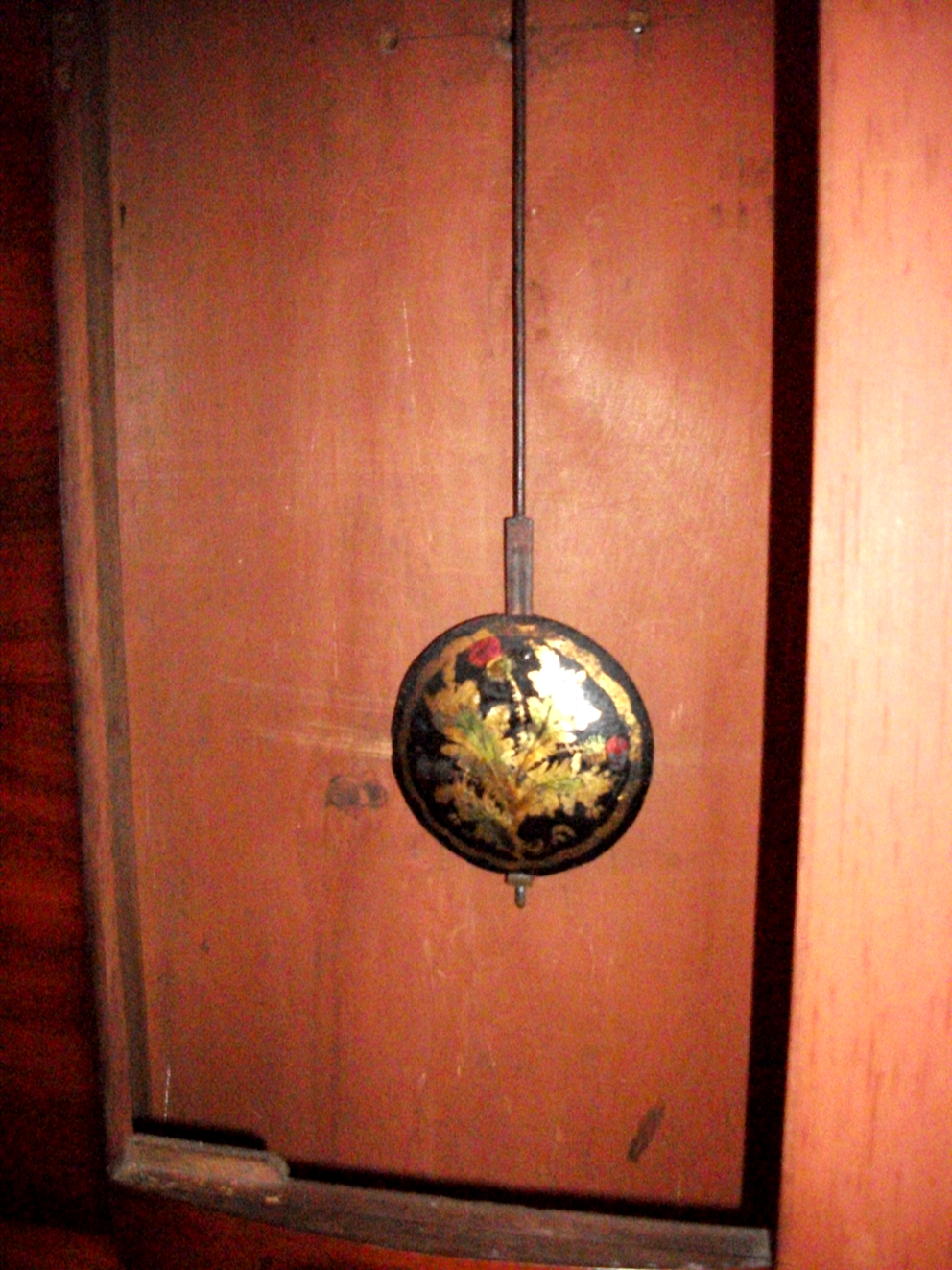
The "bob" carrying a Scotch thistle
which beats to the second

My first verified reference to the family provenance of this clock is my elderly Scottish born Great Aunt personally telling me that John Watson, by now a widower and in ill health, came to live with her parents around 1883. John brought with him a number of items of monetary and sentimental value, one of them being the Wiseman Grandfather clock. But as her parents already had a Grandfather clock (which I now own) they unusually then came to own two such clocks. Sadly, John himself died later that year aged 65 years. The clock then remained with the Watson family in Scotland until my Great Aunt and her family emigrated to New Zealand at the end of 1910. The clock, including some of their furniture, came out at the same time as freight on the 'S.S. Durham' per the Union Transit Company of Glasgow.


Grandfather clock by James Wiseman,
Lesmahagow, Scotland, c.1858

With a slow moving pendulum these clocks remained highly accurate. But despite it still usefully serving the purpose it was designed for after close to 157 years and faithfully ringing out the hours on a large bell, such clocks are less fashionable today due to their size and tending to dominate a room. Even by the latter part of the 19th century the popularity of such clocks had been on the wane, being replaced with smaller, usually more inexpensive, and just as accurate timepieces.


A short Video with the Bell Striking


But my family have still been lucky to inherit what would have originally been quite an expensive purchase. This clock still faithfully rings out the hours and with care and attention it should easily run for another 157 years. But sadly, qualified clock repairers are now becoming few and far between.


Painted Arch, Wiseman Grandfather Clock, c.1858


Bibliography :

- "Scottish Clockmakers" by Felix Hundson, 1984 (Edinburgh City Reference Library)
- "In Memoriam - Rev. W.P. Rorison DD", 1907 (held by the writer)
- Robert S. McLeish, Lesmahagow Parish Historical Society (2000)
- Watson Family Papers & Photographs (held by the writer)

Video produced with Windows Live Movie Maker, Virtual Dub cropping and Xvid Codec compression.