Showing posts with label Winton. Show all posts

Friday, 19 April 2024

ANZAC Day Remembrance 25 Apr 2024 - The Winton and District War Memorial Gates


The Winton & District War Memorial Gate
Taken Apr 2024
[From my own collection]


The 25th of April 2024, known as ANZAC Day, will again mark that rare day each year when the two sovereign nations of Australia and New Zealand both commemorate those servicemen and servicewomen who have; 

"served and died in all wars, conflicts, and peacekeeping operations and the contribution and suffering of all those who have served."

Having been brought up in the rural district of Heddon Bush in Central Southland, being located at the southern end of New Zealand's South Island, I always found it curious that unlike many other country districts, even neighbouring Drummond, there was no "brick and mortar" War Memorial. The only reference to those who served in World Wars One and Two is a wooden "Roll of Honour" board installed in the local hall, but this only commemorates former pupils of the school so the names of many local servicemen were omitted. 

For many years I had felt that perhaps, after the misery and heartbreak of the First World War years, an absolutely crippling slump in post World War One farm returns, and also constant and prodigious wartime fundraising, that there had simply been a desire to "move on" and that the will to raise further funds had simply run out of steam. There had also been very generous monetary and personal gifts to the district's Returned Servicemen who had definitely not been forgotten. But then I became aware of the fact that the Winton War Memorial Gates in Central Southland represent not just Winton but also "District[s]".  


A Pillar of the Winton
War Memorial Gate
[Source NZ History]


A plaque on one pillar of the memorial gate does in fact read; "Erected to the Memory of Those of Winton and District" while a plaque on the other pillar reads; "Who Suffered and Died in the Great War". But which districts the Memorial Gates represent is lacking and i'm sure that if asked, most people who pass here now would have no idea that the memorial related to anywhere else other than Winton. At least I now know that those Servicemen from not only Winton but also a number of districts in the area, and who gave their lives for King and Country, were in fact not forgotten. Perhaps it was felt that with a wider geographical area a broad commemoration without names would not only be more cost effective but also a tidier option with less chance of innacuracies or omissions. Had names been added there would unfortunately have been a great many and I daresay a much larger memorial would have been required.


A Pillar of the Winton
War Memorial Gate
[Source NZ History]


Winton and surrounding districts had in fact been actively commemorating ANZAC day in local Churches from the 25th April 1916. A movement to commemorate the landing of the ANZAC Forces at Gallipoli on the 25th April 1915 had started in Brisbane, Australia in early 1916, quickly spreading to New Zealand where the Premier was asked, and agreed, to declare a National half-holiday so that Memorial services could be held. 


Heddon Bush School children
commemorating ANZAC Day, April 1917
[Watson Family collection]


From the above photo we know that in April 1917 children at the rural Heddon Bush School commemorated ANZAC Day, being photographed with a large blackboard reading "Brave ANZACS's" with a New Zealand flag.  ANZAC Day would also commonly be commemorated annually at all Winton and district churches, district schools, at Moores Hall and / or the Army Drill Hall in Winton, and in various local country halls.  

On the 3rd February 1920 Winton unveiled Memorial Plaques at the Winton School, with wreaths being laid each year thereafter. But as with the Heddon Bush School Memorial board, this only commemorated Servicemen who had been former pupils of the School. The Winton Presbyterian Church also put up a "Roll of Honour" (and later also for World War Two) for all Church members who had served in the forces.

But from late 1920, and right througout the Dominion, the "War Memorial Movement" was "being taken up by the public with great enthusiasm". That today almost every township in New Zealand has a public war memorial indicates the success of the movement and the desire to honour not only the fallen but all who had served their King and country.

Various proposals for a Southland Memorial were informally put forward, with Mr Henry R. Wilson of neighbouring South Hillend (died 1972 aged 99 years) writing to "The Southland Times" in March 1920 with some radical but interesting thoughts and suggestions of which this is only an excerpt:

"At Thursday last’s meeting of the War Funds Association, eleven country districts being represented, little sympathy was shown to the idea of the proposed [Invercargill] memorial. Can townspeople wonder why ? The wishes or sympathy of rural residents was neither asked for nor considered. ... A tablet at school or athenaeum in a country centre is very well from the local point of view to keep in memory the brave fallen, but the frittering away of, in some cases, several hundred pounds, and enthusiasm in small inadequate effigies of troopers and small monuments, seen by but few, is injudicious and to be deplored. ... If country people are to subscribe they must see something tangible as the outcome. ... failing a general Southland monument, the bulk of the country people might erect one on Forest Hill,...which is Crown lands and easily seen from Riverton, Otautau, Nightcaps, Winton, Morton Mains and elsewhere.... "

It now transpires that the rural community of Heddon Bush had in fact initially desired a memorial of their own. But in early March 1921, and after having invited Mr Walker, the Mayor of Winton, to speak to the residents, there was a quite surprising development;

“…it was unanimously decided to fall in with the Winton scheme. Winton has decided to erect a clock tower, upon which will be inscribed the names of fallen heroes from the district. The proposed site is on the Railway reserve, which would be beautified and provide a suitable environment for the structure. The cost of the memorial (without the clock) would be about £1500.”   

Choosing to join with Winton was perhaps not surprising. Being only 21 kilometres from Heddon Bush, Winton had a suitable and very visible site readily available at no cost, was undoubtedly the primary commercial rural centre for most Heddon Bush residents, a proposed railway line from Winton to Heddon Bush had been fully surveyed as long ago as circa 1875 and was, even at this late date, still expected to be constructed, and more importantly, it meant being able to share the cost of a rather more substantial War Memorial with not only Winton but other rural districts which all made perfect sense. Likewise, neighbouring South Hillend only put up a World War One "Roll of Honour" board in their local school as late as June 1936 so appear to have quickly fallen in with the "Winton scheme" - hopefully with Mr Wilson's blessing! 


The Memorial Weeping Wych Elm tree in the
Winton Oval, planted to commemorate the
ANZAC Day Landings, circa 1915.
Taken Autumn, Apr 2024
[From my own collection] 


After the initial momentum, fund raising for the Winton War Memorial appears to have progressed rather slowly. The first published reference to active fundraising and plans for the Winton War Memoral is this report dated the 5th February 1924; 

"At a public meeting in Winton to discuss the form of Soldiers' Memorial to be erected, it was stated that nearly £200 was on hand for the purpose. It was unanimously decided to erect an arch-gateway, and plant memorial trees in the vicinity." 

But it appears that there was already a "memorial tree", a weeping wych elm, in the Railway Reserve, having been planted by Mr Robert Wilson, the Mayor of Winton from 1914 to 1915, to commemorate the ANZAC Day landings on the 25th April 1915. So the weeping elm (which is now a "listed" tree) can only have been planted in 1915 unless the term "Mayor" was used retrospectively, i.e., that he was Mayor at the time of the landings although this seems rather unlikely.  

As to why a "Clock Tower" did not eventuate is unknown and we now have an "arch-gateway". The local newspaper, "The Winton Record" would have kept residents well informed of developments and Winton Borough Council business but this valuable publication has not (yet) been digitized.

A report from the 20th March 1924 states that canvassing for donations had commenced and that; 

"a generous response has been forthcoming. It is more than likely that the memorial will take the form of an arch gateway leading to the railway reserve, which will be beautified by the Town Council".

Over a year later, we note that during a meeting of the Winton Borough Council in August 1925, Councillor Gullick; "brought up" the matter of the Soldiers' Memorial. It was then; "...left in the Mayor’s hands to arrange a meeting of the collectors in order that some finality be arrived at." So obviously, plans for the memorial had still only progressed slowly.  


The Winton Memorial Gates in their original
pre-2009 location fronting the Bowling Green.
[Source : NZ History]

By March 1927 a "Sub Committee" had been constituted under the auspices of the Winton Borough Council, then meeting to discuss amended plans by Invercargill Architect Mr Edmund R.F. Wilson ;

"which provide for handsome memorial gates with two imposing stone pillars.... The gates are to be erected on the site at the stone steps leading to the railway reserve. " 

Exactly why an "arch-gateway" was no longer considered is unknown, perhaps just a modification suggested by the Architect in his "amended" plans, although the wrought iron gates when closed form an arch. The concrete pillars themselves would be substantial, each weighing between 6.5 to 7 tonnes. Interestingly, and I am sure by accident rather than by design, the chosen Architect, Mr Edmund R. Wilson, is in fact a brother of the afore-mentioned Mr Henry R. Wilson. 

The official unveiling and opening of the Memorial Gates on Great North Road, Winton, took place on ANZAC Day, being Thursday the 25th April 1929, with the ceremony being carried out by Chaplain Lieutenant-Colonel Dutton of Dunedin, a veteran of both the (2nd) Boer War and First World Wars. The Rev. Dutton had, in fact, a proud military heritage, being the son of a soldier and a Grandfather who fought at Waterloo. Dutton gave a long speech approriate to the occasion, only part of which includes these comments;     

"These tablets [of memory] will serve to tell future generations of the great sacrifices made by the young men of this generation. It has taken some years to complete the erection of the memorial at Winton and I am sure we are all very pleased that it has now been accomplished. The gates, walls and fences have been erected entirely by voluntary contributions and I wish to thank all those who have so liberally contributed to the fund....”


The Winton War Memorial Gates, taken looking west
and framing the Winton Water Tower, Oct 1958
[Photo credit : William Dykes] 


The Memorial Gate was erected with a decorative low concrete wall next to Great North Road, giving convenient access to the Winton Bowling Club grounds. Where the road curves round between the Memorial gate and the former Post Office was the 1902 Band Rotunda (in its original position beside the road before demolition in 1954 due to being a "traffic hazard"), being built to commemorate the 1899-1902 Boer War and the Coronation of King Edward VII. But in later years, with the gate being situated next to a now busy main road this proved inconvenient for ANZAC Day parades and gatherings and of course the band rotunda was long gone by then. Thus, as recorded by local Historian, the late Vince Boyle  ;

"The concrete 14 tonne twin pillars with an ornate iron gate were cut off at their bases and transported to Anzac Oval (80m south on Great North Road) and re-sited there on new foundations in time for Anzac Day 2009 at a cost of $35,928."


The Winton War Memorial pillars being moved,
January 2009
[Photo credit : Robyn Edie]


The new site further south on Great North Road is situated oblique to the road almost adjoining the former 1905 Winton Post Office building and with steps now leading down into the "ANZAC Oval". This is a small park with the centrepiece being not only the ornate Band Rotunda but also the afore-mentioned spreading Elm tree.  

And in fact, the historic old Winton Railway Station dating from 1871 (sadly demolished in 1983) had been situated at the north east corner of the park fronting a short access road, being an eastern extension of Brandon street which now leads to a soul-less car and truck park. Troops would be farewelled here prior to leaving for camp and military service overseas, many never to return. As, previously noted, which rural districts are represented by the Gates is not recorded but this was no doubt deliberately left open to include the area in general. Likewise, the amount raised by each district is not recorded and being a community effort, may never have been itemized in such a way. Comparing the photos from 1958 and today, I note that the dates "1914" and "1919" are no longer highlighted in a darker colour but otherwise the Memorial has been faithfully restored to how it was originally built. As to "1919", this was actually then considered the official end of the war as the Treaty of Versailles was only signed in June 1919. If you look closely at the wrought iron gateway (in the uppermost photo) when closed you will also notice that it also forms a Celtic style Cross.


The Heddon Bush School 
War Memorial Roll of Honour
[Photo credit : Vicki-Lynne Hubber]


And the "deficiency", if you would even call it that, of the Heddon Bush District not having their own War Memorial this was, as previously noted, partially rectified when a wooden Roll of Honour board was placed in the Heddon Bush School after World War Two but lists only those Heddon Bush School ex-pupils who had served and died in both World Wars. This board was paid for using the £39.8.0 profit from the 1949 Heddon Bush School 69th anniversary celebrations. Yes, an odd date for a celebration but as some first day pupils were still living the community wished to celebrate the occasion with them. The board would later be transferred from the school to the old Heddon Bush hall and is now in the new hall opened in 1964. I recall it hanging high up on the wall, where it still hangs to this day, but I personally never took much notice of it and I do not recall at any time that it was given any particular official ANZAC Day recognition. As to South Hillend, their school closed some years ago and they no longer have a local hall so am unsure of the location of their World War One & Two Rolls of Honour for former pupils. Unfortunately the Kia Mate Koa roll of Southland War Memorials and locations is no longer available online.

But I now know that the service and sacrifice of those from not just Winton, but also from surrounding Districts, are commemorated by the Winton & District Memorial Gates so these now hold a deeper meaning for me. Winton has, in fact, a number of war related Memorial Rolls of Honour and plaques, some being viewable in public areas. 

Last but not least, I must acknowledge the work of the late Ann Robbie (died Jan 2023) for documenting not only these but in fact all of Southland's War Memorials (around 420) as well as her work in restoring a number of memorial boards and rolls of honour. The late Iain Davidson (died Nov 2023), another Southlander, also deserves equal recognition for his work in researching and documenting the lives of a great many local servicemen as well as his invaluable and tenacious work in identifying servicemen in old photographs. I am aware that Andy Macdonald is now progressing Iain's work.    

Any further information is welcome and my email link appears in the right hand menu bar. As to which "Districts" the Winton War Memorial gates represent most likely includes the following (being districts in the immediate area who do not have their own district War Memorial) :

- Lochiel
- Oreti Plains
- Heddon Bush
- Dunearn
- South Hillend
- Kauana
- Otapiri
- Hokonui
- Springhills
- Tussock Creek


"They shall grow not old, as we that are left grow old :
Age shall not weary them, nor the years condemn.
At the going down of the sun and in the morning
We will remember them."

From "For the Fallen" by Laurence Binyon (1914)


All Rights Reserved 


Sources & Acknowledgements:

- Papers Past, National Library of New Zealand  
- New Zealand History, NZ Ministry for Culture & Heritage 
- "Tales of the Turi 1984 - 1984", by M. Cairns & F.H. Plunkett
- The Cyclopedia of New Zealand [Otago & Southland Provincial Districts] (held by the writer)
- Invercargill Public Library Reference Library (and their very helpful Librarians).
- Watson Family History, 2022 (held by the writer)
- Watson Family photo collection (held by the writer)
- Dykes Family photo collection (held by the writer)
- Personal photo collection
- Vicki-Lynne Hubber

Wednesday, 22 November 2017

Chronicles of a Country Saddler, Mayor & Centenarian - Andrew Liddell of Winton


Andrew Liddell of Winton in his 97th year,
Taken at Heddon Bush, Feb 1939
[Copyrighted Photo taken by William Dykes]

Last Update 18 Jan 2018 (further information always welcome)

This blog attempts to relate something of the life story of Mr Andrew Liddell (1842 -1942), a well known and highly respected Southland identity in his day but now, and after the passage of so many years, largely forgotten. A Scottish born colonial era immigrant, Andrew Liddell not only became a successful country saddler in both Christchurch and in the small rural Southern town of Winton New Zealand, but also served as Town Mayor for a period before finally reaching the significant milestone of becoming a centenarian. Liddell would also, as we shall read, put his practical skills, experience and business abilities to very good use in the local community.
It was the finding amongst old family papers of some no doubt unique old invoices from his rural saddlery business and then, shortly afterwards, the quite serendipitous discovery of an actual original photo of Andrew that piqued my interest in researching the life story of this obviously resourceful and practical minded Scotsman. A family descendant has subsequently provided further family information including another wonderful photograph.

Confirmation of Birth of Andrew Docherty (later Liddell)
[Source : Scotland's People]

So firstly, what do we know of Andrew Liddell's early life? Historical Scottish Church and family sources confirm that he was born in Paisley Scotland on the 18th June 1842 but what is surprising is that his parents were John Docherty (1815 - March 1861*) and Helen Liddell (13 Feb 1812 - 1857). And herein lies an interesting tale upon which we will learn more of anon. I do note that while Andrew Docherty's birth is entered into the Baptismal record book of the Paisley Burgh (or Low) Church (Church of Scotland - Presbyterian) he was not baptized here. This ceremony would occur on the 6th August 1842 at the George Street United Succession Church in Paisley, being a breakaway Presbyterian Church. So it appears that both parents were from two different churches, a registration of a birth and then a baptism at separate Presbyterian churches not being uncommon in such circumstances. [*This date was confirmed by Andrew Liddell to Historian Herries Beattie. I can however find no evidence of death in civil records but this is also not uncommon in these early colonial years]

The Otago & Southland volume of the Cyclopedia of New Zealand, being published in 1906, confirms  Andrew as being the eldest son of John Liddell of Paisley. As Andrew would have had input into the writing of this bio he was at least prepared to acknowledge his father but not his original birth surname. After leaving school at nine years of age, Andrew's early employment was in rope spinning and then at a silk mill, Paisley being famous for thread manufacturing and spinning with 'Clarks' and 'Coats' being two such local firms. It was not uncommon for children of working class families to receive a short education and commence working long hours six days a week at such a young age. Could this have been one factor in a growing resentment against his father? Additionally, his later strong support of the temperance (anti drink) cause is perhaps also worth considering here. At any rate, Liddell confirmed many years later to Historian Herries Beattie that he had experienced "a hard boyhood".

But crucially, and in 1854, a young Andrew Docherty would next be apprenticed to the saddlery trade. Already his practical abilities were coming to the fore and he would go on to make this trade his future career.

It was now as a qualified saddler and at around 14 years of age that Andrew, along with his family, departed Gravesend on the Thames on the sailing vessel 'Palmyra' on the 28th October 1857, arriving at Port Chalmers, Otago, New Zealand on the 14th February 1858 after an extended 105 day voyage [Incidentally, this was the same voyage that carried the 'unlucky' Tokomairiro Church bell which I wrote about HERE]. While Captain Tierney would be charged with seven breaches of the Passenger's Act 1855 and fined £30 a number of passengers wrote in support of Tierney and many of the 300 immigrants on board had in fact signed a testimonial to him at the end of the voyage so opinions were rather divided.

The passenger manifest lists "Mr J Docherty", "Mrs Docherty", and "4 children" in steerage confirming that the family emigrated to New Zealand together, undoubtedly in search of a better life abroad. But crucially, published records also tell us that Mrs Helen Docherty died on the voyage out, being one of nine deaths on board. All would have been buried at sea and no further details were given. Family sources then advise John and his son Andrew as "going to live with relatives in Nelson". We now know this to be incorrect as confirmed by two independent sources.

A typed record of the Staples family (who Andrew later married into) provided to the NZ Society of Genealogists states; "He left Scotland on board 'Palmyra', arriving in New Zealand in February 1858, only to find that there were just eight horses in Dunedin! So he found work as a plough boy and a bullock driver for a Mr [David] Berwick of Saddle Hill. He drove a two-wheeled dray with six bullocks, taking household goods and stores to the gold diggings at the Dunstan (Clyde). Later, he drove his own team and travelled to Gabriel’s Gully, a rich goldfield near Lawrence. Later, he travelled north by steamer from Dunedin to Auckland. In 1869, he went to Canterbury, and became a saddler in Cashel Street, Christchurch."

In 1935 and again in August 1938 Andrew Liddell was interviewed by that great Historian and Author, Herries Beattie, the latter earlier preparing an article for publication in the Southland Times, being submitted on the 30th October 1935. This article is not among Beattie's papers in the Hocken Library, only the article headings and some notes. These at least confirm that Liddell drove bullock teams from Waikouaiti inland over the Pig Root to the Maniototo and Manuherikia, some of his experiences at this time being described. The published article will take a little searching as Papers Past has not yet covered this period of "The Southland Times". There may also be references in one or more of Beattie's numerous published works. 

His entry in the Cyclopedia of New Zealand merely states that from his arrival in 1858, "Mr Liddell experienced many changes incidental to early colonial life, including visits to Auckland, Nelson, and West Coast goldfields." Of this period we know that the gold rush at Gabriel's Gully took place primarily between 1861 and 1862 and that on the West Coast between 1864 and 1867 although the above biography excludes any reference to being on the West Coast goldfields although Nelson is at least mentioned.

As stated above, we find that in 1869 Liddell, and now using his mother's maiden surname, entered into business as a Saddler in Cashel Street Christchurch in the Province of Canterbury. There are two family stories relating to this change of surname but after the space of so many years it is difficult to confirm the absolute veracity of either. The first story holds that he changed his surname to 'Liddell' to simply "fit in" with the predominately Scottish settlers in the south, assumedly during his earlier time spent in Otago. The second story,  which circulated around some older members of the family and to which I would give greater weight, holds that he simply did not care much for his father and "wanted to lose his identity" so upon his arrival in New Zealand he simply assumed his maternal surname. This could have been achieved very easily if he did not have to rely on any apprenticeship papers or testimonials from Scotland for his employment or required a Church disjunction (transfer) certificate. 

Interestingly, a family story relates that Liddell was "a member of the early cycling club and was one of the few surviving persons who rode the old penny farthing bicycle". I assume this to have most likely been a club in Christchurch (possibly the Canterbury Bicycle Club) and while he was still a relatively young man.

Sale of Andrew Liddell's Saddlery Business
[Source : "The Press", 13th Jan 1882]

On the 13th January 1882 we find Andrew Liddell advertising his "Old Established" saddlery and Harness making business for sale, having been "carried on successfully by the present proprietor for the last ten years". So it would appear that from 1869 to 1872 he had perhaps only been an employee within the business before buying it out in 1872.  On the 21st May 1874 Liddell married Ada Jane Staples, a native of Imber in Wiltshire, England, having arrived in New Zealand in 1858 with her parents at just two years of age. Andrew was then almost 32 and Ada not yet quite 18 but it appears to have been a very happy marriage. Both Andrew and Ada would then set up home in Woolston with their first child being born in November 1874, being followed by twin boys in November 1876. A Lodge member, Liddell would be appointed Provincial Grand Master of the North Canterbury district in 1879, quite an honour but still not by any means the only feather in his cap.

Around June 1882 the Liddell family took a steamer south to Campbelltown (Bluff) at the southern end of the South Island. From here he would set up a new saddlery business in the strategically placed rural servicing and railway town of Winton in Central Southland. This would go on to became one of the largest such establishments in the district. But why he chose to leave an established business in Christchurch and move to Central Southland is unknown but his choice would surely turn out to be the right one. What I find interesting is that Liddell advertises his new business in Winton opening as from the 20th June 1882 but chose not to advertise his existing Christchurch business for sale until January 1883. I daresay he wished to make a go of the new enterprise before totally cutting existing ties.

The new business would carry on much as before. Besides the manufacture of saddlery, "Mr Liddell was a large importer of ropes, tarpaulins, horse covers,canvas, oils, etc." An invoice dated 1898 states that the business stocked "saddles, side saddles, bridles, coach, gig, buggy, and cart harness, spurs, whips, bits, and every description of saddlery in stock".

The First Evidence of Andrew Liddell,
Saddler & Harness Maker in Winton, Southland
[Source : "The Southland Times", 20 June 1882]

But his personal interests and service to the local community would also be notable; "He was elected to the [Winton] Borough Council in 1892, and during his term of office, a handsome Atheneum building was erected. Mr Liddell was chairman of the Winton Literary [and Debating] Institute, treasurer of the Lodge Winton [No 108, N.Z.C.], and a member of the Oddfellows, Manchester Unity".

Another obvious passion is noted in 1884 when Liddell acted as a Steward for the Winton Jockey Club annual races, no doubt having supplied much of the saddlery and various accoutrements for many of the locally owned race horses. He would then quickly go on to be elected Vice-President in 1888 and President in 1889, quite an achievement. This would, however, still prove not to be the penultimate achievement for this public spirited and very industrious man.

A Close-Up of Andrew Liddell from the Photo shown below
Taken circa 1900
[Photo Courtesy of Malcolm Liddell]

The Saddlery business at Winton appears to have been a great success with Liddell opening a new and "very commodious saddler's shop" in August 1885. This initial success may have encouraged him to open a new branch in Lumsden on the 24th August 1885. But unfortunately the new branch evidently proved not to be financially viable, being simply closed down as early as February 1887 rather than being sold as a going concern. In August 1885 Liddell makes reference to further reducing prices to "suit the times" and he, like many of his customers, were probably hit by the continuing general economic and rural downturn so expanding the business at this time was probably just bad timing, especially with additionally having to now pay for a qualified Tradesman at Lumsden.

In January 1888 his business would have a very lucky escape when the nearby Winton Hotel burnt down, Liddell being forced to remove his saddlery goods to safety across the street. A further expansion of the premises would then take place in June 1893, now stocking an even greater range of saddlery and horse related products, including equine related medicines. His business title at this times reads; "Winton Saddle, Harness, and Collar Factory".

An Invoice for "A. Liddell & Sons" dated 1st April 1898.
[Source : Personal Family Papers]

In May 1890 Liddell, as Secretary (possibly of the local Farmers' Club), chaired a meeting of farmers in the Winton Hotel to consider "the Small Bird Nuisance". He had, by now, also been elected Chairman of the Winton School Committee. And seemingly not content with an existing heavy workload of business and public activities he now became President of the Winton Caledonian Society, having served as a Committee member since 1884. But significantly, and in 1894, he was also voted onto the Awarua Temperance Party to represent Winton so was clearly teetotal and not afraid to represent this divisive cause. His obvious skills, ability to manage his prodigious workload, and his status in the community would however be fully recognized when, between 1896 and 1898, he would hold the very great honour of serving as the Winton Town Mayor. But still he somehow managed to find a little extra time to devote to his membership of the "River Board", representing, along with four other members, the Winton River District.

Andrew Liddell and his Two Sons,
taken outside the Winton Premises,
Circa 1900
[Photo courtesy of Malcom Liddell]

The business had now expanded to such an extent that on the 23rd January 1897 Liddell opened a second shop in Winton, now bringing his two sons Arthur and Herbert in as full partners, both already having "been working for him for some years". And sometime after the turn of the century, but prior to May 1903, branches would also be opened at Drummond and in Mossburn.

Unfortunately tragedy would strike at 3am on the morning of the 4th January 1904 when a devastating fire destroyed a number of wooden building in Winton, including 'A. Liddell & Sons' Saddlery shop - and no doubt also their financial records. The location is noted as being adjoining the still extant two story brick 'Jamieson's Building' which was largely saved. Liddell held insurance cover of £810 (and was in fact an agent for the company) with re-insurances of £230 each with two other firms but, it was noted, none of the businesses affected held cover for the full amount of their losses. But the business would survive this untimely conflagration. One invoice I hold is dated the 2nd February 1904 but includes an account dated July 1903 however this may be from the existing Drummond branch, being more convenient for my Grandfather than Winton.

The destruction of the Winton premises was obviously not a catastrophic financial loss as his sons would further diversify the business with additional branches being opened at Otautau as early as 1907 (after purchasing the business of Mr James Kidd) and in Balfour, all being in prosperous rural areas and serviced by the railways. But Andrew Liddell Snr., being now in his 60's, is mentioned very little from the earlier years of the 20th century as he slowly handed over his responsibilities to his very capable sons.

An Invoice for "A. Liddell & Sons" dated 2nd Aug 1904.
This has been signed by Arthur Liddell.
[Source : Personal Family Papers]

Sadly, Andrew's wife Ada died on the 3rd December 1918 at 62 years of age after a long period of ill-health. Her obituary notes that; "She was a worthy helpmate, and unobtrusively performed many kindly and charitable acts among her friends and neighbours." She also took a keen interest in her Church which I assume to be the Winton Presbyterian Church as the family were brought up in this faith. Ada was also a talented pianist. At this time their son Andrew Liddell, a baker, was serving with the forces in Palestine but would survive the war and return home. But of their fourteen children, six would die in infancy and one at 12 years of age, truly a saddening tale. Despite Andrew being 14 years older than Ada he would live on a further 24 long years after her death. 

Immediately after Ada's death, and on the 28th December 1918, Liddell now promptly sold up his furniture and personal effects and then moved in with his youngest daughter Evelyn, also a resident of Winton, but spending the winters with his family further north including his son Gordon in Wanganui.

In February 1936, and at age 94, Liddell was quoted as being; "a wonderful example of the early pioneers, being hale and hearty and often travelling in various parts of the Dominion." In fact, he continued to travel alone until he was in his 99th year. Another notable achievement was when, and at age 98, he was officially declared the oldest living "Past Provincial Grand Master [of a Lodge]" in the world, having of course been elected to that post as far back as 1879. 

Andrew Liddell's Signature on his will, 8th July 1941
[Source : Archives New Zealand]

My Grandfather photographed Andrew in the garden of my Mother's family home at Heddon Bush in February 1939, his photo being shown at the top of this page. As a well established and very hospitable Scottish born farming family, and having been long term customers, their friendship would have extended back almost to the time Andrew set up business in the district. But the invoices I hold (eight in total) are in fact from my Father's family, also being established farmers in the Heddon Bush district. So both were thus regular and loyal customers of "Liddell & Sons".  

Andrew Liddell "Southland Centenarian", taken 18th June 1942
[Source "The Auckland Weekly News", 8 July 1942]

Andrew Liddell's final milestone was reached on the 18th June 1942 when he achieved the significant age of 100 years. But owing to his then failing health a formal banquet to be put on in his honour by the Winton Borough Council had to be cancelled. Instead, a smaller gathering took place at his daughter's home. The then Winton Mayor speaking at this rather more intimate and personal gathering noted the unique situation of a sitting Mayor being able to congratulate an ex-Mayor on reaching 100 years. Liddell would also receive over 150 telegrams, including one from the King and Queen, a most telling testimony to his status in the community and of his wide circle of friends, family and acquaintances, both in New Zealand and overseas. By this stage he was not only the oldest Past Provincial Grand Master but also now the oldest Oddfellow in the world.

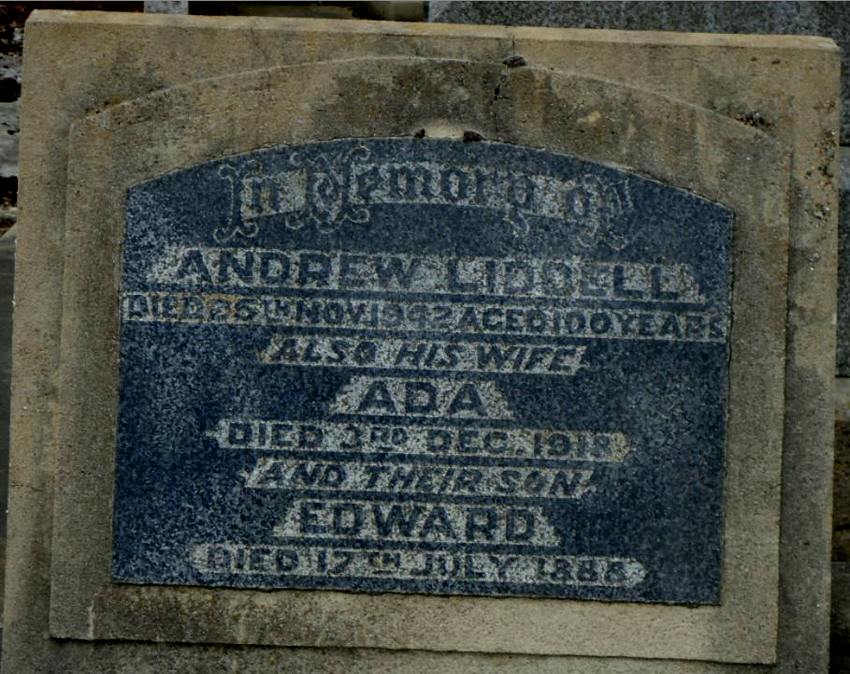
Liddell Family Gravestone,
Old Winton Cemetery
[Source : Tim Macdonald]

Having reached this great milestone in his life, Andrew died, no doubt with a contented heart for a full, long and useful life, at Invercargill on the 25th November 1942 and is buried in the Old Winton Cemetery with his wife and their son Edward who both pre-deceased him (location in Cemetery; Plot 18, Old Survey Block XI). His estate was valued for probate purposes at £682.10.6

Copyright & Updates : Commercial publication prohibited without my specific written permission. Excerpts may however be copied for private or academic use provided this site or the original publication source is acknowledged. Corrections of any unintentional errors or additional relevant information welcome. My email link appears in the right-hand menu bar.

Sources :

- Papers Past / Te Puna Mātauranga o Aotearoa
- Hocken Collections, Dunedin / Uare Taoka o Hākena (Herries Beattie papers MS-582/B/17 and MS-582/G/8)
- Archives New Zealand / Te Rua Mahara o te Kāwanatanga
- Scotland's People website
- Family Search - The Church of Jesus Christ of Latter Day Saints
- "The Cyclopedia of New Zealand - Otago & Southland", 1906 (from my own collection)
- "The Winton Record", 18 Feb 1936 (from my own collection)
- "Staples Family Tree and History" (NZ Society of Genealogists, Auckland) 
- Cochrane Family Papers (In my possession)
- William Dykes Photographic Collection (In my possession)
- Various Internet sources
- With grateful assistance from Malcolm Liddell & Jane Shennan
- Also my thanks to Tim Macdonald for taking the photograph of Andrew and Ada's Gravestone.

Sunday, 8 March 2015

The Changing Southern New Zealand Railway Landscape


My 2013 Blog on the sale of the "Kingston Flyer" tourist steam train (which incidentally has still not yet sold) prompted me to go back through my collection of railway related photographs which I took in Southland and Otago in the South Island of New Zealand through the early to mid 1980's.

I do appreciate that this Blog will have a narrow focus of interest for many readers. But these images emphasize how much has been swept away, not only by line closures but also by rationalisation and modernisation of operating procedures and infrastructure in the name of efficiency, and reducing costs and maintenance. A considerable number of Internet searchers find images my Blog via Google and other Search Engines. So these photographs, which are now over 30 years old, may prove interesting. And while much of what we see here had remained for over 100 years, the 1990's brought a much changed railway landscape. Almost all of what you see is no more. If it still exists I have noted this.

I do apologise for the lack of "trains on tracks" or people in these views. I took them at the time to preserve something of this heritage for myself rather than others as I knew their days were numbered.

Clinton Railway Station - October 1981

Clinton became was for very many years a busy refreshment stop for passenger trains, hence the long platform. Passengers would pile out of their trains and make a dash for the refreshment room, taking their tea in thick railway monogrammed crockery cups, pies, sandwiches, buns and cakes back onto the train. Service thus had to be quick. The station became, after the introduction of the diesel hauled Southerner Express in December 1970, along with on-board catering, merely a shadow of its former self, acting only as a brief passenger stop. All you see, including the goods shed with its distinctive curved roof, is gone.  


Waipahi Branch Railway, circa 1982

The Tapanui branch line from Waipahi closed in 1978 after major flood damage. This typical New Zealand Railways wooden truss bridge on stone piers spanning the Pomakaka River inexplicably survived after closure and subsequent lifting of the line. I believe it can still be seen today on Pomahaka Road about 400 metres north of the turn-off to Conical Hill Road. 


Pomahaka Railway Bridge


Gore Railway Station and Semaphore Signals - circa 1982  

Mersey Street Signal
Box which controlled
the whole station
Mersey Street Crossing showing
the Signal Box and the old Post
Office (which originally had
 a clock tower)

The former route of the Waimea
Plains Line past the old Post
Office building at right. Taken
 looking towards the Station 


Gore Railway Station Platform.
Note the "Ladies Waiting Room"


Gore Station south end
Semaphore Signal Gantry
taken looking south
Gore Station south end
Semaphore Signal Gantry
taken looking north


Oporo Locomotive Dump, Branxholme, Southland, circa 1982

A large number of old locomotives and tenders, comprising of V, P, K and even one early J Class, were dumped at Oporo by the Oreti River on the branch line through to Thornbury in 1927. At a time when scrap iron prices were obviously low, these venerable but now non-standard and generally worn out old 19th century locomotives were tipped over the edge of the line by the Oreti River to act as flood protection for the railway embankment. A number of locomotives and tenders plus spare parts from others have been subsequently recovered, including the restored - and now world renowned - American built Rogers locomotive K88 "Washington" of 1877 vintage and the unrestored Rogers K94 of 1878. Contracting work undertaken to stabilise the bank after these photos were taken covered over many of the remains. I can recall that there was evidence of cuts in metal and boilers of an indeterminate date, possibly removing white metal and copper or anything salvageable that could be sold to a scrap metal dealer. Another locomotive dump exists beside the Oreti River at Mararoa Junction but only a few pieces of unidentified metal were visible above ground when I visited the site about 1982.        


A "V" Class locomotive lies upside down,
the front buffer beam at right

A locomotive tender
Detail of the above buffer beam
and left-hand cylinder


Two boilers covered in
undergrowth and gravel
Inside view of a boiler showing
the large & small flue pipes 


Winton Railway Station, Dec 1982


Winton Station Platform
and Goods Shed
Winton Station Platform
showing a parcel trolley 


Winton Railway Station, dating from
the 1870's. The canopy had been
added later. 
Winton Railway Station
looking south


Winton Station Ground
Frame which operated
the Semaphore
Signals and possibly
yard switching 

This station retained a Station Master until closure but sadly freight volumes had dropped significantly over the previous few years.


Centre Bush Good Shed, circa 1982


This goods shed remains standing but is sadly continuing to deteriorate badly. 


Mararoa Junction, Mossburn Branch Railway, circa 1982


This had been a combined road and rail bridge across the Oreti River and enabled the Mossburn line to cross the Oreti River. The Mararoa locomotive dump was located very close nearby but there is now very little to see above ground. This distinctive and once very common type of wooden bridge was swept away after a new double lane concrete bridge was built, the Mossburn to Mararoa Junction branch line having already closed,


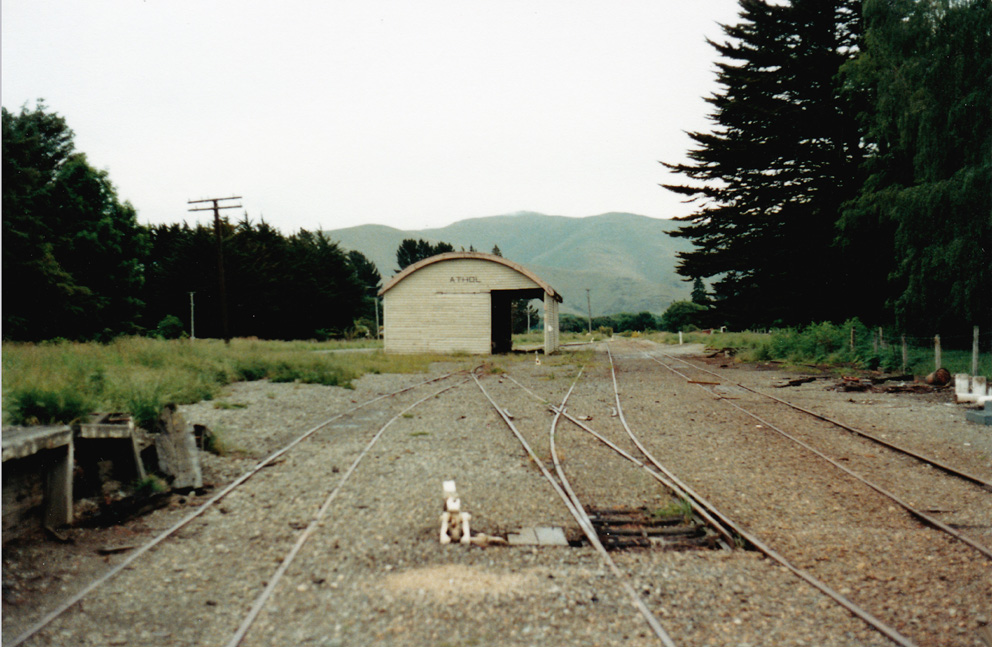
Athol Goods Yard, Kingston Branch Railway, circa 1982


The distinctive sloping roof, as at Athol and many other stations and wayside halts, assisted when there were heavy snowfalls.


Kingston Branch Railway, circa 1982
(after closure)


Kingston / Mitivot
Kingston Branch Railway, 1985


This is the replacement Kingston Railway Station, being part of the Riversdale Railway Station and moved here to be ready for the opening of the new "Kingston Flyer" tourist steam train in 1970. The station had been temporarily re-named for filming of a French automobile advertisement.

Steam locomotive AB795, having been built at Hillside Workshops in Dunedin in 1927, has just rolled into view. This locomotive, along with AB778, formed part of the newly formed "Kingston Flyer" heritage train running the 60 kilometres between Lumsden and Kingston in Central Southland. Since 1982 the "Kingston Flyer" has only run the 14 kilometres between Kingston and Fairlight but since 2012 has been mothballed and is currently for sale for NZD$2.5 million which includes the rail corridor and associated land and buildings [Link Here]. The last privately run operation proved uneconomic and it may well be that the local Council will sadly have to remove a heritage order preventing the train from being removed and operating elsewhere.


Restoration of American Built Rogers K92, 
Fiordland Vintage Machinery Club, Te Anau, circa 1986


American Rogers Locomotive Works K92, built in 1878 and having been exhumed from the Mararoa Junction locomotive dump by the Oreti River where it had been dumped in 1928, is now owned by the Waimea Plains Railway at Mandeville. Although its boiler ticket has now expired it had quite amazingly used the original pre-dump boiler dating to the early 1900's, a new boiler will most likely now be required. As opposed to the rather "flashy" restored American Rogers K88 of 1878 it has been restored to its circa 1910 guise which affords a rather interesting comparison.


A "Grass Grub" and Baggage Car 
at Christchurch Railway Station, circa 1982 


An ex-Drewry 1955-56 articulated railcar converted
to locomotive hauled carriages. Not designed for this 
type of haulage they had very a short life-span.

The railway station itself, although then used for other purposes, suffered serious earthquake damage in 2012 and parts of it have been demolished. The tower, which remains a Christchurch icon has been externally reinforced in order to support it due to cracking.


An old Vice-Regal Carriage at Arthur's Pass 
& used as a "Camping Coach" by NZ Railways Staff

I understand this carriage was later moved and
restored for private use.


A "Grass Grub" at Otira on the West Coast Line


Ex-Drewry articulated railcar of c.1955-56
and converted to locomotive haulage


Bibliography :

- All images are from my own collection and may be freely copied for non-commercial use provided a link is given back to this site. I still hold the original 35mm negatives and it may be possible to obtain higher resolution copies.