Showing posts with label K88 Washington. Show all posts

Tuesday, 10 May 2016

"Buried for 47 Years" - The Amazing Preservation Story of the Rogers K88 "Washington"


K88 "Washington"
at The Plains Railway
[Source : Wikipedia Commons]

We have already read in my first two blog instalments [click here for link] about the inaugural express train from Christchurch to Dunedin in September 1878 led by the American built "K88 Washington" (named by the manufacturer after the first US President) and for part of the way, the English built Double-Fairlie "Josephine". We will now read about their preservation, having in both cases come so very, very close to being lost to us forever. Let me first relate the amazing story of the discovery and restoration of the American Rogers built "K88 Washington" of 1877, that "flashy" and "ornamental" "watch with all its works outside" which had soon proved its doubters wrong and henceforth changed forever the focus of New Zealand Railway steam locomotive design and procurement.


The original 'Kingston Flyer' and crew at Kingston Railway
Station with an unidntified "K" class locomotive.
Note the half "birdcage" carriage. Taken post 1903.
[Photo credit : NZ Railways Publicity]

By 1885 heavier trains on the main line and the consequent introduction of newer and more powerful locomotives had meant the relegation of the "K" class from hauling main line expresses to lighter branch passenger and goods trains and (according to The Plains Railway website) sometimes acting as bankers on the steep hills north of Dunedin. In 1902 "Washington", along with other members of her class, now valiantly found a new claim to fame - hauling passenger trains west from Gore across the Waimea Plains to Lumsden and then north following the Upper Mataura River valley before crossing the glacial moraines to Kingston to meet the Lake Wakatipu steamers. The "K" class maintained their reputation for quick acceleration and speed so that this passenger service soon earned the apt title of "The Kingston Flyer".

The South Island based members of the "K" class were reboilered with a flat topped "Belpaire" firebox and boiler in 1903 replacing the original round topped "wagon-top" firebox, The new boilers were now certified up to 160 psi (pounds per square inch) whereas the originals had only been to 130 psi so a useful increase in performance would have been expected. They were also fitted with a steel cab to replace the wooden original as well as Westinghouse brake equipment.

But in November 1926, and now declared obsolete and needing major mechanical work which was not economically justified, "K88", along with a number of sister engines, were then relegated to "rotten row" in the Invercargill railway yards to await their fate. With scrap metal prices being depressed, railways management then made the decision to strip the engines of any useful parts and to dump them by the Oreti River at Oporo near Branxholme in Southland as flood protection for the then busy Makarewa to Thornbury line.

Thus on the 5th June 1927, "Washington" was ignominiously craned over and rolled down the embankment where she came to rest by the river bed, her frame and cowcatcher being bent in the process. Thirteen other locomotives were lowered and dropped around her including a "V" class coming to rest almost on top of her. Watching and photographing this event was a young railways employee, the late Jim Graham Q.S.M., whom I met in the course of business in the 1980's. I struck up a bit of a friendship with him through our mutual interest in railways and he presented me with an album of locomotive cigarette cards. I've never forgotten his generosity.

At the time the locomotives were dumped at Oporo, elderly enginemen interviewed by "The Southland Times" reminisced about the loss of their "pets" as they used to call their favourite engines. But truth is often stranger than fiction and dumping K88 in the river ultimately proved to be her salvation. One still wished that New Zealand Railways had taken greater pride in their old locomotives (as Dunedin did with "Josephine" which I will feature in my next blog) and preserved a member of each class as static exhibits. But it was not to be.


The remains of a "V" class locomotive at
the Oporo Dump Site, taken about 1982
[From my own collection]

While it was always known that members of the American "K" Class rested here amongst English "V", a "J", "P" and "V" class locomotives, those that remained above the water level and mud of the riverbank just remained a novelty for those curious enough to walk along the now little used railway line from a nearby road and explore this relatively unknown, abandoned and now overgrown locomotive graveyard (myself included!). Immediately bordering this area is the Invercargill Water Works and settlement ponds so I was a little nervous at even being in the immediate area.  

[Update : I have found a 1986 reference in "The Southland Times" that a further two "A" class locos and a "WF" class loco were also dumped at Oporo in 1948.]


A locomotive tender at the Oporo Dump Site
beside the Oreti River, 
taken about 1982
[From my own collection] 

But the revival of the "Kingston Flyer" steam train service between Lumsden and Kingson by New Zealand Railways in Dec 1971 piqued the interest of members of the Lumsden Lions Club in exhuming a reasonably intact "K" class locomotive, being an original "Kingston Flyer" engine, including a suitable tender, to display at Lumsden. Even if a suitable "K" were found and exhumed. there was no thought of other than a basic "cosmetic" restoration at best and the display of what remained. How could anything else be realistically possible?


The rusted hulk of K88 "Washington" after being 
pulled out of the mud at Oporo in January 1974
[Source : The Southland Times]

An investigation of the Oporo dump site at Branxholme by Lion's Club members in 1973, assisted by 30 volunteers, uncovered a "K" class locomotive seemingly "in fairly good condition", buried in mud and silt. Braving wind and occasional showers, and assisted by a tow truck to pull out obstructing trees plus three sludge pumps, they managed to dig around the boiler casings so that the locomotive could be more easily inspected. Amazingly some brass work on the engine was apparently intact although the sand dome, connecting rods and steel cab were missing and the rear bogie had come adrift from the rest of the locomotive but was in itself also intact.

But now the subject of finance to remove the locomotive and prepare it for display at Lumsden came to the fore. A figure of $6,000 was placed on just housing the engine but "tens of thousands of dollars more to sandblast, refit and repaint". Thereafter interest "had waned as the job was thought to be too big".


(L to R) Merv Coutts, Wayne Nicoll and Hans Tyssen
inspect the rusty remains of K88 "Washington" at Oporo.
Taken January 1974
[Source : The Southland Times]

Nevertheless, it was a group of interested Southland Vintage Car Club enthusiasts led by Wayne Nicoll (who, it is reported, had known the position of this "K" since 1963), Merv Coutts and Jack Toomey who, in January 1974, and after "being spurred on by a certain amount of pub-talk", decided to have the locomotive extricated from its muddy grave. This involved a whole weekend of hard work using two bulldozers when the river was at its lowest level. The Invercargill City Council also helpfully held back the flow of water from the nearby waterworks. The appearance of the "K", which was now sitting upright, having been pulled out of its 8 foot hole, was then described as [looking] "pretty rough". It is only at this point that the locomotive is referred to as the famous "K88 Washington". How that attribution was then made is not recorded.

The vintage car enthusiasts now offered the locomotive to any interested body who would take it for restoration "with no cost attached". If no interest was forthcoming the locomotive would, according to the Council, have to be bulldozed back into its hole. But if any group were sufficiently interested the enthusiasts generously offered to extricate a tender which was also resting in the silt of the river bank.

While some interest was shown this came to nothing. that is, until the Ashburton Steam Preservation Society stepped in. In spite of the rust, Mr Nicol believed that the locomotive "was in good shape" and that there was every prospect that it could run again. A suitable Rogers built "K" tender was then located.


"K88 Washington" loaded onto a transporter
prior to being trucked to Ashburton, June 1974.
[Source : The Southland Times]

So, in June 1974, and after lying on the river bank for six months, a transporter finally took the remains off to Ashburton thus beginning a new chapter in the history of "K88 Washington". Unfortunately a steam chest [the block fitted above the piston casing and containing the steam valve] had been removed at the Branxholme site and left behind because it was too heavy to carry. When the Society President, Mr S.J. French, returned to the site it was gone and must have required more than one person to remove it. Despite appeals for its return, it was never been located and a new one had to be cast.

Driving force, society member the late Bob Anderson, a woolbuyer by trade but having engineering skills, now "made the restoration work his pet project" with the initial aim of having the locomotive operational by 1978, when it would be 100 years old. Mr Anderson had looked down at the locomotive remains as he travelled past the Oporo dump site on his way to Riverton in the 1930's little realizing that he would one day spend eight years restoring one.

Mr Anderson now set himself a target of removing one and a half bolts each night after finishing his normal day job. The right hand piston proved troublesome, having seized and "took a lot of shifting, over a month". He freely admitting that "it nearly drove me round the twist" and "he did not know if he loved the engine or hated it". It was during the dismantling process that a brass fitting was discovered stamped "K88" which finally put to rest any doubts that this was indeed the famous "Washington".


The late Bob Anderson, driving force behind
the restoration of "K88 Washington"
[Source : The Southland Times]

After three years of work the locomotive had been stripped down to component parts and Mr Anderson then progressed to having the boiler ultrasonically tested, being  passed as "sound" which is quite amazingly considering it still carried the original "Belpaire" boiler fitted in 1903. The Marine Department now authorized the re-tubing of the 110 tubes in the boiler. The firebox was in reasonable shape, only requiring minor patching. The re-use of the boiler and firebox had then been critical to the full restoration of the engine to steaming condition.

After re-tubing, a boiler hydraulic test took place in April 1978, gaining an authorized steaming pressure of 130 psi [pounds per square inch]. While this was less than the original pressure of 160 psi the boiler was in fact tested to 245 psi. Boiler testing is undertaken with high pressure cold water thus no explosion is possible and at worst a leak is all that would occur. The boiler was mounted back onto the frame in October 1979. Specialized machining of parts was either done by a local specialist engineering firm or by the Hillside Railway Workshops in Dunedin. While restoration work had for the first five years been mostly carried out in the open air, "Washington" was now moved into the engine shed for the rest of the assembly. At one point a serious illness left Mr Anderson wondering if he would get to complete his project but thankfully he recovered to continue the restoration.


The cab and brass lettering on K88 "Washington",
taken at "The Plains Railway", March 2016
[From my own collection] 

Work continued through to 1980 on replacements parts including the ash pan, boiler fittings, cylinder covers and a brass steam dome. Mr Anderson was delighted when another Society member sold a single R class (English) Fairlie locomotive brass steam dome which was then used in the restoration of K88. the ribbed replacement sand dome being ingeniously made of fibreglass.

On the 17th May 1980 the Minister of Railways, who had promised to present a bell when restoration was completed (never seriously considering it would be completed!), then had to search high and low for a suitable bell to present to the Society. Astonishingly, this bell was later found to have come from sister locomotive 1877 built "K87 Lincoln" (named after the US President). A new wooden cab of "ash and beech" to match the original (apparently in walnut) had been made and fitted by a local Ashburton cabinetmaker with the letters "Washington" on the side of the cab being cut from the original brass boiler bands.

For the first time since 1927, "K88 Washington" finally moved briefly under its own power on the 7th November 1981. This was an entirely unrehearsed event under the direction of Mr Anderson for a television film crew who were present on the day and only eventuated through the boiler being "in steam" and the arrival at 10 am of a valve cover which was hastily bolted on. One piston rod was still missing along with valve spindle packing. But to move just 100 yards on the day was a major achievement for what most had originally considered an impossible project. With these missing items rectified the following day "Washington" completed several more short runs.


K88 "Washington" pictured at 
The Plains Railway, 27th March 2016 
[From my own collection]

Further work still to be completed before her expected re-commissioning in 1982 included fitting piston rings, re-setting the bent and damaged original cow catcher (partly using fittings taken from another locomotive), making and fitting brake shoes, hangers and linkage for the coupled axle, and fitting the cab floor and tender drawbar. Quite a bit of work was still required on the tender.

In 1982, Southland film producer Wattie Norman, who had filmed the exhumation of "Washington" from her muddy grave, was now riding on and filming that very same engine in steam at "The Plains Railway" at Tinwald. As the principal restorer Bob Anderson noted, "the old engine ran remarkably smoothly due, [he thinks] to the very large wheels it has." The official recommissioning ceremony took place in November 1982 with Bob Anderson at the regulator. Mr Anderson estimated that it had taken him 10,000 hours of work to restore the engine. Also on the footplate was 94 year old W. (Bill) Fraser who rode on "Washington" as a New Zealand Railways apprentice at Gore in 1909.


Bob Anderson on the footplate of K88 "Washington" in 1983
[Source : NZWW Nov 1983]

Her restoration to working condition made world news, most especially in the international railway press. While the driving force behind the restoration had been Bob Anderson, he was always supported by willing and dedicated helpers, especially when some of the major tasks had to be done.

After some years of occasional running on "The Plains Railway" "Washington" was last steamed for Bob Anderson's funeral in June 1987 after which she failed her boiler examination. The society now commenced the task of removing the boiler tubes but ultimately the firebox and boiler barrel were condemned due to wasting away of the metal. Thereafter, "Washington" sat forlornly in parts for some years until a new all steel welded boiler could be designed and funded at a cost of around $150,000, being made by a Lyttelton Engineering firm. Before being recommissioned again in 2002 a great deal of additional engineering work was undertaken on her that had not been able to be undertaken during Mr Anderson's initial restoration. This included the straightening of her bent frame from when she had rolled down the bank at Oporo.


K88 "Washington" at the Dunedin Railway Station Centennial,
taken October 2006
[Source : From my own collection]

In 2006, "Washington" was transported south where she took an honoured part in the centennial celebrations for the Dunedin Railway Station. Here, and in steam, she took part in the locomotive cavalcade as well as running short trips in a "push pull" service for the public down to Sawyers Bay. She thus retraced a very small part of her epic journey of September 1878. An eye catching aspect of her appearance here was the interpretation of her "loud livery", having reputedly carried a "kaleidoscope of colours [of] green, blue, yellow, red, purple, and gold" when first placed in service in 1878.


K88 "Washington" at the Dunedin Railway Station Centennial,
taken October 2006

[Source : From my own collection]

She continues to be steamed occasionally on "The Plains Railway" [click for link] where she enjoys a well earned retirement not far from the main south line where she triumphantly steamed past on that memorable journey 138 years ago. On the 26th February 1984 I travelled on the footplate and well remember Bob Anderson at the regulator with his fireman, John Mitchell. I still have the cine sound film I took during this visit, including on the footplate.


K88 "Washington" preparing for departure at
The Plains Railway, 27th March 2016
[From my own collection]

This Easter (2016) I travelled in a period carriage behind "K88" where a new much younger generation of railway enthusiasts obviously took an equal amount of pride in not just presenting "Washington" in a gleaming and extremely well cared for manner but also in having the pleasure of being able to drive the famous - and now quite priceless - 1877 built Rogers "K88". Not bad for a locomotive buried for 47 years and whose restoration relied on so many inter-related events and people. So, never let it be said that "pub talk" is a waste of time.
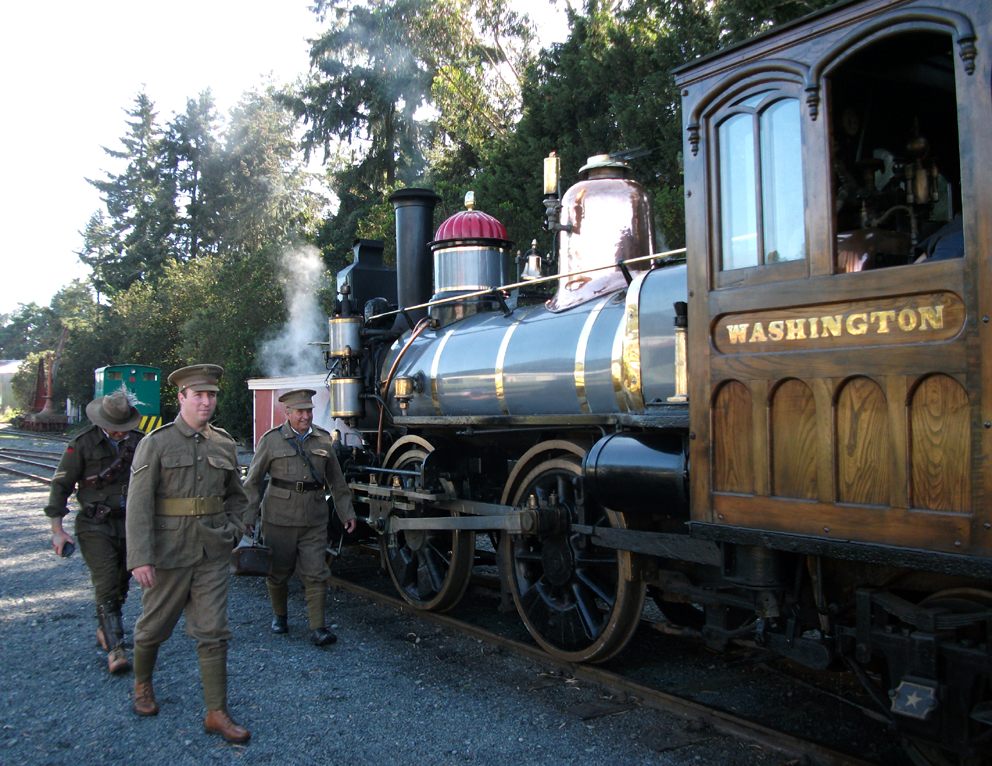

K88 "Washington" with members of the Canterbury
Military Vehicle Club taken at The Plains Railway,
taken 27th March 2016
[Source : From my own collection]

Finally, I highly recommend this very professional HD film of "K88 Washington" running on The Plains Railway, having been taken by a talented young rail enthusiast, Robert Boulton, in 2015. But for the Belpaire style boiler, the incongruous water tank behind the tender (in case of any line side fires due to very dry conditions), and the slightly more modern red carriages (originally Pullman green) dating from 1908 to 1915, the segment of the video between 4.06 and 4.42 could just as easily be "Washington" with Ben Verdon at the regulator heading south on the inaugural express in September 1878. Who would have believed that 138 years later this almost timeless scene could ever have been recreated.


Footnote :

The un-restored remains of another "K" can be found at The Plains Railway, that of "K94" of 1878, having been excavated from Oporo in March 1986 and trucked north to Tinwald. Bob Anderson had hoped to restore this locomotive which "is expected to take between five and seven years depending on availability of spare parts". Upon excavation "The wheels spun freely and the bearing boxes were still packed with grease and a rag wick". But Mr Anderson's death in 1987 precluded any further work on this locomotive. The stripped down remains may today be seen behind the large locomotive shed at "The Plains Railway" where the massive J class No 1260 locomotive (currently undergoing boiler work) normally resides.

The former Fiordland Vintage Machinery Club did complete the restoration of "K92" which also entered service in December 1878. It can normally be viewed at the fledgling Waimea Plains Railway at Mandeville. Update Dec 2016 : "K92" has just been moved to "Southern Steam" at Invercargill for a ten year boiler survey. This is hopefully good news as she has been "out of ticket" for some years now and starting to look rather forlorn. She carries her "pre-dump" boiler so fingers crossed that some re-tubing is all that is required.


Sources :

- Papers Past / Te Puna Mātauranga o Aotearoa
- New Zealand Electronic Text Collective / Te Pūhikotui o Aotearoa
- The New Zealand Railways Magazine, 1934
- "The Southland Times"
- "The Ashburton Guardian"
- "Rails" magazine
- "The Plains Railway" website
- "The New Zealand Women's Weekly", 1983
- "The New Zealand Motor World", 1983.

Tuesday, 3 May 2016

"Washington" and "Josephine" Open the Christchurch to Dunedin Railway, 6th Sept 1878 (Part Two)


Double-Fairlie "Josephine",
Burton Brothers Photo, believed
taken during a trial run in 1872.
[Source : OESA Collection, 1979]

Part Two : Oamaru to Dunedin Section

This is the second part of my blog featuring  the first "through" passenger express train to run on the main south line from Christchurch to Dunedin on the 6th September 1878. Click HERE to read the first part. The events described in this blog are entirely factual.

Arrival of "Josephine" and "Rose" From Dunedin

A special double- headed train comprising of the English built "No E26" Double Fairlie 0-4-4-0T locomotive "Josephine" assisted by her sister engine "No E27 Rose" and hauling four carriages and a new guards van had departed Dunedin at 7 am that same morning in order to convey dignitaries and guests to Oamaru to meet the inaugural Christchurch to Dunedin train. The former, as lead engine, was decorated with evergreens with her front plate bearing the conspicuous motto "Advance New Zealand". Both locomotives would henceforth work this section of line. The Dunedin train arrived in Oamaru punctually at 12 o'clock with the Christchurch train headed by "K88 Washington" arriving half an hour later. With Oamaru holding a "high holiday" upwards of 500 persons had gathered to welcome the arrival of the two trains from north and south.


The centrally mounted cab, firebox and controls on
the Double Fairlie "Josephine", taken 1925
[Source : Alexander Turnbull Library] 

Both "Josephine" and "Rose" had been built by the Vulcan Foundry at Newton-le-Willows in Lancashire England in 1872. Josephine had been the first locomotive used on the new Dunedin and Port Chalmers Railway during the latter part of 1872 while "Rose" had hauled the first official train on the 31st December 1872. With a distinctive double boiler and two funnels with the driver and fireman on opposite sides of the boiler in a centrally mounted cab the Double Fairlie locomotives presented a unique appearance.


The old Oamaru Railway Station
[Source : J. Dangerfield]

Some Canterbury / Otago Rivalry

After "much discussion", which in fact lasted the whole time the guests were away banqueting, and showing some strongly entrenched Canterbury / Otago provincial rivalry, it is finally decided that the English built "Josephine" would be relegated to second engine whilst "Washington", the new American locomotive, would continue the journey as lead engine.This at least saved the consist of (now) fourteen carriages from being broken up into two separate trains. With the luncheon over by 1.40 pm we again make our departure. Our driver from Christchurch, Ben Verdon, remained on the footplate of "Washington" along with a local man to show him the road, fireman Tom Scott, and the afore mentioned New Zealand Railways Locomotive Superintendent, Mr Allison Smith.


The old Oamaru Railway Station. The line at left is to the
north while that to right is to the south thus all trains had
to inconveniently reverse out of the station.
[Source : NZ Railways Publicity]

Steep and Prolongued

At this time the Oamaru Railway Station was situated further south than the present station which necessitated reversing out of the old Harbourside Station before running south again. This gave very little run up to pick up speed before tackling an almost immediate steep and prolonged two mile 1 in 50 gradient up the Waiareka Bank [click for UTube video]. This remained a serious challenge for locomotives and enginemen alike until the end of steam in 1971, double heading being the norm.


The Driver of K88 "Washington",
Mr Benjamin Verdon
[Source : The Cyclopedia of NZ]

"Look here Verdon, this won't do"

The Canterbury enginemen knew that their Otago counterparts considered the English Double-Fairlie locomotives to be the better engines and in an effort to prove them wrong "K88" Driver Ben Verdon decided "to put 'Josephine' through her paces."

So Verdon "kept his engine pretty close going up the Waiareka bank just to see what the Josephine could do, and found that she was making hard work of itMr Smith [New Zealand Railways Locomotive Superintendent who was riding on the footplate] noticed it, and said, 'Look here Verdon, this won't do; you mustn't play up on the Josephine.'" to which Verdon replied, "All right; I only wanted to see what she could do." But the damage to "Josephine" had already been done.

So Different to the Flat and Dreary Plains of Canterbury

While the line as far south as Oamaru had been opened in February 1878, that portion between Oamaru and Dunedin must now pass through "country of so different a formation to the flat and dreary plains of Canterbury... as contrasted with the ever recurring tussocks of the Northern Province." The line south to Moeraki covers 26 miles and cost £156,000 (£6,000 per mile) to construct while the 46 miles from there to the junction with the Port Chalmers line cost £385,000 (£8,369 per mile). "The line is all gradients and curves, and the construction, particularly in the last 14 miles, was of the heaviest nature."

1,000 Acre Paddocks

After Waiareka the line passes through a number of large estates, a notable one being the Totara Estate which is divided up into 1,000 acre paddocks, "unbroken by any fence". We are informed that this is now on the market in small blocks as part of the break up of the once great estates thus giving prospective landowners a chance to own their own block of highly productive land for sheep farming and grain. A little further on at Kakanui "a white stone quarry" is also observed with "a machine specially contrived for the purpose of sawing out blocks... which only have to be lifted into the [railway] trucks and they are ready to be carried away." The land above this limestone formation is particularly rich and is selling for between £30 to £35 an acre.

Leaving Kakanui the line then passes through a short tunnel into the valley of the Otepopo river, "...a very picturesque spot". Then through to Hampden, the line now crosses The New Zealand Land Company's estate, being characterised by heavy cuttings, the first major earthworks observed on the line south. Hampden is a little village "which some think one day will become the centre of a flourishing agricultural district."

"Such As It Is"

The character of the country "is still rolling downs sloping to the seashore backed by ridges of brown-looking hills." The seaside harbour settlement of Moeraki, "such as it is", is noted as having a jetty and just two houses. A little branch railway runs out to the jetty, being constructed for half its length upon trestles in the sea. The writer observes that two months previous, and after a severe gale, a cutter had been thrown against the jetty where it remained jammed even now.


Puketapu [Pukeitapu] Hill, Palmerston, 1898
[Source : The Cyclopedia of New Zealand]

The "Pretty" Town of Palmerston

To avoid the "precipitous Horse Range", the line now diverges to the sea shore where it runs for some miles to Shag Point. We next ascend Pukeoiti Hill at an elevation of 115 feet. Through further heavy cuttings we break into the Shag Valley and Palmerston District which affords us with a splendid view. The conical shaped Mount Pukeitapu overlooking Palmerston is a distinctive feature. Fears had been expressed that the opening of the line to Dunedin would "injure" the "pretty" town of Palmerston but it has the advantage of being situated at the junction of the main road with the road leading to the Dunstan Goldfields. Already, a ten mile branch line to Dunback is being planned.

"We Can't Stay"

We arrive at Palmerston at 3.45 pm, having covered the 36 miles from Oamaru at an average speed of 25 miles per hour. According to the official programme, there was to be another banquet here but with the Mayor of Palmerston on the train the corporation members seemed at a loss to know what to do in order to "receive" the Governor. Thus the latter remained in his carriage and did not alight. But all hopes "of escaping another speech" were dashed when the Governor was informed that the councillors were going from carriage to carriage looking for him, the vice regal carriage not having pulled up alongside them. So there was nothing for it but to be "addressed", the Governor getting out of his carriage and listening to the speech before giving a brief reply adding, "we can't stay". But after the battle of the two engines there is, according to the reminiscences of Driver Ben Verdon, a slight delay before departure while the fitter, who had travelled up with "Josephine", is required to undertake repairs and get her ready for work again.


Waikouaiti Railway Station, 1878
[Photo Credit : Waihemo Museum]

Now Behind Time

Now behind time the Railway Commisioner, Mr Conyers, insists on the train getting underway again, being farewelled at 4 pm by the usual cheers. Traversing the nine miles to Waikouaiti, the undulating countryside is much like between Oamaru and Moeraki. The tidal river lagoon here obviously proved troublesome for the contractors with no less than three bridges required to be built in the space of a few hundred yards.

And Now The Heavy Work Commenced

"We now find our passage barred by heavy looking wooded mountains, rejoicing in the uneuphoneous [pleasant or agreeable sounding] name of Kilmog. Up the sides of it we climbed and now the heavy work commenced. The curves are something dreadful, the engines often disappearing in a cutting long before the tail end of the train had come round a curve."


"The Yankee K laughs at the Josephine on the first
through train from Christchurch to Dunedin".
[Source : "The New Zealand Railways Magazine", 1934] 

Frantic Gesticulations

"At the Maori kaik [settlement], a group of Natives are assembled waving mats, sticks, meres, and anything apparently they had been able to lay [their] hands on. One man in particular caused great amusement, by his frantic gesticulations on the edge of a cutting, where he jumped about, flourishing a greenstone mere, as if anxious to execute a war dance for our special delectation [pleasure and delight]".


Double Fairlie "Josephine", as seen at Beaumont on
the Roxburgh branch line during her later service
 with the NZ Public Works Department, 1914.
[Source : G.W. Emerson]

In A Fearful State

By the time the train had reached Seacliff high above the sea "Josephine" was "in a fearful [mechanical] state. The fitter wasn't able to do her any good; so she was cut off and left behind. We [subsequently] got on very well..." Naturally the Canterbury enginemen were delighted. But for the unknown driver of  "Josephine" to have been beaten by Verdon driving a flashy American locomotive would have been very hard to stomach. Her crew felt that she had been unfairly made to take too much of the load and that this had contributed to her failing. One could also argue that "Washington" completing the journey on her own on the steep climb over the hills to Dunedin with 14 carriages, albeit at a slower speed, proved beyond doubt which was the more reliable locomotive.

It must however be said that the Double Fairlies quickly developed a reputation for being rather unspectacular performers. And with the complication of two driving mechanisms geared to separate driven axle units and the added maintenance of steam and exhaust pipes fitted with swivel and expansion joints plus wheels that "shimmy ecstatically from rail to rail, the flightiness and non-reliability of the [Double Fairlie] type is evident."


A steam train passing passing Waitati Station and Presbyterian
Church at Blueskin Bay after descending from Mihiwaka but 
before the equally difficult and twisting climb up to Seacliff. 
Taken pre 1909.
[From my own collection]

One of the Heaviest Pieces of Railway Work

Our coastal views are cut short by a short tunnel before descending some miles down steep gradients to Blueskin Bay which we reach around 5.33 pm. A point to mention here is that braking on the train was primitive and consisted of a hand brake on the locomotive and another on the guards van. It was the responsibility of the guard to apply his brake as and when the locomotive was braking. There is no mention of a specific "brakesman" on this journey but it became normal practice to have a driver, fireman and brakesman on the footplate before the advent of Westinghouse air brakes after the turn of the last century.

We now travel on the flat until we reach Waitati Station. From here commences one of the heaviest pieces of railway work in New Zealand, having only being completed at the end of 1878 at a cost of £68,000.  

The Sparks Would Fly

Our newspaper correspondent now refers to an "overheated axle box at Blueskin [Waitati] Station" which required a stop of a few minutes. Mr Conyers had apparently observed sparks and suspected an overheated axle box as being on fire and requested the train stop for an inspection. But in his reminiscences, Driver Ben Verdon refers to this as being caused by making speed down one of the steep and twisting gradients on the line to make up lost time and that "In the 'Six-Wheelers' the front carriage used to swing till the wheels touched the frame, and then the sparks would fly."

From the Waitati Station, "a fourth class passenger station with sidings and other adjuncts" we now commence "the Purakanui section" by crossing the Waitati river via a seven span bridge of 93 feet and then the Orokonui Inlet by means of a "substantial timber bridge" comprising of three 30 foot spans.


The Dunedin Railways "Seasider" service
traversing the steep cliffs high above the ocean
[Source : Dunedin Railways]

Don't look Down!

We now ascend a steep gradient to the Blueskin Cliff. "The speed is decreased, and very necessarily so, for not only is the way narrow and actually over-hanging the sea, but there is not an inch of straight rail at any point.... so long was the train that when passing through the heavy cuttings... the engines disappeared before the last three carriages had come out of a smaller cutting behind."

"The dizzy depths of the sea below which washes the foot of the rocks are enough to appal [sic] weak nerves, and I would suggest to all tremulous people who may happen to travel on this line to keep well inside the carriage doors."

"Having rounded the cliff, which is quite a quarter of a mile in extent, the dangers are not yet over, as the track has been hewn for some yards out of an almost perpendicular mountain side. To effect this, men had to be slung down from the top in ropes to hew the rock with pick and chisel; blasting could not be resorted to on account of its unreliable character."


Navvies excavating the rock face with picks
and shovels high above Blueskin Bay, 1876
[Source : NZ Railways Publicity]

Chose to go by Sea Rather than Risk Their Lives

Passengers had already speculated "a great deal" on the journey south how the train would negotiate this sheer solid bluestone cliff, Access around this seemingly impenetrable obstacle was in fact only achieved by cutting a narrow "siding" or ledge cut out of the cliff at a height of about 400 feet above the sea. A fault line through the cliff was crossed by girders under which the sea could be observed from the footplate looking down on the landward side of the engine. But danger also lay above with the risk of rockfalls onto the line or in fact onto any passing train. A strict speed limit of 10 mph had been imposed but not always adhered to. The great English railway writer, Charles Rous-Martin could recall being "...on the footplate when we have rounded the point at 25 or 30 miles an hour." Some prudent travellers in fact chose to go by sea rather than risk their lives traversing this dangerous obstacle. Just prior to 1900 a tunnel would replace this short section of line which was then consigned to history, thankfully with no record of any mishap.


The Dunedin Railways "Seasider" service
emerging from the Cliff Tunnel. The line
had originally skirted around this bluff.
[Source : Dunedin Railways]

Magnificent Views

The line above Purakanui Bay affords us with magnificent views of the bay and across the sea to the headlands of Waikouaiti and Moeraki. A large embankment constructed with 100,000 cubic yards of earth and rubble, being the largest in the Colony, carries the line at an elevation of 80 feet above a precipitous cliff. The approaches to this section are, on either side, through very heavy rock cuttings of 12 chains in extent, the highest portions of which are 60 feet.

A steam train has reached the summit at the wayside
Mihiwaka Station after having just emerged from the
dreaded climb through the tunnel, circa 1920's.
[Source : National Library of New Zealand]

The Deborah Bay Tunnel

We now enter the 66 chain long (1.33 kilometer) Deborah Bay Tunnel, being constructed at a cost of £57,000. At first we descend through the tunnel at an easy gradient of 1 in 995 before descending more steeply at 1 in 60 for the last 50 chains (1 kilometer). The time taken on the descent takes just four and a half minutes while the ascent would have taken seven and a half minutes. A marble plaque above the south end records "Commenced 8th June 1877; finished August 1877". [This tunnel is now commonly referred to as the Mihiwaka Tunnel and remained a feared obstacle by locomotive crews on northbound trains until the end of steam in 1971].


Port Chalmers with the Main South Railway
descending down the gradient to Sawyers Bay
in the foreground, taken in 1880
[Photographer : D.A. De Maus]

Under the Port Chalmers Cemetery

Emerging from the above tunnel the line now twists and turns as we travel through various cuttings and across a 60 foot embankment sloping down to the sea before travelling through the short but curved 4 chain long "McGregors Tunnel". Magnificent views of the Otago Harbour with Mansford Town below [now known as Carey's Bay] soon come into view before we enter the 10 chain long short radius "Mansfordtown Tunnel". After emerging from this tunnel [which now passes under the Port Chalmers Cemetery] we descend on a steep 1 in 50 gradient through a deep cutting across the hillside before the town of Port Chalmers and harbour opens up below us. Apart from tall ships in the harbour we will also, if we are quick, observe close to the line the distinctive and decorative bluestone bell tower of the 1872 Presbyterian Church. We continue cautiously down the gradient for about a mile before we reach Sawyers Bay, almost at sea level, being the junction with the Port Chalmers Line. We are now 6 miles distant from Dunedin.


The Sawyers Bay Railway Station and
Signal Box,,taken circa 1950
[Source : Hocken Collections]

The Final Leg of the Journey

The final leg of the journey follows the formation of the erstwhile 1873 Dunedin and Port Chalmers Railway Company line from Sawyers Bay as it first plunges into the short Sawyers Bay tunnel before meandering around the various small and very picturesque bays of Dunedin's inner harbour.


Dunedin Railway Station in the 1870's
[Hocken Collections]

Failing To See How They Would Reach Dunedin

Having earlier travelled "at [such] a comparatively slow pace" and "on many occasions the train [being] on two curves at once" left many passengers shaking their heads and failing to see how they could possibly reach Dunedin by the time fixed. Even much later in the day, and after Waitati, the probability of being up to an hour late was believed quite possible.


Inaccuracies aside, this is the only illustration of  the
arrival of the train in Dunedin. The Governor is shown
being greeted as he steps from his carriage.
[Source : "Otago Centennial 1848 -1948"]

"Snorted Loudly Up To The Platform"

With an estimated 10,000 to 12,000 people waiting at Dunedin and the train now over an hour late the crowd endured this "severe trial" with "the utmost good humour and order prevailed". A signal from Pelichet Bay indicates that the engine is finally approaching as it now runs along the causeway. Our train now has but a short distance to travel before "Washington" "snorted loudly up to the platform" of the original Dunedin "Metropolitan" Railway Station at 6.37 pm, well past the original scheduled arrival time of 5.30 pm. The original wooden passenger station lay where Queen's Gardens is now situated, facing the road of the same name. The line further south then continued along what is now Crawford Street.


The old Dunedin Railway Station at lower left,
taken from the spire of First Church.
Burton Brothers Photo, 1874
[Source : OESA Collection]

Ten Million Pounds

Waiting on the platform at the Dunedin Railway Station are "... the Volunteers with the guns, which belched forth a salute to the Governor, while the band played "Home, sweet home". The town was already illuminated, and the crowd [dense]. Rockets were whizzing through the air, Roman candles burning in every direction, and glowing above all was the dazzling electric light, which shone from four or five buildings in the principal streets of the town. Most of the large places of business were also illuminated in various ways, the best of them being the portrait of Sir J.[Julius] Vogel at the Prince of Wales' Hotel, in a sea of fire." [This is highly significant as Sir Julius Vogel had been a great promoter of railways during his tenure as New Zealand Premier during the 1870's, raising ten million pounds in London for the purposes of funding roads, railways and infrastructure].


Sister Locomotive Rogers K92 on
the new turntable at Dunedin
(not installed till after Sept 1878)
[Source : Hardwicke Knight Collection]

Such was the crush of people at the station that Driver Verdon could not manage to get the engine through the crowds of people "for about two hours", then, lacking a proper turntable, had to break the engine and tender to get the engine turned for the return trip the following day. Then both Verdon and his fireman Tom Scott were forced to sleep in chairs till 7.30 am the next morning, proper accommodation being impossible to obtain. A pit inspection the next morning showed that "Washington" had suffered no damage and made a successful trip back to Christchurch "without any difficulty".

Quite a Feat

The full journey south has taken us twelve and a half hours and but for the delay at Palmerston would have taken just twelve hours. Despite the claims by the crew of "Josephine" that they were given an unequal challenge, I feel all credit must still be afforded to K88 "Washington".

And to run a small to medium sized locomotive such as K88 "Washington" over this whole distance, including traversing a highly challenging line with tight curvature and steep gradients, for an almost continuous twelve and a half hour period was indeed quite a feat. Mr Allison Smith would have been well pleased with the performance of his "Yankee K" and of his capable locomotive crew.

The success and reliability (and speedy delivery) of the "K" class led the way to not only the ordering of further American built locomotives but also the adoption over the ensuing years of many American locomotive features and equipment into New Zealand locomotive design.    

And What of "Washington" and "Josephine"?

The third Blog in this four part series [click here for link] takes a detailed look at what became of K88 "Washington" and the final blog will feature what became of the double-ended Fairlie "Josephine". The answer is quite surprising if not unbelievable as both survive today, one being in full working order. That both survived, as we shall read, is almost beyond belief.


Sources :

- Papers Past / Te Puna Mātauranga o Aotearoa
- New Zealand Electronic Text Collective / Te Pūhikotui o Aotearoa
- The New Zealand Railways Magazine, 1934
- "The New Zealand Listener", 1983
- New Zealand Historic Places magazine
- "New Zealand Railways to 1900", by C. Rous-Marten (from my own collection)
- "Otago Centennial 1848 - 1948" (from my own collection)

Tuesday, 26 April 2016

"Washington" and "Josephine" Open the Christchurch to Dunedin Railway, 6th Sept 1878 (Part One)


K88 "Washington" with her original "wagon top" 
boiler. Taken at Rolleston in 1878.
[Source : Upper Hutt City Library]

Part One : Christchurch to Oamaru Section

It was on the 6th September 1878 that the first "through" express passenger train ran on the Christchurch to Dunedin section of what now became the Main South Railway. This blog shall relive that momentous twelve hour journey courtesy of on board correspondents who reported the journey at length in the newspapers of the day. The events described in this blog are entirely factual.


The route of our journey south, as
shown on a railway map from 1900
[Source : "New Zealand Railways to 1900"]

Finally Joined on the 7th September 1878

Construction of "The Great South Railway" (originally gauged at 5ft 3in) had commenced on the flat plains south of Christchurch as early as 1865 with Timaru being reached in February 1876 and finally Oamaru in February 1877. Construction of the line north of Dunedin had commenced with the 3ft 6in line to Port Chalmers being opened on the 1st January 1873. Most of the latter would form the future main line north. But between these two centres lay the challenging section north of Dunedin, specifically the hills up to Mihiwaka and down to Blueskin Bay and the equally challenging gradients of the Seacliff section. Thus the two lines would finally be joined at Goodwood on the 7th September 1878, being only 57 km north of Dunedin but 310 km south of Christchurch.


George Phipps, 2nd Marquis of Normanby &
Colonial Governor of New Zealand 1874 - 1879
[Source : Wikipedia Commons]

The Governor of New Zealand

The first "through" express train would be honoured to include the Colonial Governor of New Zealand, His Excellency George Phipps, 2nd Marquis of Normanby, accompanied by his support staff, Lady Normanby, the Captain and officers of 'H.M.S. Nymphe', Parliamentary representatives and their wives, four native members of the House of Representatives [Hoani Nahi, Taiaroa, Takamoana, and Tawiti], Mayors and Councillors from both north and south, members of various Boards and Chambers, plus various other invited guests and groups. All up, around 300 passengers will be conveyed south to Dunedin with more joining in Oamaru.

The consist for the journey south comprised of ten new or newly painted carriages, that carrying the official dignitaries being emblazoned with the Vice-Regal coat of arms, and two "ornamental" style brake-vans. Upon daybreak the consist presented a "dazzling appearance".


K88 "Washington",
from a period engraving
[Source : Rogers Catalogue, 1886]

The "Star of the Show"

But undoubtedly the 'star of the show' for the journey to Dunedin is the "powerful" American built 2-4-2 locomotive K88 "Washington" having been built by the Rogers Locomotive Works of New Jersey in 1877, and entering service in March 1878. In stark contrast to the English built locomotives hitherto imported into New Zealand,  "...The [American] locomotives created quite a stir with their bar frames, 'Gothic' style wooden cabs, locomotive bell, ornate embellishments and, rakish appearances which were at odds with the traditional English locomotive appearance in New Zealand at the time and were described by one commentator [Charles Rous-Marten] as "a watch with all its works outside". But they quickly developed a reputation as fast and free running engines, "[They] are considered infinitely superior to the English locomotives... they are wonderfully equable in their rates of speed, and may be depended upon almost to a second".


Christchurch Railway Station, pre 1910
Opened Dec 1877, Demolished pre 1960
[Source : National Library of New Zealand]

So Let Us Begin Our Journey :

Being at an early hour and still dark on a frosty Christchurch morning the station and platform are dimly lit, access to the latter being by card or invitation only. But with a crowd of passengers and their luggage to be got on board we are presented with a busy scene. A marked feature is the number of ladies present who will be undertaking the journey with us. The passengers busy themselves with reading the morning papers and an amusing little brochure describing what may be seen on the line south to Timaru "and the dangers that used to attend the old style of travelling".


An unknown driver (but reputed to be Ben Verdon)
on the footplate of K88 "Washington" in 1878
[Source : Upper Hutt City Library]

On the footplate are driver Benjamin [Ben] Verdon and fireman Tom Scott along with (for at least parts of the journey) the New Zealand Railways Locomotive Superintendent, Mr Allison Smith who was most interested to see how the engine would perform, having been personally responsible for ordering these flashy new American K Class engines. 

Finally, at 6.05 am and just before daybreak, the signal is given and with a sharp tug from K88 "Washington" our train is set in motion. The few spectators present (as none had been allowed on the platform) attempt to raise a cheer "but the effect was feeble, and rather dispiriting than otherwise".  


Christchurch Railway Station and platform in the 1880's
[Source : "The Weekly Press"]

 Despite being seven minutes late on departure two or three unlucky passengers are still seen frantically running for the train but on we glide and no more grace will be given. The celebratory mood of those aboard is enlivened by the Dunedin Glee Club striking up in one carriage with the Dunedin Railway Band in another. By now well beyond the city we are rewarded by views of a "glorious sunrise" on as fine a morning "as anyone could wish" with only a slight haze hanging over the plain. Our long journey will be broken by many watering and coaling stops plus the obligatory and rather tiresome "ceremonial" stops at various towns on the journey south.


The Rakaia Combined Road and Rail Bridge, built 1873
[Source : Christchurch City Libraries]

"His Best Foot Foremost"

A steady pace of 23 miles per hour is maintained across the flat plains to the Rakaia River and the impressively long wooden trestle bridge. While this engineering feat brings forth "admiration" those on board, "...seemed to be a little disappointed at finding nothing but a few paltry streams in the [river] bed." Departing Rakaia at 7.30 am, and to make up time spent watering the engine, it is determined to get to Ashburton by 8 am. Thus "Washington" "had to put his best foot foremost" and we now reach the heady speed of 30 miles per hour.

"Gaily Festooned"

Arriving at 8.10 pm, a large crowd awaits us at Ashburton but only the Mayor and councillors have been permitted onto the platform. With the Governor on board the inevitable addresses need to be read first. Dignitaries are then duly acknowledged before the Railway Band strikes up again and the official guests depart in a waggonette to the town hall. Here tables have been laid with breakfast for about 350 officials and guests. A formal arch had been constructed outside the hall "gaily festooned with evergreens, and surmounted with flags" and bearing the words "Success to the Christchurch and Dunedin Railway". Quite surprisingly, and despite the formalities involved, the train and official guests still manage to depart at 8.30 am sharp for the long run south across the flat South Canterbury plains to Timaru.

"By this time a clear view could be obtained of the country, and it was with admiration that those who had not seen them before scanned the bold line of the Southern Alps. Very beautiful they looked in the morning sun, with their snowy crests sharply defined against the blue sky, and relieved by the chocolate hue of the lower slopes."


The turning of the first sod of the Temuka to Timaru
Railway Section of the Main South Railway by the
Mayoress of Timaru, Mrs Cain, 4 Oct 1871
[Source : NZ History Net]   

The Dizzying Speed of 40 Miles Per Hour

Residents and school children at Orari and Winchester cheer us as the train passes by before stopping for another water stop at Temuka,

Timaru is reached at 10.05 am, in fact a little before the scheduled arrival time, the journey having been completed at an average speed of 25 miles per hour although for a considerable distance where the line was flat with no crossings the dizzying speed of 40 miles per hour had been achieved. The rails laid south of Ashburton are recorded as being new and "half the weight of the 70lb rails north of Ashburton" which caused "Washington" to "rattle furiously", even at 25 mph.

With "half the town" of Timaru waiting to greet the guests. a salute is fired by the artillery before the guard receives His Excellency. The Town Clerk then reads the formal address of welcome. A "very pretty" triumphal arch has been constructed close to the station bearing the words "Welcome", "Success to Agriculture, Industry and Commerce", and "Progress, Canterbury and Otago United".


Timaru Railway Station and Yard
taken looking south
[From a period postcard]

The Train Departed Without Them

While the Governor and some of his party repair for a ten minute visit to the Grosvenor Hotel for champagne "to wash down the dust which had become rather thick in the carriages", others partake of a tour of the town on the many carriages provided for this purpose. But upon returning to the station "some who indulged in this amusement", are taken aback to find that our train has departed without them! These included the Mayors of Ashburton, Hokitika and Greymouth. The Commissioner of Railways [ie, the General Manager] for the South Island, Mr W. Conyers, having determined to keep to the set timetable, had allowed only a 30 minute stop instead of the 45 minutes expected; "The feelings of the disappointed ones may be better imagined than described".

Departure from Timaru took place at twenty minutes to eleven, accompanied by another artillery salute and an even larger crowd of spectators "cheering with hearty goodwill".  


Rogers K94 and English built J82
about to depart Timaru Station
[Source : "Grand Old Days of Steam"]

We Almost Touch the Sea Beach

"The way lay for many miles through the lovely downs of South Canterbury... [before encountering] ...a succession of cuttings and bridges until the plains beyond the Waimate Junction appear. The sea is close on the left; in fact, in places we almost touch the sea beach, and on the right, the nestling farms, the broken contour of the downs, and the rugged peaks of the Alps  bathed in a flood of sunshine..."


The long Rakaia combined road and rail bridge
taken pre 1956. An overhead water tank can be
observed to be used in case of fire.
[Source : "Rails In The Hinterland"] 

Nearly Double the Normal Speed

Now running "at nearly double the normal speed", we travel past the junction with the Waimate branch railway then over the level plain beyond. We next cross the "splendid cylinder bridge" over the Waitaki River which brings forth a rush to the carriage platforms as we cross at a "moderate" speed. [The bridge supports were constructed of cylindrical iron and may still be seen in the river bed]. Having only departed Timaru two hours previous we now leave behind the Province of Canterbury and enter the Province of Otago. Now "putting on more steam" we have but 15 miles further to travel before reaching Oamaru just a few minutes after 12.30 pm.


Oamaru Breakwater in the late 1880's and showing
the Railway Line onto the Normanby Wharf

[Source : NZ History Net]

Another Address is Inflicted on the Governor

Guests leave the train only for a few moments at Oamaru "while another address is inflicted on the Governor", a salute fired, three cheers given, then our train steams onto the breakwater. Here another address is given, this time by the Oamaru Harbour Board, a truck or two of stone is run down the line to the breakwater, and the opening of this short industrial line is proclaimed under the name of the "Normanby Wharf". A luncheon then follows in the goods shed with the usual speeches and toasts being given.


To read Part Two of this blog featuring the decidedly eventful Oamaru to Dunedin section please click Here.


Sources :

- Papers Past / Te Puna Mātauranga o Aotearoa
- New Zealand Electronic Text Collective / Te Pūhikotui o Aotearoa
- The New Zealand Railways Magazine, 1934
- "The New Zealand Listener", 1983
- New Zealand Historic Places magazine
- "New Zealand Railways to 1900", by C. Rous-Marten (from my own collection)
- "Otago Centennial 1848 - 1948" (from my own collection)