Showing posts with label Royal Visit to New Zealand 1901. Show all posts

Monday, 31 March 2014

"Welcome to Our Royal Visitors" - 1901 Style


The coloured fronticepiece of the official record
of the visit of  the Duke and Duchess of Cornwall
and York to New Zealand in June 1901. Many of
the images below are taken from this publication
[From my own collection]

The Dominion of New Zealand will be hosting Prince William, Duke of Cambridge together with his wife, Catherine Duchess of Cambridge, and their young son Prince George to New Zealand from the 7th April to the 16th April 2014. This provides an opportunity to look back at an interesting aspect of past Royal Tours - the Ceremonial Arch. In this Blog we specifically look at the visit to New Zealand of Prince William's Great Great Grandfather, HRH Prince George, Duke of Cornwall & York and his wife, HRH Princess Mary, Duchess of Cornwall & York (later King George V and Queen Mary) in June 1901. 

Perhaps understandably due to their cost and very temporary nature, ceremonial and full floral arches are now a thing of the past. While many look very solid, they were generally nothing more than wood, painted canvas, and/or moulded plaster over a wire frame in the manner of stage scenery. That they did not find other uses elsewhere would also prove this point. 

Auckland Arches
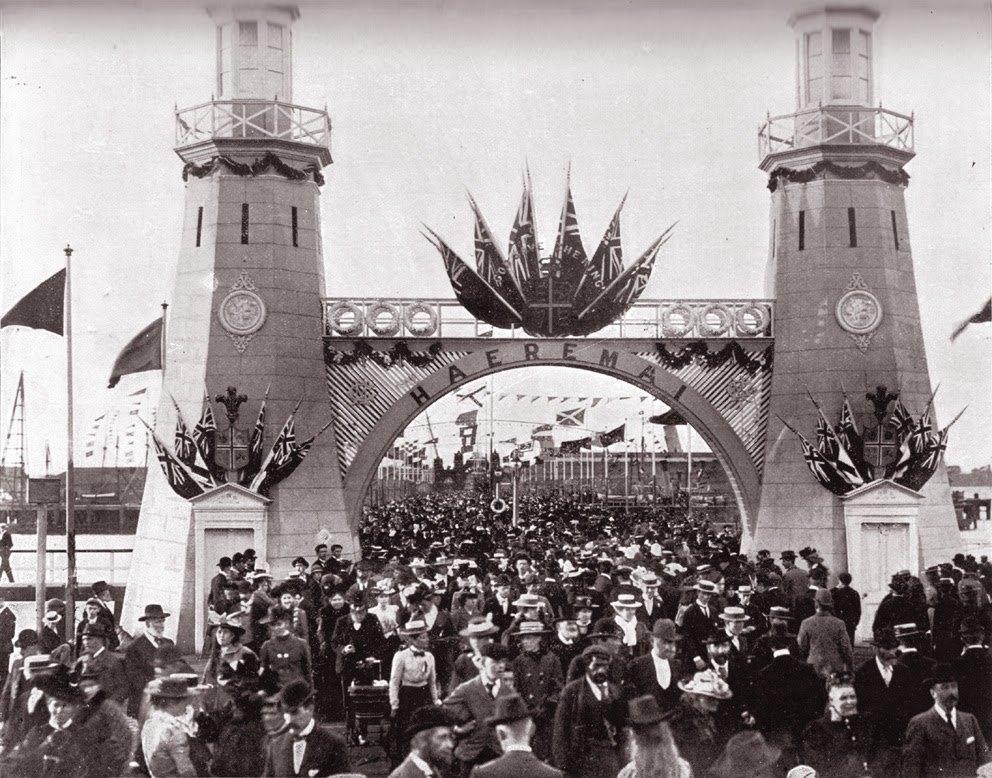
The Auckland Harbour Board Arch on the
Queen Street Wharf comprised of two light
houses connected by a Roman arch.
[Source : "Royalty in New Zealand", 1901]

The construction of ceremonial arches had in fact a long history going back to Medieval England but had even earlier European origins in both Renaissance Italy and early France. By passing through an Arch, a guest would be acknowledged as an honoured and respected friend or ally, perhaps in the manner of an honoured visitor now being given the "keys" to a city. 


The classically designed New Zealand Government Reception Arch
complete with Ionic columns. The wording on the arch reads in
English and Māori : "Welcome - Aroha Tonu, Ake Ake Ake",
meaning literally 'with continuing affection always', with
"Cornwall" and "York" above the side arches.
Photo taken by Mr R.A. Cook.
[From my own collection]

Temporary ceremonial Arches are in fact known to have been hastily constructed in ancient Rome to provide a symbolic "Triumphal Arch" through which a victorious army and Generals could march through, often later being replaced with permanent structures to honour their victory.           


The Auckland Harbour Board Floral Arch at the foot of the
Queen Street Wharf comprising of nikau, grass-tree and
fern, cockades of red and white, and surmounted by
the Royal Arms with  flags flying above, and on either
side the New Zealand ensign.
[Source : "Royalty in New Zealand", 1901]

But it appears evident that by the Victorian era it would not be the done thing for a Government or local body or organisation not to be represented in this way and i'm sure there was often an element of good-natured one-upmanship involved, in other words, not to be seen to be outdone by others. And of course, nobody but nobody would want the Royal visitors to think that New Zealand's welcome was inferior to that of any other country. But the expense appears to have been entirely secondary and in fact the general New Zealand public, who for most had not previously experienced any royal pomp and ceremony first-hand, appear to have revelled in and wholeheartedly embraced this overt display of affection for the Royal couple. That these decorative Arches gave all a demonstrative way to show their loyalty to the Crown and the warmth of their welcome is, I believe, well represented in these images. The only city in these images not represented by a visit by the Duke and Duchess of Cambridge in April 2014 is Rotorua.        

Rotorua Arches

The Māori  Floral Arch, Rotorua.
"The most handsome of all the arches... for the Royal tour"
'Muir and Moodie Photo'
[Source : "Royalty in New Zealand", 1901]


Wellington Arches

The Citizens' Arch, Wellington
[Source : National Library of New Zealand]

The Citizens' Arch on Customhouse Quay, Wellington with Hunter Street on the right. The words on the arch read : "Welcome from Pakeha and Maori". Flags, together with the Wellington Coat of Arms, decorate the top of the arch. Taken by James McAllister, June 1901.


The Māori Arch, Wellington
[Source : National Library of New Zealand]

A group waiting to welcome the Royal visitors at the Māori Arch in Charlotte Street, Wellington, taken 18th June 1901.

"The shape was the front of a runanga house above, supported by floral towers. The gable boards of this were no painted counterfeits. They were priceless Maori carvings, old beyond the category of known dates, supposed to reach back to Moriori times. Grass trees in front and rear on each side of the street suggested forest surroundings, and the inscriptions were "Haere Mai" [meaning "Welcome, enter".] and "Naumai" [meaning "Welcome"]." 

The precious carvings were watched day and night, also being insured against fire. A fire hydrant and hose were kept close-by in case of any emergency. 


The Westport Arch, Wellington
[Source : National Library of New Zealand]

The town of Westport's Arch on Lambton Quay, Wellington. 

"A triple arcading, it was singularly massive, with handsome entablature and cornice, like some old Roman arch of triumph, with commemorative tablets; but instead of bronze, cunningly moulded into historic grouping, coal filled the openings; massive blocks of coal - the same that saved the "Calliope" from the Apia hurricane - and gold medallions on each front told of the western resources..." 

The words on the arch read : "Westport's Greeting" and "The coal that saved the Calliope". Taken by James McAllister, June 1901.


The Cereal Arch, representing
Marlborough and Wellington Suburbs
[Source : "Royalty in New Zealand", 1901]

The cereal arch was formed by "piling up sheaves of grain... and adorning them with flowers..."  


The Cuba Street Arch, Wellington
[Source : National Library of New Zealand]

A wooden arch in carved Māori style erected at the corner of Cuba Street and Dixon Street, Wellington. The Māori words "Kia Ora Koutou" are a formal greeting to three or more people. 


The Government Arch, Wellington
[Source : National Library of New Zealand]

The carriage conveying the Duke and Duchess of Cornwall and York passing under the Government Arch on Lambton Quay, Wellington, during their procession through Wellington. The arch was modelled on the design of Balmoral Castle and bore on one side the inscription "God bless the Duke and Duchess" and on the other the Māori equivalent, "Ma Te atua korua e atawhai". Taken 18th June 1901.


The National Dairy Association's Arch, Wellington
[Source : National Library of New Zealand]

The National Dairy Association's arch on Lambton Quay, Wellington. Taken by James McAllister.


The Wellington Woolen Manufacturing
Company Arch, Wellington
[Source : National Library of New Zealand]

The Wellington Woollen Manufacturing Company Ltd Arch on Jervois Quay, Wellington. It ingeniously reads "See the Warmth of Our Welcome" and included a "tricolour display of bales". Taken June 1901. 


The Chinese Citizens' Arch, Wellington
[Source : National Library of New Zealand]

The Chinese Citizens' Arch on Manners Street, Wellington. Taken by James McAllister.


Christchurch Arches


The Agricultural Arch, Christchurch
[Source : "Royalty in New Zealand", 1901]

"Rural Canterbury lived here for the nonce in foliage, beeves and muttons and dairy cattle stalled on either side, the fruits of the soil arranged above, guarded by stock-riders : an unusual combination, signifying perhaps typically above-ground the burial below of the hatchet, once so deadly between the shepherd kings and the advancing tillers of the soil. The unity above the tomb of that obsolete weapon produced fruit in words of warmth and loyal welcome."


The Frozen Meat Arch, Christchurch
[Source : "Royalty in New Zealand", 1901]

"...with its graceful span of ice counterfeited - as a broken piece of some wandering iceberg of the sea - resting on blocks of ice, real, enclosing carcasses dressed for the butcher, also chrysanthemums of delicate hues and handsome form, and bearing words of welcome, well displayed..."


The Fire Brigade Arch, in
Worcester Street, Christchurch
[Source : "Royalty in New Zealand", 1901]

"A graceful concept this arch, just as if a company of firemen, surprised on the march, by the sudden appearance of the Royal party, had hurriedly put together their long ladders, tossed a few flags over them, thrown in a little greenery hastily plucked, and hoisted up a few words of welcome, had taken their places in helmet and tunic, standing at "attention", while the pageant passed by with the clamour of many voices."


The Government Floral Arches over Victoria Bridge
 [Source : "Royalty in New Zealand", 1901]

"The procession started again in the midst of the cheering, the roll of acclamation settled itself once more alongside the Duke and Duchess as they moved with their powerful escort had converted the Victoria Bridge down Victoria Street, under the Government Arch. This had converted Victoria Bridge into a tunnel of foliage and flower, and it was beautifully reflected in the smooth water of the Avon below..".

Dunedin Arches


The Chinese Arch, Dunedin
[Source : "Royalty in New Zealand", 1901]

"In Princes Street the Chinese Arch rose some 46 ft. over the roadway, two square towers in trellis work flanking, with pointed tops like extinguishers, ornamented with carved boards rising up high on either side; square windows beneath them, just where the latticing connecting the towers and making the arch crosses the street. The whole was a mass of red and yellow, effective, but a little hard, as the primary colours always are in Chinese hands; relieved somewhat by a drapery of red, white, and blue on the lower side of the arch, and thick decoration of greenery at the butts of the towers. "Welcome," the motto on one side, and "Welcome from the Chinese Citizens," the greeting on the other." 


The 'Maypole Arch', in The Exchange, Dunedin
[Source : "Royalty in New Zealand", 1901]


The Government Arch, Dunedin
[Source : "Royalty in New Zealand", 1901]

"...Inside the Octagon [facing George Street]...., was the Government Arch, large central with two smaller flankers of similar Gothic outline, like the medieval castellated entrance to some great city; two turreted towers dividing the three arches, themselves connected by the battlemented top of the city wall, pierced with Gothic ellipse, carrying the shields of York and Cornwall, and rising in the centre two battlement steps above sky-line to display the Royal crown above the Royal Arms. The tops of the flanking arches rising to centre peaks carried each a flagstaff and standard. The turrets above the towers had each a system of poles and standards, four corners, and a central taller one than the rest; and all the standards were joined into a single scheme by a string of signal-flags, which spelt "Welcome." Like the Government Arch in Wellington, it was a close imitation of the entrance to Balmoral Castle. The letters "E.R." flanks the Royal Arms, and the flankers of the ducal shield are the ducal letters "C.Y." The effect is as of the grey granite of Aberdeen; the ducal shields are red and white, and the crown has the national colours. "Welcome to the Duke and Duchess" faces from one side in large warm colours, and the other looks down the brilliant george Street vista in Maori fashion, "Aroha Tonu, Ake, Ake, Ake," which being rendered into English means "Love unceasing, for ever, and ever, and ever."..."        


The Marine Arch, Dunedin
[Source : "Royalty in New Zealand", 1901]

"...Two turreted towers, connected by an entablature, the broad frieze of which carried a large "Welcome;" the arcading hung with a row of life-buoys inscribed with the names of the Union [Steam Ship Company] fleet. The corners of the towers were softened with greenery, their faces carried the Royal and Ducal monograms with steering-wheels, anchors, propellors, and models of steamboats; above the entablature, lying across the street, was a model of the "Monowai", gay with a full dressing of flags; and on the frieze a great warm Celtic welcome, "Cead Mille Failthe." Various house-flags flew from the turrets; two tall flagpoles carried the Royal Standard and the Union Company's familiar house-flag. The arch, covered with canvas, looked like stone, and ta night was charmingly lighted."
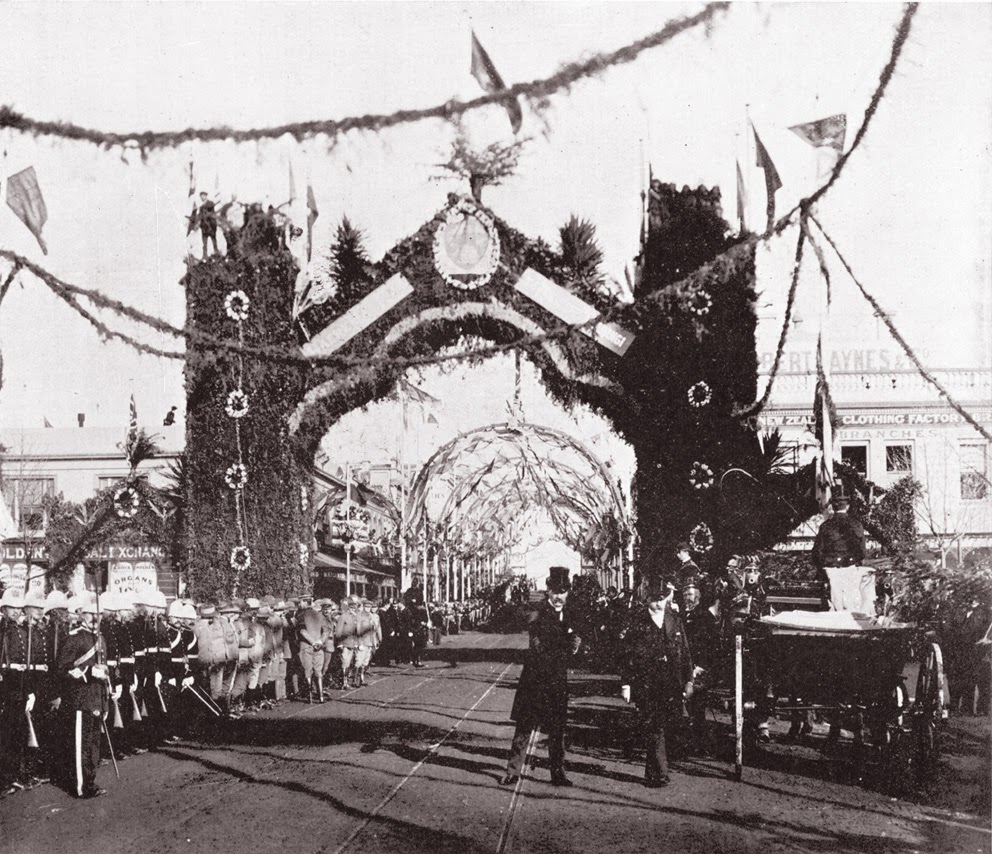

The Citizens' [Municipal] Arch, The Octagon, Dunedin
[Source : "Royalty in New Zealand", 1901]

"At the Princess Street entrance to the Octagon towered the Municipal Arch - a construction in foilage, two great square towers connected by a leafy arcading with entablature peaks above to the height of 40 ft. above the road-way, and fashioned into triple eiilptic Gothic outline below, conncted to two small arches, with peaked tops, at each side. It carried the city coat of arms on the centre peak of the entablature; pillared wreaths, each a floral setting to the rose of York; monograms, floral emblems everywhere. Cabbage-palms filled the square top of each big tower, a big flag floated from each corner of these, the Royal Standard flew from a tall pole rising from the centre peak, and the two lesser peaks over the smaller arches carried each its pole and standard. The entablatures carried Maori words of welcome, "Haere Mai te Manuhiri Tuarangi," and "He Mata Kanohi He Toto Kawera" - which signify respectively, "Welcome illustrious strangers," and "At sight of you our hearts burn within us." The various outlines in different shades of green, and heads of palm and punga at diverse coigns of vantage, greatly heightened the effect of this fine arch. A small band of Maoris were posted on the top to give voice welcomes at the proper time."  


Bibliography / Rārangi Pukapuka :
  • Photographs taken by Mr R.A. Cook (from my own collection)
  • "Royalty in New Zealand" by R.A. Loughnan, 1902 (from my own collection)
  • National Library of New Zealand / Te Puna Mātauranga o Aotearoa

Monday, 10 June 2013

Remembering The 1901 Royal Visit to Auckland, New Zealand


"Welcome" : Flags and the Royal Coat of Arms atop
the Landing Arch on the Queen Street Wharf, Auckland.
[Photographer RA Cook]

This is a companion piece to my previous blog relating to the visit of [the then] HRH Prince George, Duke of Cornwall & York and HRH Princess Mary, Duchess of Cornwall & York (later King George V and Queen Mary) to New Zealand in June 1901. This blog specifically features the visit of the Royal couple to Auckland, using a number of unique photographs in my collection.


The Duke & Duchess of Cornwall and York, 1901
[Source : The Auckland Weekly News]

Those photographs attributed to Mr RA Cook are from my own collection. To the best of my knowledge these have never been seen before and are unpublished. We shall see more of Mr Cooks photographic work in future blogs. I have been unable to ascertain anything more about Mr Cook other than that he appears to have been an employee of "Smith & Caughey Ltd" in Queen Street Auckland, a member of the West End Rowing Club, and possibly residing in Ponsonby. There appears to be no record of his burial in Auckland. I would be interested in any further information on Mr Cook.


The Royal Yacht "Ophir" pictured in the Waitemata Harbour,
having carried the Duke and Duchess to New Zealand.
[Source : The Auckland Weekly News]

The Royal Yacht 'HMS Ophir" (actually the Orient line passenger steamer 'S.S. Ophir'), conveyed the Duke and Duchess of Cornwall and York on their tour of the British Empire, visiting Gibralter, Malta, Ceylon, the Straits Settlements, New Zealand, Australia, South Africa, and Canada.


The Auckland Wharf at the foot of Queen Street
decorated for the Royal Reception
[Photographer RA Cook]

Above we see pedestrians promenading along the Auckland Wharf at the very foot of Queen Street which has been decorated with various flags to welcome the Royal guests.  


The Auckland Harbour Board Arch
[Photographer RA Cook]

During the Royal Reception the Duke and Duchess would "progress" through a series of these celebratory arches. This image, taken looking south from the base of Queen Street Wharf, shows pedestrians walking through the nautically themed Auckland Harbour Board Royal Reception Arch. The words on the arch read (in Māori) "Haeremai", meaning "Welcome".  To the right can be seen Mrs H. Spargo's "Gladstone Coffee Palace" with the "Waverley Hotel" visible directly through the arch.


The Royal Reception, Lower Queen Street
[Source : New Zealand Electronic Text Collection]

A view of the large crowds gathered in front of the dais and Government platform at right, taken in Lower Queen Street Auckland during the Royal Reception, 11th June 1901


Another view of the Royal Reception, Lower Queen Street
[Source : Ed Kruger]

Two views of the military guard of honour and large crowd gathered in Lower Queen Street during the Royal Reception. The large building to centre left is the Waverley Hotel.

The Duke and Duchess were welcomed onto the dais by the Mayor of Auckland, Dr Logan Campbell; the Governor of New Zealand, Lord Ranfurly, the Prime Minister, Richard "King Dick" Seddon; and Pa Maretu Ariki, a Sovereign Chief of the Cook Islands. Unfortunately the rain came down during the reception and umbrellas promptly appeared amongst the crowd.      


Auckland Troops at the Royal Reception
[Photographer RA Cook]


The Friendly Society [a Masonic order] marching
along Queen Street during the Royal Reception
[Photographer RA Cook]


The Municipal Arch, Wellesley Street East
[Photographer RA Cook]

The Auckland City Municipal Arch on Wellesley Street East. The City Coat of Arms can be seen at the top of the arch. At left can be seen part of the Auckland Free Library building (now the Auckland Art Gallery). 


The New Zealand Government Reception Arch
[Photographer RA Cook]

The classically New Zealand Government Reception Arch, complete with Ionic columns. The wording on the arch reads in English and Māori : "Welcome - Aroha Tonu, Ake Ake Ake", meaning literally 'with continuing affection always', with "Cornwall" and "York" above the side arches.


Queen Street Auckland decorated for the Royal Reception
[Photographer RA Cook]

Queen Street Auckland festooned with flags, a profusion of greenery, and what appear to be floral ropes, for the Royal Reception. The large building to left of centre and surmounted with the small round tower is the Victoria Arcade Building, being on the corner of Queen Street and Fort Street. This building included 'George Fowlde Ltd', Outfitters, on the ground floor.


Smith & Caughey Ltd Department Store in Queen Street
[Photographer RA Cook]

Next to Smith & Caughey's at centre right is 'WC Dennes' selling pianos, organs, knitting machines, mangles & perambulators, and on the right is Rendell's Ladies' Warehouse.


The Duke and Duchess passing along a rather wet Queen Street
in an open horse-drawn carriage during the Royal Reception
[Photographer RA Cook]


A military Guard of Honour lines the route as the Royal part pass by. While the Duchess is using an umbrella (along with many in the crowd), the Duke is showing that stoical British spirit and braving the winter elements!

The Duchess is reported to have been "...simply dressed in a black cloth gown with a black fur about her throat, and a small black tulle toque." The Duke wore a Naval uniform, "The Duke's handsome Admiral's uniform was hidden under a great cloak. He smiled and doffed his cocked hat in response to the cheering".     


New Zealand Militia firing a 'feu de joie' in Auckland during the Royal Tour
[Source : National Library of New Zealand]

A 'Feu de joie' is a progressive firing of guns, literally the 'Mexican wave' version of firing off a volley of rifle shots into the air. I believe this may have taken place at "Potter's Paddock" in Remuera during a review and march-past of 4,000 troops in front of 20,000 people, being attended by the Duke and Duchess. Rain is reported to have fallen at times with the ground being "wet and muddy".

Not Forgotten

South African War veterans also attended the review, "some of them lame, and others apparently not quite robust, but the crowd had not forgotten the service they had rendered to the Empire; and the Empire had not forgotten it either, for later on they received their medals at the hands of the Duke."

Somewhat Upside-down

But an embarrassing faux-pas took place prior to the review. The grand stand had been decorated with flags "stretched from gable to gable.. [but] ..The principal flags had apparently been hoisted by some amateur, for the lions of the Royal Standard above the Ducal pavilion were on their backs, and even the Union Jack at the saluting base was upside down. There was something decidedly funny about this, but it must be remembered that we are at the antipodes, and naturally things are somewhat upside down. The Royal Standard was turned the other way around after the Duchess had taken her seat, but the poor, unoffending Union Jack fluttered to the end as it had been originally hoisted."


Bibliography :

- Papers Past
- Those images attributed to Mr RA Cook may be freely copied for personal, academic and non-commercial use provided a link is given back to this page. 

Friday, 9 November 2012

Remembering The 1901 Royal Visit to Dunedin, New Zealand


HRH, Prince George, The Prince of Wales, as
portrayed at the time of the Coronation of his
Father, King Edward VII, 1902
[from my own collection]


The Royal Visit of HRH Prince Charles, the Duke of Cornwall & HRH Camilla, the Duchess of Cornwall to New Zealand put me in mind of the visit of [the then] HRH Prince George, Duke of Cornwall & York and HRH Princess Mary, Duchess of Cornwall & York to my home-town of Dunedin in June 1901.


HRH Princess Mary, The Princess of Wales,
as portrayed at the time of the coronation of
King Edward VII, 1902
[From my own collection]

Created Prince & Princess of Wales in November 1901, both would be crowned King and Queen of Great Britain and her Dominions in 1910. Sadly, this would be their one and only visit to New Zealand.


A mounted miniature on a decorative velour base of
HRH Princess Mary, The Duchess of Cornwall & York.
Taken by Russell & Sons, Photographers, London, c.1893.
[From my own collection]

Arriving in New Zealand on the 11th June 1901 aboard the specially converted Orient Liner 'H.M.S. Ophir', and accompanied by a Naval escort of no less than six British warships, the visit of the Royal couple was primarily to personally thank the country for supporting Britain in her conflict with the Boers in South Africa. The visit had in fact been approved by Queen Victoria not long before her death which occurred on the 22nd January 1901.


A colourful assemblage of flags on a Locomotive
used for the Royal Train, June 1901.
Photo by Albert Percy Godber.
[Source : National Library of New Zealand]

Their visit took in their arrival port of Auckland, thence by railway to the central North Island thermal wonderland of Rotorua, back by railway to Auckland and then a further voyage by the "Ophir" to Wellington.

The Official Government Programme for the
Visit of Their Royal Highnesses The Duke and
Duchess of Cornwall  & York to New Zealand,
June 1901
[Source : National Library of New Zealand]

Thence by the 'HMS Ophir' across Cook Strait to Lyttleton for Christchurch in the South Island and then further south by railway to Dunedin, before returning again by railway to Lyttleton where they departed on the 'HMS Ophir' on the 27th June 1901.


The Lounge Car used for the Royal Train, 1901.
Note the 'homely' fireplace and over-mantel mirror!
The whole car had been specially built for the tour.
[Source : National Library of New Zealand]

Their visit to New Zealand met with rapturous welcomes and a heartfelt outpouring of loyalty to Britain and the Empire. Large crowds flocked to every vantage point in cities and along Railway lines to catch even a fleeting glimpse of the Royal couple.


A modern view of the Fernhill Club Dunedin, the Dunedin Residence
of Their Royal Highnesses the Duke & Duchess of Cornwall and York,
Dunedin June 1901.

No less that 900 men guarded the line between Christchurch and Dunedin. Upon the arrival of the Royal Party at Dunedin Railway Station, on time, at 6pm on the evening of the 25th June 1901 loud cheers broke out and bands played the National Anthem.


The Royal Drawing Room at the Fernhill Club, Dunedin, 1901
[Source : Matapihi]

The Duke then inspected the Dunedin Naval Cadets who formed the guard of honour. Thereafter the Royal Party were driven past cheering crowds to the Fernhill Club, the Otago Hussars and Mounted Rifles contingents forming the escort and guard of honour whilst bands played along the route. The Octagon through which the party passed, and the four ceremonial arches spanning the route, were ablaze with electric light. These comprised of a Government, a City, a Suburban, and a novel Chinese arch. At night the Octagon was a “scene of great beauty” with illuminated decorations, and the evening was rounded off with a great fireworks display.


HRH Princess Mary's Stateroom at the Fernhill Club, Dunedin 1901
[Source : Matapihi]

That evening His Excellency Lord Ranfurly, the Governor of New Zealand, and the Countess of Ranfurly, hosted a State Dinner for the Royal Party and invited guests, including the Prime Minister, the Honourable Richard Seddon, at the Fernhill Club.  While resident at Fernhill the Royal Standard flew from the flag pole.


HRH Prince George's Stateroom at the Fernhill Club, Dunedin 1901
[Source : Matapihi]

During the evening, the Dunedin Liedertafel Group serenaded the Duke & Duchess, whereupon the Duke appeared at the window and courteously asked them if they would sing again.


A Colourful Invitation to the Presentation of the Address of Welcome
to Their Royal Highnesses the Duke & Duchess of Cornwall & York
at Dunedin, 25th June 1901.
[Source : National Library of New Zealand] 

At 11.30am the Royal party left the Fernhill Club for the gaily decorated Octagon in the centre of the City where the presentation of addresses was to take place.


HRH The Duke of Cornwall & York replying to the Citizen's Address of
Welcome at the Royal Reception in the Octagon, Dunedin, 26 June 1901.
[Source : The Auckland Weekly News]

The Reception for the Royal Couple in the Octagon,
Dunedin, 26th June 1901
[Source : The Auckland Weekly News]

Thereafter the Duke of Cornwall & York presented war medals to returned South African Troopers while the Duchess presented the South African war medal to Nurse Ross.


HRH The Duke of Cornwall & York on the dais presenting Medals to
returned South African War servicemen, Dunedin 26th June 1901
[Source : The Auckland Weekly News]


A single grainy frame from an extremely rare and historic film showing
the Duke of Cornwall & York presenting Medals to South African War
Servicemen in the Octagon, Dunedin, 26th June 1901.
Click HERE to view the full 1 minute 39 second film.


HRH The Duke of Cornwall & York Inspecting the Military Veterans
at the Royal Reception in the Octagon, Dunedin, 26 June 1901
[Source : The Auckland Weekly News]

A Royal procession then commenced through the City at 12.15pm, the party returning to the Fernhill Club half an hour later.


The NZ Government Royal Reception Arch,
The Octagon, Dunedin, June 1901
[Source : The Auckland Weekly News]

At 2.30pm the Royal Party then proceeded to the Children's Demonstration at the Caledonian Ground where they watched over 2,200 school children undertake various activities including physical drill, 'marching evolutions', wand exercises, and a mass march-past.


Dunedin School children, representing 23 schools, marching past
the Royal Visitors at the Children's demonstration, Caledonian
Grounds, Dunedin, 26th June 1901
[Source : The Auckland Weekly News]

The Royal party then visited the Agricultural & Pastoral Society's Show in the Agricultural Hall thereafter to the Dunedin Horticultural Show in Ross & Glendinning's buildings in High Street before returning to the Fernhill Club. At 9.45pm they returned to the Agricultural Hall for a reception.

HRH The Duke of Cornwall & York Laying the Foundation Stone
for the Memorial to Queen Victoria, Queen's Gardens, Dunedin,
26th June 1901.
[Source : The Auckland Weekly News]

After another night at the Fernhill Club the last official duty for the Royal party was to lay the foundation stone for the Memorial to Her Late Majesty Queen Victoria at "The Triangle" [now known as Queen's Gardens].


A grainy but historic published image of Their
Royal Highnesses, The Duke & Duchess of
Cornwall & York leaving the dais after unveiling
the foundation stone for the monument to
Queen Victoria in Dunedin, June 1901
[Source : 'The Outlook']

Rather touchingly, two children who had "tramped from Invercargill" were presented to their Royal Highnesses and given presents of autographed photographs.

Before his departure the Duke addressed the assembled crowd on behalf of himself and the Duchess :

"...We shall leave this beautiful [and] hospitable island with deep regret and shall go away with the hearty cheers of your people still ringing in our ears, bearing in our hearts grateful and unfading recollections of the happiness experienced at their hands. Kia Ora."

Fortuitously, despite it being winter, the Royal Visit to Dunedin had been accompanied by cold but clear weather.


The completed Statue to Queen Victoria
in Queen's Gardens, Dunedin.
The foundation stone was laid by HRH The Duke of
Cornwall & York on the 27th June 1901.
At rear is the Cenotaph War Memorial.
[Source : Wikipedia Commons]

Thereupon the Royal Party departed for the nearby Railway Station and at 11am took their leave of Dunedin to return north to their ship at the port of Lyttleton. At the personal invitation of the Duchess, the Mayoress of Dunedin, Mrs Denniston, was graciously invited to travel with her on the Royal Train for the long journey north. This would have been considered a great honour. As one of her three Ladies in Waiting had taken a cold in Christchurch and not come south the Duchess may have appreciated some extra - and obviously convivial - company.


The Dining Area on the Royal Train, 1901.
Photo by Albert Percy Godber.
[Source : National Library of New Zealand]

The only resounding criticism of the Royal Visit south was that it had to be curtailed so early in order that the Royal Couple could return to their ship at Lyttleton rather than head south a shorter distance by railway and board the 'HMS Ophir' at Bluff, possibly including a visit to the world famous Milford Sound. A Commodore of the British Royal Navy accompanying the 'HMS Ophir' was widely derided in the press for being afraid of taking his ships "South-about" or "to go through Cook Strait in the dark".

Nevertheless, the visit of the Royal couple to Dunedin and to New Zealand was a resounding success. And moreover, Dunedin was reported to have "proved itself one the most demonstrative of New Zealand cities".

My companion Blog on the 1901 Royal Visit to Auckland using a number of unpublished photographs from my own collection may be viewed Here.


Bibliography :

- The Encyclopedia of New Zealand.
- Nga Whare Matauranga o Tamaki Makaurau
- Te Puna Matauranga o Aotearoa
- Matapihi