Showing posts with label Edward Simpson. Show all posts

Tuesday, 27 August 2024

The "Industrial Exhibition" of 1862 - Dunedin's Forgotten Exhibition


"The Club House", Maclaggan street, Dunedin, taken 1861.
Venue for the 1862 "Industrial Exhibition & Bazaar"
[Source : Hocken Collections] 

The Forgotten "Industrial Exhibition" of 1862

Most readers will have heard of the hugely successful 'New Zealand and South Seas Exhibition' of 1925-1926, some will know of the earlier 'New Zealand and South Seas Exhibition' held during 1889-1890, and a few readers may even have heard of the 'New Zealand Exhibition' held in 1865, all being held in Dunedin, New Zealand. But I would wager that the majority of readers will have no knowledge of the first Exhibition held in Dunedin, being the 'Industrial Exhibition' of 1862. To put this in perspective, this was just fourteen years after the official founding of Dunedin by Free Church of Scotland settlers in 1848.

In this Blog we shall look primarily at 'how', 'why' and 'where' this Exhibition came about and how its great success would be the catalyst for the much larger 1865 'New Zealand Exhibition' held in Dunedin. My own connection to the earlier 1862 Exhibition is that my Great Great Grandfather supplied a block of dressed stone from Waikava (now known as Waikawa) for the Exhibition hence my initial interest in learning more about this event.


A Bound Copy of the Descriptive Pamphlet Referred To Below
[Source : Smith's Bookshop, Christchurch] 

The Year of the “Great Exhibition” 1862

Coincidentally, 1862 would also be the year of the Great International Exhibition held in London and in which, I might add, the Province of Otago would be represented, with Mr Mathew Holmes being tasked at the last minute with taking with him; “Otago’s hastily collected contributions” for the “New Zealand Court”. What I can confirm being part of our contribution included a framed copy of “The [Otago] Daily Times” printed on satin, photographs, and not unsurprisingly, various examples of Otago minerals and gold. The latter display would in fact win a Gold Medal. Distributed at the Exhibition would be a pamphlet entitled “Descriptive Sketch of the Province of Otago New Zealand” which included chromo-lithograph coloured engravings (taken from the photographs of Mr Melhuish) of the Otago diggings - and of Dunedin.


An Early Advertisement for the
Industrial Exhibition, 7 Nov 1862

A Worthwhile Adjunct to the Fancy Bazaar

So, with the ‘Great Exhibition’ having been very much in the news it should come as no surprise that on the 6th November 1862 we read that Dunedin had decided to hold its own “Exhibition” as a worthwhile adjunct to a “Fancy Bazaar” being organized as a fundraiser for the Episcopal [Anglican] Church building fund;

A very interesting feature is proposed to be added to the Fancy Bazaar in the shape of an industrial museum, or exhibition of local arts and manufactures, and natural products. It will be a species of Great Exhibition on a small scale… A committee has been appointed to make the necessary arrangements”.

The committee quickly secured funding with this report dated the 15th November 1862 indicating no lack of support or exhibits for the venture;

The Committee of the Industrial Exhibition in connection with the Fancy Bazaar have been most active in their exertions, and have been promised an amount of support that promises to make the Exhibition a great success. Of New Zealand products they have been assured samples of gold, iron dust, coal, copper, chrome ore, wood, prepared flax, and wools. In local manufactures they are likely to be well supplied, as also with photographic views of local scenery. An interesting feature will be a number of American labor-saving machines. Samples of a variety of Australian products are also promised them.

And it would not stop there as, despite the short time frame, the Provinces would be welcome, and were in fact very keen, to contribute items which would include mined minerals and coal. Businesses would be quick to recognize the opportunity to display their range of goods to a wider audience, being not only New Zealand manufactured goods, but also foreign made labour saving items for which they imported and sold. These give a wonderful glimpse into the type of industrial and mechanized labour saving equipment that might be available at this time.

That the Exhibition should have wide appeal is clear, with the Editor of the ‘Otago Daily Times’ noting; “…there is good reason to hope that the Exhibition will, although far from being a complete exposition of the varied industries of New Zealand, be extremely interesting to all who have the progress of the country at heart, and by no means unsatisfactory to those who ask only to be amused.

McLaggan street, Dunedin and showing the "Club House"
from a photo by William Melluish, 1862
[Source : Te Papa Tongarewa] 

A New Venue - "The Club House"

By the beginning of December 1862 it had, due to; “the uncertainty of the weather, and for other reasons… been decided to hold the Industrial Exhibition at the old Club House, instead of at the Grange as originally proposed.” The original plan had been to hold the Bazaar and Exhibition in large tents and marquees surrounding the home of well-known identity Mr John Hyde Harris in North Dunedin. The new venue would be offered through the kindness of well-known (even today) businessman, Mr John (Johnny) Jones.

A Close-Up of those gathered outside and on the Balcony
of "The Club House" Maclaggan street, Dunedin, 1861
[Source : Hocken Collections]
 
What was "The Club House"?

The ‘Club House’ provided an ideal central city venue which would also enable most of the exhibits to be placed under secure cover. This building then served as the first (rented) premises of the “Dunedin Club”. Author Ian Dougherty writes that the “Dunedin Club” was formed in 1858 with the first members being from what was known as the “Squatters Association”. These were a group of rural runholders who, desiring to avoid “Dunedin’s boisterous hotels when they visited town for supplies” and with the town “growing short of comfortable accommodation”, rented premises in MacLaggan street. It is these premises that are pictured here in 1861, with members and visitors standing by the fence and on the veranda. The Dunedin Club would occupy these premises until 1867.

After alterations in 1863 the building would re-open as the “Dunedin Club Hotel” before passing through more changes of name including a more substantial re-build. In more recent years I believe the Broadway Hotel stood here until around 1974. After being looked at as a possible Youth Hostel I believe the hotel to have been demolished in the late 1970’s or early 1980’s. Speights Brewery occupied the site as part of their operation until the 1990’s and the site is now approximately where the entrance to Harvey Norman’s store is located.

But we must return to the Industrial Exhibition which was now attracting considerable attention in the Provinces. An Auckland newspaper devoted a leading article to the subject, urging upon its readers, “the advantage of having the province of Auckland fully represented”.

The First Attempt of the Kind in the Colony

The local “Otago Witness” urged its readers; “whether farmers, stockowners, goldminers, or tradesmen of the importance of putting forth every exertion, not only to make the exhibition a success, but to enable this Province to put in an appearance worthy of itself and of its standing among the Provinces of New Zealand. The Exhibition now about to be held will be the first attempt at anything of the kind in the colony, and it is fitting that the wealthiest and must go-a-head Province, should have been the one to originate it; but it is useless to disguise the fact that if a considerable effort is not at once made by the residents of Otago, this Province will be beaten upon its own ground by others, which, although possessing less resources, have taken up the subject more earnestly.

Bazaar & Exhibition Advertisement, Dec 1862


Open Daily - Except the "Presbyterian Fast Day"

Opening on Tuesday the 16th December 1862, the Industrial Exhibition would be open daily through to Saturday the 20th December but would not open on Thursday the 18th, being a “Presbyterian Fast Day” (a religious observance that many Presbyterians today will not be aware of, least not adhere to).

The first industrial exhibition ever held in New Zealand, is to be opened in Dunedin to-day. This exhibition is in connection with a bazaar in aid of the funds of the Episcopal Church, and from the great interest that is manifested in both undertakings, a great success is anticipated. The exhibition will be a partial one, as time has not been given to organise a thorough exposition of New Zealand industries and productions, but will still be very interesting, and will lead the way to a more pretentious exhibition next year.

Arrangement of The Venue

For the Bazaar, the club-room is appropriated, but is extended to more than double its original size, by the available ground upwards, and outwards to the street boundary, being boarded and canvassed in. The place is neatly adorned with flags, evergreens, and flowers, the effect being greatly aided by the line of pillars supporting the club-house verandah, which afford a natural line of decoration; for the weather boarding has been removed, so as to form really one apartment, extending from the street to the back of the club-room.”

A view looking north over Dunedin.
Taken by William Melluish, 1861
[Source : Te Papa Tongarewa]


We Now Enter the Exhibition & Bazaar

Before entering the Exhibition proper, visitors would pass a series of “large and excellent photographs by Mr William Melluish, illustrating the ‘Progress of Dunedin’”. Also an exhibit of “lithographs and engravings” including a copy of “The Sun” dated the 28th June 1838 containing an account of the Coronation of “Her Most Gracious Majesty” with the first page printed in gold; and a coloured lithograph of the new Church.

Entering the Exhibition proper, through laurel-twined openings we can now view a long line of Bazaar stalls on the right and to the left is the refreshment stall and the Post Office. In front is the orchestra led by “Mr Kohler and his talented assistants” where they “discourse most elegant music”.

A Quick Look at the Bazaar Stalls

As to the various stalls, which were manned by a large number of women, these offer a fascinating glimpse of the type of items that might be offered for sale at such events. These included;

Coral work from Mauritius, leather work, fancy goods for children, pretty vases, needle and wool work, a Christmas tree covered with toys and trinkets, Christmas toys for children, plants in pots, hand bouquets, work boxes, hand-worked cushions and ottomans, papier maché goods, clocks, toilet articles; draught board & dressing case of New Zealand woods, malachite writing desk, Indian robes; flowering plants; and ferns and hanging baskets of sea weed which were “charming in their unpretending elegance, and which are the work of orphans”. We can also observe a fortune-teller who; “found ready listeners”.

We Now Enter the “Industrial Exhibition”

The Industrial Exhibition would be divided between two large rooms, one being the “club room”, as well as “a tent covered courtyard”.

Perhaps due to space and the late arrival of various items the displays do not appear to have been exactly arranged by theme so I have attempted to do so, breaking up the more interesting exhibits into their various groups.

The "Pride of Dunedin" Shand Mason Fire Engine of 1861
as Exhibited at the Industrial Exhibition.
Now stored at Toitu Otago Settler's Museum
[Source Wikipedia Commons]

Industrial, Scientific Equipment and Machinery

The Volunteer Fire Brigade’s new fire engine “The Pride of Dunedin”, Apparatus for ascertaining the boiling point of water at different elevation; a complete Alpine set of Meteorological instruments; a walking stick “of improved construction, and adapted for the use of naturalists”; castings for machinery from the Otago Foundry; washing board; several washing, wringing and mangling machines; butter churns, cheese press, a portable water-closet (toilet), compound agitator, knife cleaner, rotary and archimedean egg whisk; model steam engines; a “high pressure engine”; a gold-saving cradle; patent bread maker; Griffiths's compound action agitators for mixing fluids and liquids, Stephenson's breadmaker, Kent's triturating strainer, meat cutter and sausage machines; American cow milker, dog power, porthole auger, wheel seed sower, root extractor, quartz crusher, cradle and digger's appliances; paging machine; printing machine, and a lithographic printing press at work.

[And per Mr. John Roberts of Princes street] Glass tubes with specimens of the strata borings from Bell Hill and; “Various diagrams of machines patented by him in Manchester. They consisted of a self-acting vertical boring machine, self-acting planing-machine to cut both ways and in all the angles, apparatus for chambering holes after drilling for blasts, and a patent winch— the latter two being accompanied by models; a self-acting boring and turning-lathe was also exhibited by Mr. Roberts”.


My Gt. Gt. Grandfather, Edward Simpson Snr, a Stonemason
from Suffolk England, Former Surveyor of South Dunedin,
and an Exhibitor at the Exhibition. Shown with his wife Lucy
and a Grandchild, taken early 1861.
[From my own collection]


Minerals, Natural Resources & Plants

A gilt “octohedron” representing the 22 tons (600,000 ounces) of gold obtained in the Province since the first discovery in 1861; samples of gold from Wetherstons, the Dunstan, the Arrow & Lake Wakatipu district, Lammerlaw, Tuapeka, Coromandel, and the Australian fields; a collection of named minerals including garnets, chromate of lead and potash from Dr Hector, the Provincial Geologist; a collection of fossils; “only a few” examples of wool, blocks of lignite and coal from Clutha, the Grey River, Canterbury, Tokomairiro, Saddle Hill, Buller, including examples from throughout New Zealand; chrome, copper. Malachite, cutlery made in London from Taranaki black iron sand; examples of polished native woods and furniture including black pine from “Stewart’s Island”; stone building materials; carved chimney pieces and samples of stone from the Caversham Quarry; flooring tiles, bricks, flower pots, drain and roofing tiles, lime stone blocks; stones and shells from Invercargill; grey and black granite from the Bluff; Blocks of Waikava (now known as Waikawa) stone by Mr E. Simpson,“The whole of the stone was well worthy of notice – that from Waikava especially so from its apparent hardness and durability”; marble from the Horse Shoe Ranges and after manufacturing into lime mortar; chrome ore, Moeraki sand, currant wine “made from fruit grown in the Octagon”; [In the centre of the second room] a “fount” [font] constructed of the same stones used in the building of the new Episcopal [Anglican] Church, i.e. blue Caversham and Look-out Point stone; wool, alpaca wool; and New Zealand woods.

Dunedin Horologist Mr Arthur Beverly
"One of the cleverest men in early Dunedin"
[Source : Toitu Otago Settler's Museum]

 
Manufactured Goods (for the Public)

A cased display by Mr Beverly of watches and jewellery including, “a fine clock with a lever movement patented by Mr Robertson of his establishment”; “beautiful” brooches, rings and carved ivory; flour and bread “from mixed colonial flours”; Dunedin made soaps and candles, hogsheads of ale from the Well Park and Water of Leith Breweries; “elaborately finished saddles”; New Zealand leather and “well-made boots”, New Zealand candles and soap, inlaid tables and wood carving of New Zealand woods, and “prepared” New Zealand flax.

Labour Saving Items for Home use

Demonstrations of sewing machines including Singer, Thomas, Wheeler and Wilson brands, being the only “machinery in motion”; “Bradford's” washing, wringing, and mangling, carpet sweeping machine, French and English knife cleaners, apple papers, slices and covers, Archimedian and rotary egg whisks, American cheese press and churns, knife cleaners; triturators [mixer]; sausage meat cutters and fillers, coffee mills; apple-parer, corer and slicer; egg whisks.

Flora and Fauna

Fresh specimens of native ferns and shrubs, a display of native mosses, sea weeds and ferns; carrageen (Irish) moss from near the mouth of the Tokomairiro; “perfect” dahlias and other flowers cut from turnips; “strings” of native stuffed birds prepared for presentation to a museum; Australian birds and a penguin; seedling apples from Tokomairiro; and samples of wheat & seeds.


The Engraving of the Act of Separation and Deed of Demissionm
of the Free Church of Scotland, 1843
[Source : Wikipedia Commons]


Photographs, Engravings & Paintings

Old paintings and drawings, architectural drawings including of the new Customs House then being erected, a portrait of the Rev. Dr. Burns “the father-pastor of the Province”; stereoscope photos of New Zealand bush scenery; an engraved copy of “Act of Separation and Deed of Demission of the Free Church of Scotland” held in Edinburgh 1845; and a lithograph of (the new) St. Pauls Episcopal Church.

Antiquities & Articles of Historical Interest

Bronzes and antiquities; old Roman coins; Chinese boxes and textile fabrics including “handsome silks from the Emperor of China’s wardrobe, taken at the loot of the Summer Palace”; Maori relics including a canoe, the front bow of a boat, a baler, and “Maori axes and relics from a grave at Murdering Beach”; moa bones; fossils, and fossil wood; thirty-two autographs of eminent persons including those of Her Majesty Queen Victoria, The Duke of Wellington, Sir Robert Peel & Charles Dickens.

The Great Success of the Exhibition

The gross proceeds amounted to about £1,200 and with expenses not exceeding £200 the net amount in aid of the building fund would amount to between £950 to £1000 (approaching $145,000 in today's value)

With needing to open the same day as the Bazaar, and additionally being in borrowed accomodation, time and space were against the Committee, but; “enough has been done to arouse a general feeling of interest… and the Committee have gained practical experience of how to make an organized effort hereafter.”

A final report, written by the Exhibition Secretary Mr Alfred Eccles in December 1862, notes it’s great success and alludes to a future much larger Exhibition :

With the Bazaar opening on the 16th December it was necessary for the Exhibition to open the same day. While the time to organize the Exhibition was “far too short” the committee had intended the Exhibition to be a mere “annexe” to the Bazaar ;

but the idea was received with so much fervor by the public, and attracted so much attention in all the other provinces, that the chief embarrassment of the committee was to find a proper place for the reception of the numerous and valuable articles promised, and they confidently hope to see held here in the ensuing year an exhibition worthy of the whole colony, and which shall truly represent the progress and resources of New Zealand generally”.

The [committee] trust that the goodwill so freely expressed from neighbouring Provinces, and the experience gained on the present occasion will not be lost, for they feel assured that if a proper building for this and similar purposes, were erected, an Exhibition on a far larger scale would be successful, and they believe that Otago in her new position could in no way more readily secure the respect and confidence of the other Provinces than by taking the lead in this and kindred movements beneficial not only to herself but to the whole of New Zealand.


The Much Larger 1865 Exhibition Building
in Great King street, Dunedin
[Source : Wikipedia Commons]


Planning for the Larger 1865 Exhibition

After the great success of the Industrial and Mining Exhibition of 1862 it should come as no surprise that planning would quickly commence on a much larger Exhibition, also to be held in Dunedin. Based on the interest shown in the 1862 Exhibition, the interest of the public, and the support of the Provinces, the success of a larger event could now be practically guaranteed. International participation would also be sought which was readily forthcoming. And this event would undoubtedly raise Dunedin’s profile as a business and commercial centre and secure for local investment some of the money now flowing out of the Otago goldfields. 

After securing Government and Provincial funding of a commendable £4,000 for "general purposes" and another £4,000 to build a suitable venue (totalling over one million dollars in today's values), a purpose built permanent Exhibition building would be erected in Great King street. “The New Zealand and South Seas Exhibition” would open on the 12th January through to the 6th May 1865 with 31,250 visitors viewing 1,600 exhibits from 700 exhibitors. The work - and optimism - of the organizers would be richly rewarded and the event would prove to be a resounding success. 

Dunedin would then go on to organize two further and highly succesful Exhibitions, in 1889 to 1890, and 1925 to 1926. 


All Rights Reserved

Bibliography & Sources :

- "Papers Past" [National Library of New Zealand / Te Puna Mātauranga o Aotearoa]
- GenFram Image Collection (held by the writer)
- Te Papa Tongarewa / Museum of New Zealand
- National Library of New Zealand / Te Puna Mātauranga o Aotearoa
- Hocken Collections / Te Uare Taoka o Hākena
- Toitu Otago Settlers Museum
- Wikipedia Commons

Sunday, 4 June 2017

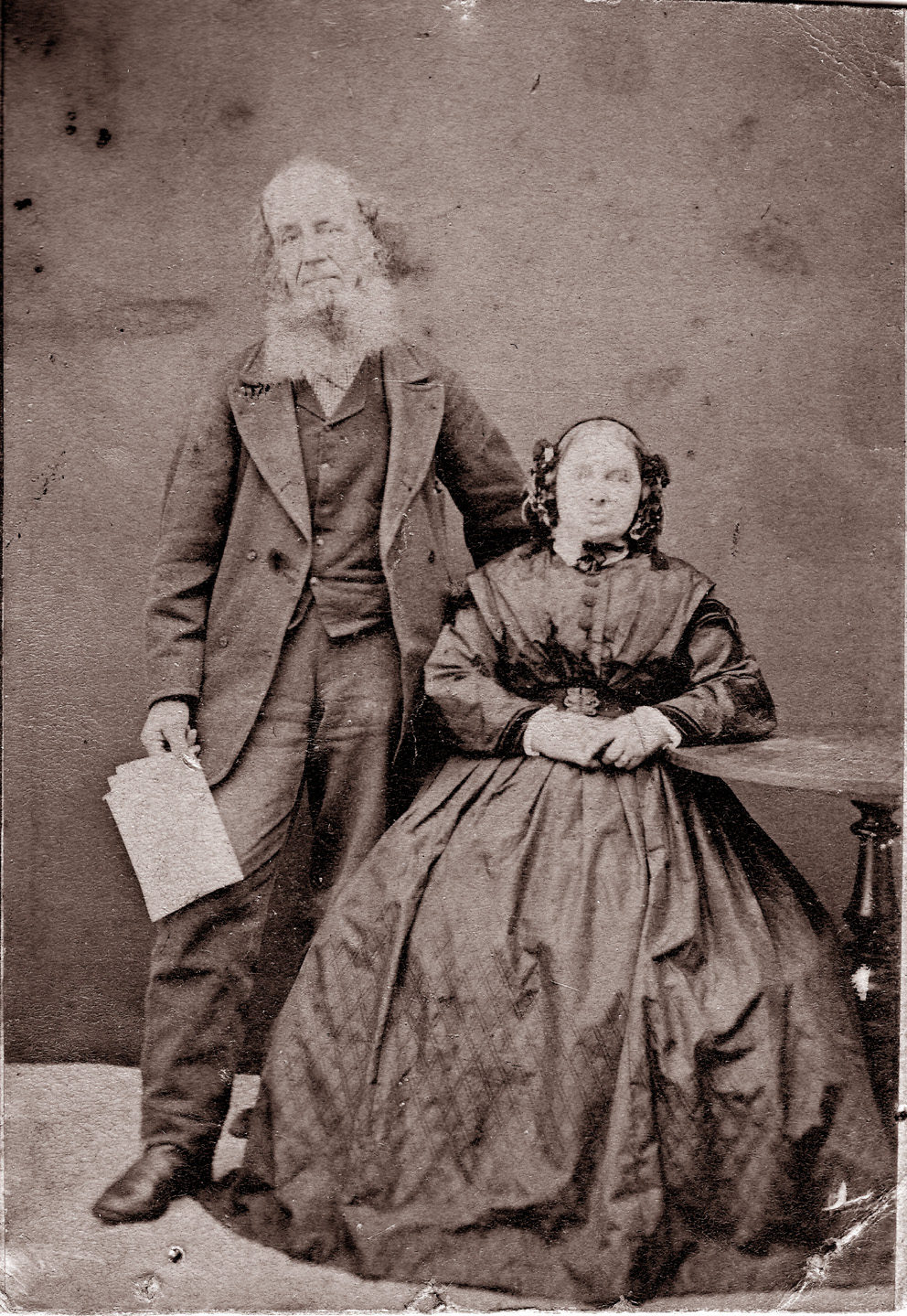
Edward Simpson 1809 - 1877 : Reflections on an Emigrant and Colonist


Edward & Lucy Simpson,
Nicholas Brothers Photo, Otago, NZ
(Possibly taken in Dec 1872 when the
Nicholas Brothers visited Riverton)
[From my own collection]

On the 29th August 1861 no less than ten adult members of the Simpson family from Stowmarket in Suffolk England, led by Edward Simpson Snr, the patriarch of the family and his wife Lucy née Hopson, embarked 'en masse' on the sailing vessel 'Chile' from London Docks bound for Port Chalmers Otago in the South Island of New Zealand.

This blog attempts to tell not only something of the story of Edward Simpson Snr., my Gt. Gt. Grandfather, his early life, his story of emigration, and of his building a new life in Riverton on the southern coast of New Zealand but also something of his views on his life in New Zealand, colonial matters, and on colonization. These have been gleaned from a quite unique collection of surviving correspondence and show Edward to be an insightful man but also very much 'to the point' and not afraid of voicing his opinions.

But firstly, who was Edward Simpson? We know a little of his early life. We note his birth on the 31st May 1809 at Stowmarket in Suffolk, England, being the son of Edward Simpson Snr., an Innkeeper of Stowmarket, and Susan Bridgman. His father is noted as having been declared bankrupt on the 26th December 1795 so the family were probably never well off.

His obituary is the only record that in his early days he had been a cabin boy, working under the auspices of his Uncle, the Captain of an East-Indiaman, who appears to have taken the young Edward under his wing. Of this Uncle or of the voyages made I, as yet, know nothing. The East India Company were, at this time, trading around India and the Far East and this would have opened up the young Edward's eyes to the world as well as giving him an early and very practical education. Cabin boys were typically engaged when aged 14 to 16 years and would slowly learn the ways of seafaring life, many advancing on to becoming qualified seafarers.

But by 1831, and at age 22, Edward had returned to Stowmarket in Suffolk, evidently keen to settle down. Here, on the 10th July 1831, he married Lucy Pleasance Hopson, also of Stowmarket. Having, with his wife fourteen children, it would appear that Edward was very much a family man and this may have influenced his desire to leave the nomadic seafaring life and settle down with a wife and bring up a family. Lucy's Father John Hopson was a stonemason and Edward may have learnt his trade under him as I note the two were in business together for some years. But Edward would also enter the stonemasonry trade in his own right, setting up a stonemasons business around 1833.

The picturesque Simpson Family Home adjoining the
Stonemason's business at 5 Ipswich Road, Stowmarket.
Note the yard with an array of carved tombstones.
[Source : Humphries Family, England]

Edward and Lucy resided at 5 Ipswich Road in Stowmarket, the business adjoining their home. The photo above shows the house and yard stacked with gravestones after the turn of the 20th century when it was being run by a grandson, George Simpson. Three of Edward's sons (including my Gt. Grandfather) also became stonemasons, presumably being apprenticed to their father in the business.

By 1861 Edward, along with his wife, five sons, two daughters, and a daughter in law, had made the momentous decision to emigrate half way around the world to New Zealand.

Edward Simpson giving notice that he is handing over
his business to his son John Simpson, an advertisement
from
"The Ipswich Journal" of 5th Oct 1861.

The family stonemasons business in Stowmarket would continue under Edward's son John. With the future of the business secure, we can only surmise that Edward's family saw, as many emigrants of their time did, that greater opportunities for advancement lay elsewhere, in this case half way around the world in New Zealand.

Edward himself was then 52 years of age and now joined his family as they sought out a new life in the colonies. Adventure and the world that lay beyond England was already nothing new to Edward. No doubt feeling that he was not yet too old to start a new adventure in life and, along with his wife, desirous of accompanying so many of their family abroad and seeing them settled, it would appear that Edward willingly left the comfortable life that he knew. This meant leaving behind family and friends but they would not be forgotten for Edward was a prodigious letter writer, remaining in regular contact with his adult children and grandchildren back home and giving them a less than gentle reprimand when they did not respond in a like manner.

But why emigrate to New Zealand? The Otago Provincial Government were at this time proactively seeking skilled immigrants and offered a paid passage and indentured employment by means of a "Promissory Note", the cost of the passage to be repaid from their employment with the Government. This would provide settlers with some measure of surety. And in any case, few could afford the fourteen pound per person fare. That the Simpson family were still not particularly well off is confirmed by their availing themselves of this arrangement, even if this meant travelling by "no frills" steerage class on the three month voyage out.

The Simpson Family with Edward and Lucy in front
centre, taken in Stowmarket, Suffolk, England, 1861
[Source : Humphries Family, England]

On the 29th August 1861 the Simpson family departed London docks on the sailing vessel "Chile" bound for Port Chalmers New Zealand, arriving safely on the 10th December 1861. While Edward kept a diary of the voyage out he makes no mournful entries upon their departure from English shores, appears to be attentive to all goings on, and despite the tedium is in good spirits. In a letter dated 1876 Edward writes that sea travel was not so bad, in fact more comfortable than a tiring railway journey.

As it would turn out, only Edward was able to repay some of his debt to the Provincial Government with his children repaying none of theirs. This was, apparently, not an unusual occurrence as the Provincial Government were not always able to provide suitable work or to pay wages that were equivalent to that which could be derived from private employment.

So what employment did the Provincial Government provide? The obituary for his son Edward confirms that, along with his father, both remained in Dunedin for a year, being engaged in surveying land at St. Kilda, purportedly naming streets after places in Suffolk. This would be from their arrival in December 1861. But curiously, we find in December 1862 a reference to "[stone] Blocks from Waikava, by Mr E. Simpson" mentioned in a report to the planning committee for the Industrial Exhibition to be held at Dunedin. It is known that his son Charles, also a stonemason, had been at Waikava [now known as Waikawa], where his first wife Emma died in July 1862 [Link Here]. So, Charles must have gone on first, to be joined later by his father, perhaps after Emma's death.

But by the end of 1862 the Simpson family, including Edward Snr. and his wife, had taken a coastal sailing vessel down to Riverton in Southland, being a trading and fishing port, and former whaling station. It was no doubt Edward's daughter Ellen marrying and settling in Riverton in September 1862 that enticed the family to settle here. The first published reference to Edward being resident here is in April 1863.

Simpson family research indicates that Edward did not own land until 1869 when he is listed as freehold owner of a section but is yet to build on it. In June 1871 he writes disparagingly that, “I feel there is no longer hope for a house for me and nine in New Zealand I have for a long period been writing and leading my family and connections to expect something.”

Cliff Cottage, Riverton,
The Home of Edward Simpson Snr.
[From my own collection]

But his luck would soon turn and it would not be long before he would finally build his own home, "Cliff Cottage" on Brook street at South Riverton overlooking Jacobs [now Aparima] River with a good view of the ferry operated by his son Charles across to the main township of Riverton. This would be around 1872 -73 when his name appears in the Burgess Roll. The 1900's rebuilt house survives above the bowling green. (update Nov 2022) Family descendants can contact me (link in right hand menu bar) if you would like any more information on Edward Simpson's ownership of this property. 

On the 28th June 1871 a proclamation was issued creating the township of Riverton and South Riverton as a municipality. This now created the necessity of compiling a citizens list with Edward Simpson Snr. being asked to look after the revision of the list, his role being to "hear and determine the claims of the Citizens thereof to be inserted in such List and the objections of such citizens to any other Citizen having his name retained thereon."

Edward's abilities and desire to serve his community were obviously noted. In March 1872 his appointment as Clerk to the Resident Magistrate in Riverton was confirmed; "It is notified in the New Zealand Gazette of the 14th inst. That Mr Edward Simpson has been appointed by His Excellency the Governor to be the Clerk of the Resident Magistrate’s Court at Riverton." From September 1874 to July 1875 he was also the Town Surveyor for Riverton, only giving this up due to ill health.

Edward Simpson, a self portrait
 [Source : Humphries Family, England]

So, what thoughts did Edward have on his new life in New Zealand? Surprisingly, some of Edward's correspondence has survived, both in New Zealand and with family descendants in England. Edward often corresponded with Theophilus Daniel, a prominent Riverton settler (and later Mayor of Riverton), member of the Southland Provincial Council and Wallace Member for the House of Representatives when the latter was away on council business. These letters are very useful as they relate not only to events happening in Riverton but also show how Edward, an educated and wordly man, could freely express and discuss opinions and ideas that he might not have so readily expressed to family members. Latterly, Edward also made known his opinions in the local press, writing under the non-de-plume "Excelsior".

In 1866 Edward makes mention of how he had, at one time, desired to return home, the local economic situation obviously being a factor; "I seemed to have a strong desire to return at one time, I dreamed that my wish was accomplished and I was in England, what with change of circumstances and faces, I felt anxious to get back to New Zealand again – and felt when I awoke as tho’ I was thankful that I was not out of it. I looked upon it as a warning from providence and it seemed to satisfy me that my duty was to wait “His time” and not be uneasy. I was surprised at the change in myself and feelings, there may be changes here that may benefit us a little, it is evident that people are not satisfied with things as they are and if a change come it may come quickly; Colonial changes generally do." [To his Daughter Lucy, 19th Nov 1866]

In 1869, Edward still appears somewhat unsettled; "I should like very well to look round and see you all – but cannot see how at present but strange things happen sometimes and we cannot tell how we may be led by providence now where we may be called to end our days. I do not feel settled here but I believe that people would be as much surprised to see me move from here as they were at home to see me leave England." [To his Daughter Lucy, 29th August 1869]

In the same letter Edward does however allude to his active support of political matters. In 1861 Southland had separated from Otago to form a self-governing Province in its own right and he holds the firm belief that, economically, this had been a mistake;  

"I am not quite certain that I should have stopped here so contented as I have, had I now been taking an active part in endeavouring to bring about a change, and I seem to hope that there is now a fair prospect of our being reunited with Otago. A separation took place the April previous to our landing in New Zealand. Certainly no province ever had a fairer chance or better prospects and prosperity brought extravagance and its consequences are ruin and depression. We have drove the parties from power. What may be the result hereafter I cannot say and it cannot well be worse than it has been. We certainly anticipate improvement in this district and hope we may not be disappointed. It is hard when you have expended money hard earned to see your little property through mis government reduced to one third of its cost in value or less than that even – but such have been our case – we think sometimes we were wrong in coming here but cannot tell – seem to have had a call to do all that I can in aiding the change – believe that my labours have told and acknowledged as useful. I trust that what I have wrote or spoken have been in humble dependence and that if it was right he will add his blessing to my labours."  [To his Daughter Lucy, 29th August 1869]

Construction of the Jacob's River Bridge in 1874 which joined
South Riverton to the main township. Edward Simpson Snr.
lived at Cliff Cottage which appears left centre up the hill
[Source : Records of Early Riverton and District]

Here Edward spells out his dislike of corruption and dishonesty, being prompted by discrepancies in entries in the Electoral Rolls within the Jacob's River District and elsewhere whereby deceased persons were being retained on the roll in an attempt to gain greater importance and representation;

"I wish to be known as a foe to corruption and abuse in every form (if known at all) and that wherever it shall be found it may always count on me as its enemy. I hope yet to see the time when a purer and better system shall prevail, equitable laws justly carried out; and men that enforce them shall in their own persons and acts set an example of obedience." [Letter to "The Southland Times", 15th Feb 1869]     

Edward's blunt opinions and desire to effect change clearly comes through in letters to his friend Theophilus Daniel, this being a good example; 

"...I felt annoyed and vexed afterwards to find that there had been no enquiry and that George Cassels had the petition title, I was able to go for it. I am truly sorry to see so much indifference it argues bad for our cause, what men are made of I cannot tell - but indifference to their own interests (except the pocket) seem to prevail to an almost incredible extent and as to the future, it must provide for itselfMr P told me this morning he had ‘withdrawn from all night meetings and committees and found the less he did the better he was respected’ – will it always be so??" [To Theophilus Daniel, 7th May 1875] 

“I hardly supposed you would have shown my letters to his Honour but as such letters are simply the reflex of the mind they are at least honest and not studied to fit or please anyone.  If I think it I speak or write it and if I don’t I won’t.” [To Theophilus Daniel, 23rd May 1875] 

On the subject of immigration and new settlements we also have some very interesting insights; 

"There is some country not far from here well suited to shipbuilders – good timber – convenience and a demand for shipping of the right sort – there is an Ordnance just passed to establish two special Settlements on the west coast in the Province of Otago – one of them about sixty miles from here “Preservation Inlet” 100,000 acres of land has been voted and part to be given to first settlers and all the remainder sold for the special benefit of the Settlement as a start for the [?] If I was young and strong I would like such a beginning and would go – but I now begin to tumble about on rough ground and cannot see wet from dry after dark. I am little fitted for a new country but still would have a better idea how to proceed than any newcomer." [To his Daughter Lucy, 29th August 1869]

Edward expands on his belief in new colonial settlements and the best way this should be effected;

"How Shall We Increase Our Population? Immigration is the peg on which we hang all our hopes for the future, and the earliest pages of history point to that which has ever been the most successful mode of civilization, viz., by going forth in bands under an acknowledged leader, with some coherent bond or chain to keep them together; and what stronger tie than Christian love can bind man to man... Shall I remind you of the Pilgrim Fathers in Massachusetts, or the Catholics who settled in the more Southern States of America; the Mormons at Salt Lake, the Presbyterians in Otago; the English at Canterbury [N.Z.],... Why then should we not have here our Independent Congregational Societies, Baptist, Wesleyan, Primitive Methodist, or even Temperance settlements...This, then, is the agency that would be most successful with us, holding together those of kindred spirit. You would in this way get the best kind of immigrant at the least possible expense - the most permanent settler, and a larger share of the middle class. Are the Government prepared to encourage this system?" [From an undated letter found among his papers after his death].

From these quite remarkable insights we can gain an impression of someone who believed his opinions to be useful and that he could bring about a measure of change where needed. He was, however, exceedingly loving and gentle in letters to his family. His strong religious beliefs also come though in both his letters to his family and his obituary which notes "the strict honour and probity [strong moral principles, honesty and decency] in which he trained his sons". As his own Father wrote in a poem addressed to him in 1814 [Also read his name downwards in the highlighted letters]:

Each father’s care by nature’s claim do bind,
Direct us to implant in their young mind;
While they are young, you may affect with ease,
Attune them, and direct which way you please.
Regard, dear boy, your father’s firm request,
Displease not God, but firmly on Him rest.
Such is my wish that you may be His care,
In every change may you His blessing share;
Mind well the steady path that leads to life,
Pass on in honest ease and shun all strife.
Sincere to all as you to manhood rise,
Observe you serve your God as your grand prize;
Neglecting prayer to God you’ll be despised.


In Memoriam Card for Edward Simpson Snr.
[From my own collection]

Edward Simpson Snr. died at "Cliff Cottage" Riverton on the 8th October 1877, being in his 69th year and leaving an estate of £575. [around NZD$98,000 in today's values]. He is buried, with other family members, in the Riverton Cemetery under a recumbent sandstone gravestone fittingly carved and sent out by his son in Stowmarket. 

Copyright : Unless otherwise stated, all images are from my own personal collection but may be freely copied for academic and non-commercial use provided this site is acknowledged. Commercial reproduction is prohibited without my specific written approval.

Sources :

- Personal papers and photographs (held by the writer)
- Humphries family, England
- Papers Past [National Library of New Zealand / Te Puna Mātauranga o Aotearoa]
- British Newspaper Archive
- Simpson Family History, compiled by Rebecca Amundsen, 2006
- "Records of Early Riverton and District", 1937 (1971 reprint) [From my own collection]