Showing posts with label Heddon Bush. Show all posts

Friday, 19 April 2024

ANZAC Day Remembrance 25 Apr 2024 - The Winton and District War Memorial Gates


The Winton & District War Memorial Gate
Taken Apr 2024
[From my own collection]


The 25th of April 2024, known as ANZAC Day, will again mark that rare day each year when the two sovereign nations of Australia and New Zealand both commemorate those servicemen and servicewomen who have; 

"served and died in all wars, conflicts, and peacekeeping operations and the contribution and suffering of all those who have served."

Having been brought up in the rural district of Heddon Bush in Central Southland, being located at the southern end of New Zealand's South Island, I always found it curious that unlike many other country districts, even neighbouring Drummond, there was no "brick and mortar" War Memorial. The only reference to those who served in World Wars One and Two is a wooden "Roll of Honour" board installed in the local hall, but this only commemorates former pupils of the school so the names of many local servicemen were omitted. 

For many years I had felt that perhaps, after the misery and heartbreak of the First World War years, an absolutely crippling slump in post World War One farm returns, and also constant and prodigious wartime fundraising, that there had simply been a desire to "move on" and that the will to raise further funds had simply run out of steam. There had also been very generous monetary and personal gifts to the district's Returned Servicemen who had definitely not been forgotten. But then I became aware of the fact that the Winton War Memorial Gates in Central Southland represent not just Winton but also "District[s]".  


A Pillar of the Winton
War Memorial Gate
[Source NZ History]


A plaque on one pillar of the memorial gate does in fact read; "Erected to the Memory of Those of Winton and District" while a plaque on the other pillar reads; "Who Suffered and Died in the Great War". But which districts the Memorial Gates represent is lacking and i'm sure that if asked, most people who pass here now would have no idea that the memorial related to anywhere else other than Winton. At least I now know that those Servicemen from not only Winton but also a number of districts in the area, and who gave their lives for King and Country, were in fact not forgotten. Perhaps it was felt that with a wider geographical area a broad commemoration without names would not only be more cost effective but also a tidier option with less chance of innacuracies or omissions. Had names been added there would unfortunately have been a great many and I daresay a much larger memorial would have been required.


A Pillar of the Winton
War Memorial Gate
[Source NZ History]


Winton and surrounding districts had in fact been actively commemorating ANZAC day in local Churches from the 25th April 1916. A movement to commemorate the landing of the ANZAC Forces at Gallipoli on the 25th April 1915 had started in Brisbane, Australia in early 1916, quickly spreading to New Zealand where the Premier was asked, and agreed, to declare a National half-holiday so that Memorial services could be held. 


Heddon Bush School children
commemorating ANZAC Day, April 1917
[Watson Family collection]


From the above photo we know that in April 1917 children at the rural Heddon Bush School commemorated ANZAC Day, being photographed with a large blackboard reading "Brave ANZACS's" with a New Zealand flag.  ANZAC Day would also commonly be commemorated annually at all Winton and district churches, district schools, at Moores Hall and / or the Army Drill Hall in Winton, and in various local country halls.  

On the 3rd February 1920 Winton unveiled Memorial Plaques at the Winton School, with wreaths being laid each year thereafter. But as with the Heddon Bush School Memorial board, this only commemorated Servicemen who had been former pupils of the School. The Winton Presbyterian Church also put up a "Roll of Honour" (and later also for World War Two) for all Church members who had served in the forces.

But from late 1920, and right througout the Dominion, the "War Memorial Movement" was "being taken up by the public with great enthusiasm". That today almost every township in New Zealand has a public war memorial indicates the success of the movement and the desire to honour not only the fallen but all who had served their King and country.

Various proposals for a Southland Memorial were informally put forward, with Mr Henry R. Wilson of neighbouring South Hillend (died 1972 aged 99 years) writing to "The Southland Times" in March 1920 with some radical but interesting thoughts and suggestions of which this is only an excerpt:

"At Thursday last’s meeting of the War Funds Association, eleven country districts being represented, little sympathy was shown to the idea of the proposed [Invercargill] memorial. Can townspeople wonder why ? The wishes or sympathy of rural residents was neither asked for nor considered. ... A tablet at school or athenaeum in a country centre is very well from the local point of view to keep in memory the brave fallen, but the frittering away of, in some cases, several hundred pounds, and enthusiasm in small inadequate effigies of troopers and small monuments, seen by but few, is injudicious and to be deplored. ... If country people are to subscribe they must see something tangible as the outcome. ... failing a general Southland monument, the bulk of the country people might erect one on Forest Hill,...which is Crown lands and easily seen from Riverton, Otautau, Nightcaps, Winton, Morton Mains and elsewhere.... "

It now transpires that the rural community of Heddon Bush had in fact initially desired a memorial of their own. But in early March 1921, and after having invited Mr Walker, the Mayor of Winton, to speak to the residents, there was a quite surprising development;

“…it was unanimously decided to fall in with the Winton scheme. Winton has decided to erect a clock tower, upon which will be inscribed the names of fallen heroes from the district. The proposed site is on the Railway reserve, which would be beautified and provide a suitable environment for the structure. The cost of the memorial (without the clock) would be about £1500.”   

Choosing to join with Winton was perhaps not surprising. Being only 21 kilometres from Heddon Bush, Winton had a suitable and very visible site readily available at no cost, was undoubtedly the primary commercial rural centre for most Heddon Bush residents, a proposed railway line from Winton to Heddon Bush had been fully surveyed as long ago as circa 1875 and was, even at this late date, still expected to be constructed, and more importantly, it meant being able to share the cost of a rather more substantial War Memorial with not only Winton but other rural districts which all made perfect sense. Likewise, neighbouring South Hillend only put up a World War One "Roll of Honour" board in their local school as late as June 1936 so appear to have quickly fallen in with the "Winton scheme" - hopefully with Mr Wilson's blessing! 


The Memorial Weeping Wych Elm tree in the
Winton Oval, planted to commemorate the
ANZAC Day Landings, circa 1915.
Taken Autumn, Apr 2024
[From my own collection] 


After the initial momentum, fund raising for the Winton War Memorial appears to have progressed rather slowly. The first published reference to active fundraising and plans for the Winton War Memoral is this report dated the 5th February 1924; 

"At a public meeting in Winton to discuss the form of Soldiers' Memorial to be erected, it was stated that nearly £200 was on hand for the purpose. It was unanimously decided to erect an arch-gateway, and plant memorial trees in the vicinity." 

But it appears that there was already a "memorial tree", a weeping wych elm, in the Railway Reserve, having been planted by Mr Robert Wilson, the Mayor of Winton from 1914 to 1915, to commemorate the ANZAC Day landings on the 25th April 1915. So the weeping elm (which is now a "listed" tree) can only have been planted in 1915 unless the term "Mayor" was used retrospectively, i.e., that he was Mayor at the time of the landings although this seems rather unlikely.  

As to why a "Clock Tower" did not eventuate is unknown and we now have an "arch-gateway". The local newspaper, "The Winton Record" would have kept residents well informed of developments and Winton Borough Council business but this valuable publication has not (yet) been digitized.

A report from the 20th March 1924 states that canvassing for donations had commenced and that; 

"a generous response has been forthcoming. It is more than likely that the memorial will take the form of an arch gateway leading to the railway reserve, which will be beautified by the Town Council".

Over a year later, we note that during a meeting of the Winton Borough Council in August 1925, Councillor Gullick; "brought up" the matter of the Soldiers' Memorial. It was then; "...left in the Mayor’s hands to arrange a meeting of the collectors in order that some finality be arrived at." So obviously, plans for the memorial had still only progressed slowly.  


The Winton Memorial Gates in their original
pre-2009 location fronting the Bowling Green.
[Source : NZ History]

By March 1927 a "Sub Committee" had been constituted under the auspices of the Winton Borough Council, then meeting to discuss amended plans by Invercargill Architect Mr Edmund R.F. Wilson ;

"which provide for handsome memorial gates with two imposing stone pillars.... The gates are to be erected on the site at the stone steps leading to the railway reserve. " 

Exactly why an "arch-gateway" was no longer considered is unknown, perhaps just a modification suggested by the Architect in his "amended" plans, although the wrought iron gates when closed form an arch. The concrete pillars themselves would be substantial, each weighing between 6.5 to 7 tonnes. Interestingly, and I am sure by accident rather than by design, the chosen Architect, Mr Edmund R. Wilson, is in fact a brother of the afore-mentioned Mr Henry R. Wilson. 

The official unveiling and opening of the Memorial Gates on Great North Road, Winton, took place on ANZAC Day, being Thursday the 25th April 1929, with the ceremony being carried out by Chaplain Lieutenant-Colonel Dutton of Dunedin, a veteran of both the (2nd) Boer War and First World Wars. The Rev. Dutton had, in fact, a proud military heritage, being the son of a soldier and a Grandfather who fought at Waterloo. Dutton gave a long speech approriate to the occasion, only part of which includes these comments;     

"These tablets [of memory] will serve to tell future generations of the great sacrifices made by the young men of this generation. It has taken some years to complete the erection of the memorial at Winton and I am sure we are all very pleased that it has now been accomplished. The gates, walls and fences have been erected entirely by voluntary contributions and I wish to thank all those who have so liberally contributed to the fund....”


The Winton War Memorial Gates, taken looking west
and framing the Winton Water Tower, Oct 1958
[Photo credit : William Dykes] 


The Memorial Gate was erected with a decorative low concrete wall next to Great North Road, giving convenient access to the Winton Bowling Club grounds. Where the road curves round between the Memorial gate and the former Post Office was the 1902 Band Rotunda (in its original position beside the road before demolition in 1954 due to being a "traffic hazard"), being built to commemorate the 1899-1902 Boer War and the Coronation of King Edward VII. But in later years, with the gate being situated next to a now busy main road this proved inconvenient for ANZAC Day parades and gatherings and of course the band rotunda was long gone by then. Thus, as recorded by local Historian, the late Vince Boyle  ;

"The concrete 14 tonne twin pillars with an ornate iron gate were cut off at their bases and transported to Anzac Oval (80m south on Great North Road) and re-sited there on new foundations in time for Anzac Day 2009 at a cost of $35,928."


The Winton War Memorial pillars being moved,
January 2009
[Photo credit : Robyn Edie]


The new site further south on Great North Road is situated oblique to the road almost adjoining the former 1905 Winton Post Office building and with steps now leading down into the "ANZAC Oval". This is a small park with the centrepiece being not only the ornate Band Rotunda but also the afore-mentioned spreading Elm tree.  

And in fact, the historic old Winton Railway Station dating from 1871 (sadly demolished in 1983) had been situated at the north east corner of the park fronting a short access road, being an eastern extension of Brandon street which now leads to a soul-less car and truck park. Troops would be farewelled here prior to leaving for camp and military service overseas, many never to return. As, previously noted, which rural districts are represented by the Gates is not recorded but this was no doubt deliberately left open to include the area in general. Likewise, the amount raised by each district is not recorded and being a community effort, may never have been itemized in such a way. Comparing the photos from 1958 and today, I note that the dates "1914" and "1919" are no longer highlighted in a darker colour but otherwise the Memorial has been faithfully restored to how it was originally built. As to "1919", this was actually then considered the official end of the war as the Treaty of Versailles was only signed in June 1919. If you look closely at the wrought iron gateway (in the uppermost photo) when closed you will also notice that it also forms a Celtic style Cross.


The Heddon Bush School 
War Memorial Roll of Honour
[Photo credit : Vicki-Lynne Hubber]


And the "deficiency", if you would even call it that, of the Heddon Bush District not having their own War Memorial this was, as previously noted, partially rectified when a wooden Roll of Honour board was placed in the Heddon Bush School after World War Two but lists only those Heddon Bush School ex-pupils who had served and died in both World Wars *. This board was paid for using the £39.8.0 profit from the 1949 Heddon Bush School 69th anniversary celebrations. Yes, an odd date for a celebration but as some first day pupils were still living the community wished to celebrate the occasion with them. The board would later be transferred from the school to the old Heddon Bush hall and is now in the new hall opened in 1964. I recall it hanging high up on the wall, where it still hangs to this day, but I personally never took much notice of it and I do not recall at any time that it was given any particular official ANZAC Day recognition. As to South Hillend, their school closed some years ago and they no longer have a local hall so am unsure of the location of their World War One & Two Rolls of Honour for former pupils but they do still exist and have been photographed. The Kia Mate Toa roll and photographic record of Southland War Memorials and locations can be searched HERE.

[* Update Oct 2026. I was very recently advised that a "painted board" commemorating those Heddon Bush School pupils who had served and died during World War One had in fact hung in the old School building prior to 1949 but for how many years I do not know. This will almost certainly have been an "illumimated address" type of hand painted board and will have been framed. Sadly, with being replaced by a more permanent, much larger, and more visible memorial after 1949, and at the time the late Ann Robbie had been compiling her list of Southland War Memorials prior to 2023, no one knew what had become of the old board. With assumedly being on display for many years it had most likely become very faded but still, being recornized for what it represented, it really is a shame that it appears not to have been kept.]  

But I now know that the service and sacrifice of those from not just Winton, but also from surrounding Districts, are commemorated by the Winton & District Memorial Gates so these now hold a deeper meaning for me. Winton has, in fact, a number of war related Memorial Rolls of Honour and plaques, some being viewable in public areas. 

Last but not least, I must acknowledge the work of the late Ann Robbie (died Jan 2023) for documenting not only these but in fact all of Southland's War Memorials (around 420) as well as her work in restoring a number of memorial boards and rolls of honour. The late Iain Davidson (died Nov 2023), another Southlander, also deserves equal recognition for his work in researching and documenting the lives of a great many local servicemen as well as his invaluable and tenacious work in identifying servicemen in old photographs. I am aware that Andy Macdonald is now progressing Iain's work.    

Any further information is very welcome and my email link appears in the right hand menu bar. As to which "Districts" the Winton War Memorial gates represent most likely includes the following (being districts in the immediate area who do not have their own district War Memorial) :

- Lochiel
- Oreti Plains
- Heddon Bush
- Dunearn
- South Hillend
- Kauana
- Otapiri
- Hokonui
- Springhills
- Tussock Creek


"They shall grow not old, as we that are left grow old :
Age shall not weary them, nor the years condemn.
At the going down of the sun and in the morning
We will remember them."

From "For the Fallen" by Laurence Binyon (1914)


All Rights Reserved 


Sources & Acknowledgements:

- Papers Past, National Library of New Zealand  
- New Zealand History, NZ Ministry for Culture & Heritage 
- "Tales of the Turi 1984 - 1984", by M. Cairns & F.H. Plunkett
- The Cyclopedia of New Zealand [Otago & Southland Provincial Districts] (held by the writer)
- Invercargill Public Library Reference Library (and their very helpful Librarians).
- Watson Family History, 2022 (held by the writer)
- Watson Family photo collection (held by the writer)
- Dykes Family photo collection (held by the writer)
- Personal photo collection
- Vicki-Lynne Hubber, Heddon Bush
- Mrs Dorothy Fleming, Winton

Sunday, 5 August 2018

The Heddon Bush School Riot of 1888

The Heddon Bush School Building and Pupils.
The old Schoolhouse is to the rear.
Taken circa 1939
[Source : "Looking Back 100 Years"]

The Heddon Bush School riot of 1888 is a story I have touched on before but considered this most unusual story worthy of some further background research in an attempt to find out more about this destructive fracas. For it would be the parents who rioted and damaged the school property and building rather than the pupils! But, as we shall read, this small country school would suffer another 'riot' and I was in fact an eye witness to the second all out fight to the death!

Our story commences on Friday the 18th February 1881 with the opening of the small Heddon Bush School in rural Central Southland. The school, being sited on a 12 acre 'glebe',  had been surveyed prior to the district being thrown open for selection under the 'Deferred Payment System' (lease to buy) only three years previous. But without doubt, one thing that mattered greatly to the new settlers was the education of their children (being a harmonious mix of both Catholic and Protestant) and they worked hard to have a school built and opened.

The opening of the school took the form of a soiree, concert and evening ball carrying on till "daylight did appear" but presumably being held in a local shed as the school itself was only a diminutive 24ft by 16ft with the public hall not built until 1897.  Still, the School Secretary, Mr JH Young; "congratulated the residents of the district on being possessed of a school, and hoped it would flourish. Many older settled districts did not possess such a fine school, and it said much for the energy of the settlers that they had succeeded in such a short time in getting a school in their midst." As the settlers had experienced "a [great] deal of trouble in getting the school" he hoped that the children would attend regularly. While a schoolhouse had not yet been built this was completed within the following 12 months. 

Heddon Bush School from the rear, showing the entrance.
The Head Teacher, Mr Samuel Jackson and Mrs Jackson
appear in this image. Taken circa 1916.
[From my own collection]

The first appointed Teacher, being from March 1881, would be Mr John Armstrong being followed by Mr John Officer. As in future years, all Teachers would be employed by the Southland Education Board but were also directly responsible to an elected School Committee formed of local settlers, generally all having children attending the school.  

The first reference to the apparently divisive Samuel ["Sam"] Rosewell Girle as Teacher at Heddon Bush is May 1882, having been appointed by the Southland Education Board, such appointments usually being renewed every twelve months. Girle would still be in residence as "Head Teacher" through 1887 but his days would now be numbered. 

George Hassing with his Wife and Daughter
outside the Heddon Bush Schoolhouse.
Taken circa 1905
[Source : "Looking Back 100 Years"]

But who was Samuel Girle? Genealogy sources confirm that he had been born in North Shields, Northumberland, England on the 8th May 1821, arriving in Tasmania on the "Boedicea" in 1836. I might add that there is no record of him as being a convict! He appears in fact to have worked here as a Teacher, would marry in 1846, but in 1850 was unfortunately forced to apply for bankruptcy. He appears to have continued teaching thereafter. The first mention of him in New Zealand is when his appointment to the Long Bush school was confirmed in 1879, and then noted as passing an elementary science examination for teachers in March 1880. 

The first hint of trouble at the Heddon Bush school would come in October 1887 with Girle being; "given three months notice of the termination of his engagement" by the Education Board. While the reason is not given one only has to look back at the School Inspector's grading marks for October 1886 so see that Heddon Bush School, at 55% of passes, rated bottom for academic achievement with, for instance, Limestone Plains at 72.3 and Riversdale as high as 76.4 This followed similar results in August 1885. 

The local community were quick to respond, with "a number of residents" petitioning the Education Board on the 4th November 1887 to have the services of their Teacher retained. The Board then referred the matter to the Heddon Bush School Committee for "an expression of their opinion".  While their reply has not been published their opinion would strongly support the Board in their original action.

Mr George Hassing with Heddon Bush School Pupils, circa 1905.
My Aunt and two Uncles appear in the front row
(from left, 3rd, 6th, and 7th).
[From my own collection]

At the Board meeting on the 6th January 1888 it was decided to adhere to their former resolution of termination. But after a deputation of residents waited on the Board asking that any decision be deferred until a new School Board had been elected in April their request was acceded to. 

At the next meeting, being held on the 3rd February 1888, the existing School Committee and represented by their Solicitor Mr Macalister, questioned the Board as to why the notice of termination of engagement had been suspended. The Board responded that; "The object was to enable the householders to give an expression of opinion on the subject".   

On the 23rd March 1888 the Board, and after taking the unusual step of going into committee, "resolved that the committee of the Heddon Bush school be informed that the Board proposed to re-appoint Mr Girle as head teacher of their school till the 31st May next [i.e. 1889]". 

No doubt feeling considerably aggrieved and effectively sidelined, the School Committee, and obviously then wishing to be rid of Mr Girle, took the highly unusual and equally divisive step of writing to the Minister of Education asking him to intervene as they had not been consulted on the Board's decision. The Minister replied that he had not the power to intervene and that, while the committee should be consulted, it was ultimately up to the Board to appoint or dismiss. Mr Girles' re-appointment was duly confirmed on the 4th May.

George Magnus Hassing
Heddon Bush Schoolteacher 1888 to 1906
[From my own collection]

But most surprising, and considering the intransigence of the Education Board, it was publicly announced in July 1888 that Mr George Magnus Hassing would "take charge of the Heddon Bush school". While published records are now silent on the matter, the memoirs of Mr Hassing give us a fascinating glimpse of what then transpired, being written in his usual lively and entertaining style. Here is an unedited copy of his report of the proceedings and the subsequent "riot";    

"My predecessor [Girle], an old and worthy gentleman, had for years, unfortunately, made but poor progress with his pupils. He was a teacher of the 'old school', and certainly ignored the new [Education] Act, hence the stagnation. The parents divided for and against retaining him, and the local feud became very bitter indeed. Finally, after a free fight at the annual householders' meeting, a committee opposed to retaining the teacher came into office.  As the [Education] Board did not immediately grant their request to remove the teacher, they turned him out of the school and locked the building.

The teacher, however, opened the school in the residence for those who wished to retain him. But one night, under cover of darkness, he made a sortie and captured the school building. When this news reached the committee they armed and rushed for the recapture. They drove out the teacher and scholars, smashed up the table, chairs, windows, and doors. The teacher, finding himself utterly defeated, thereupon left the district, and died a few years after.

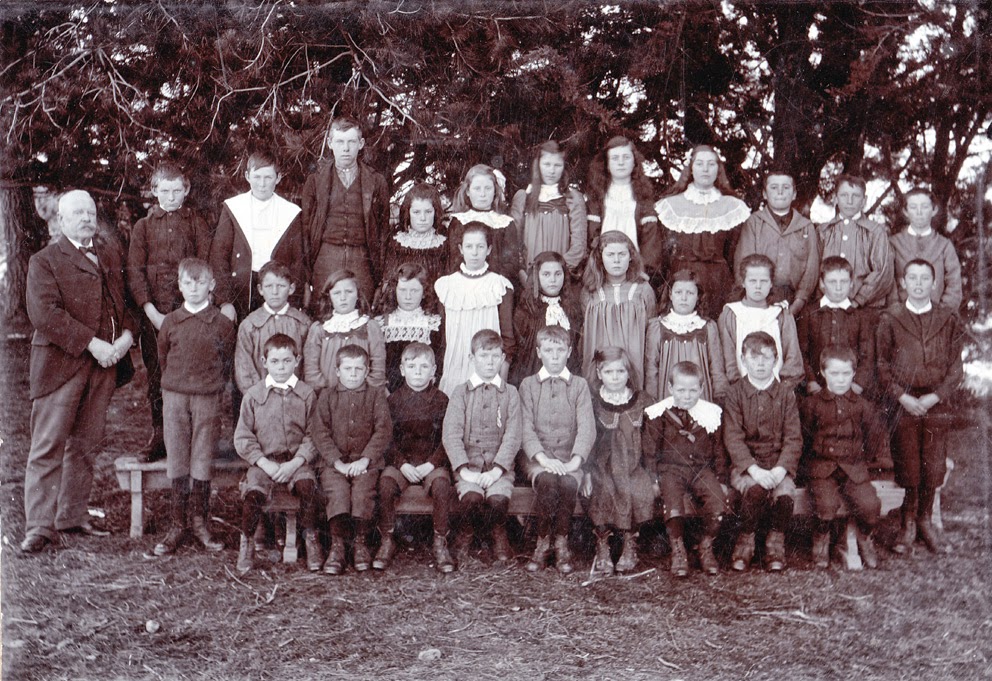
Heddon Bush School Pupils, circa 1907
My Father is seated 5th from left, 2nd row from front
beside the Teacher, Miss Minnie Hanning.
[From my own collection]

Apart from the smallness of my salary as a teacher, I worked overtime till near mid-night for the first month in repairing the broken furniture, pasting up maps, putting in panes of glass etc. I saw at once that it was absolutely necessary to create peace and harmony between the opposing factions in order to make the school a success. I therefore advised them that an important public meeting would be held in the school house. In anticipation of another free fight the meeting was well attended. I then addressed those assembled, stating to them that the unchristian and suicidal policy they had followed, showed them clearly how they were ruining the chances of their children's progress as well as their own social joy, happiness and brotherly feeling. I entreated them to look upon the matter in its most serious aspect, and called upon them as good and honest men to make friends at once.

At the close of my address a wonderful reaction set in. The whole assembly stood up and shook hands most heartily, they fell upon each other's bosoms, and shed tears of joy. After that evening we had uninterrupted friendship and brotherly love among the whole community during the many years it was my privilege to live and labour among them."    

Being written in the years prior to Hassing's death in 1928 I would discount any possibility that he had embellished the story for dramatic effect. Despite being of Danish birth he simply had a wonderful mastery of the English language. Elderly residents of the district would have quickly called him out had he been telling tall tales and there were even a number of first day pupils still living who attended the 68th Anniversary celebrations in May 1949. The unusual anniversary date had in fact been chosen because of this very fact.

My Father's Badge & Decade Ribbon from the
Heddon Bush School Anniversary, May 1949.
[From my own collection] 

As to the unfortunate Samuel Girle, and then aged 67 years, he would go on to be appointed as "Temporary Head Teacher" at the new school at Longridge, Balfour in June 1888. Thereafter his name appears at various Southland schools but always on temporary appointments, the last such appointment being in 1889. By 1890 he had moved to Invercargill where he died on the 19th July 1906, aged 85 years. Descendants placed a new headstone over the family grave site in 2016.  

Even Hassing appears to give Girle a passing compliment in referring to him as "an old and worthy gentleman" and it must be remembered that half the local residents were quite happy to retain him. But retaining old teaching methods and not being readily amenable to change he had simply had his day as an effective Teacher. By comparison, Hassing successfully taught until he was 85 years of age and was much liked by pupils and parents, being not too strict but "if a pupil wanted to learn, he provided the opportunities and the benefits available from even the best of teachers" [written by George Catto, a former pupil of Hassing].

Now, as to the second Heddon Bush school "riot", this would have taken place around December 1966 and also involved a smashed table and chairs with pupils intent on hitting each other, but let me explain. The Head Teacher, Mr Warner Lamb, had gone to some trouble to go over to Otautau to purchase a quantity of soft "Pinex" wood panels to use as props for an end of year school production. Needing to undertake some other business he left the senior room boys to make these into a makeshift table and chairs. During the play, a cast member would be pushed over the table and chairs in a mock fight and they would safely collapse. It may have been a western themed play but I cannot recall for certain. But things got out of hand when temptation became too much and a few boys were whacked with pieces of pinex. Then it became a free for all and a matter of self preservation although I recall that the girls kept well out of it saying that there would be big trouble when the teacher returned.

The Newly Extended Heddon Bush School,
Taken early 1965
[William Dykes Photographic Collection]

Naturally he was furious at his precious pinex being smashed up in such a manner and all the boys, including myself, were given a stern lecture including the strap, regardless of culpability or age. This was not the only occasion where all the mixed age male pupils in this classroom were strapped and on one occasion it turned out that none of us were at fault. But nothing was said, no apologies, no complaints from parents, these were just very different times. 

Having met this same (and now far less scary) teacher again at the 125th celebrations in 2006 he was quite blown away and perhaps, I even thought, rather emotional at the academic achievements of his former pupils so perhaps such punishment had its place after all! Having said that, my Scottish born Grandfather strongly believed in the birch as a form of punishment, perhaps having been forced to submit to this in his youth. But then he was, as was his brother, both very high achievers, a Solicitor in Edinburgh and a First Class Marine Engineer. But seriously, I believe it is always a qualified and engaged teacher who has the ability to bring out the best in and inspire their pupils onto greater things in life. Both Mr Hassing and Mr Lamb undoubtedly had these attributes.

All Rights Reserved

Sources :

- Personal Family Papers and Photographs (held by the writer)
- William Dykes Photograph Collection (held by the writer)
- "Papers Past" [National Library of New Zealand / Te Puna Mātauranga o Aotearoa]
- "The Memory Log of G.M. Hassing", 1930 (from my own collection)
- "Looking Back 100 Years - Heddon Bush School 1881-1981" (from my own collection)

Friday, 29 June 2018

A Study in Photographic Identification - "St John De Mar at His Sod Hut"

My Grandfather with his Horse Team at
St John's De Mar's "Sod" Hut, Heddon Bush.
Taken circa 1900
Photographer possibly W. Cameron of Winton
[From my own collection]

Having commenced cataloguing a vast collection of old family photographs a couple of years ago, this particular image caught my eye and has truly proven to be the image that keeps on giving. I very much enjoy the challenge of identifying old photographs, this aspect of being a Photographic Archivist being part and parcel of my working career over many years. And this interesting image has enabled me to successfully apply various identification methods which I will detail in this Blog. And, as we shall read, we cannot or should not believe everything we see! 

But what we will be looking at here is surprisingly not one but two photographs, both coming from entirely separate sources however both were taken of the same subject matter and apparently at the same time. Essentially we will explore where, when and who in relation to the subject content including an attempt to identify the photographer with an explanation of the process whereby I have arrived at these conclusions.

St John De Mar's "Sod Hut"

What do we see in this image?

A bush setting with a stand of mature native forest. On the left is a colonial era canvas covered hut with walls constructed of logs and a chimney made of sods. Outside the hut we can just discern a watering can. Over to the right, as shown in the full image, we can see a horse drawn waggon with two adults and two children.

My Grandfather with his Four Horse Waggon

Who do we see in this image?

Although the photo lacks any attribution, it was found amongst board mounted photographs owned by my Grandfather, a sheep and grain farmer of Heddon Bush in Central Southland. While the image is rather grainy I have no doubt that my Grandfather is the bearded man sitting on the waggon holding the child. That it is in fact my Grandfather is also confirmed by the fact that this is his own four wheeled waggon and I hold another image of it to doubly confirm this attribution.

Why my Grandfather was in fact here is unknown although his farm was only just over a mile down the road. It may well be that he was simply passing (the site is by two main roads) and asked by the Photographer to pose with his horses for some added detail and interest - and perhaps hopeful of making a photo sale (in which he was evidently successful!). Even at this date a canvas and sod hut would have been very unusual, such basic dwellings constructed of local materials had probably all been replaced by the 1880's after the first settler farmers became sufficiently established over the previous decade and building supplies were more easily able to be transported once proper roads were constructed. 

Confirmation of John Searle's Employment prior to 1903;
"Jan 1st [1903]Wages to date £14.6.9"

Knowing that my Grandfather permanently employed a ploughman / labourer over these years we also make use of family archives to identify the gentleman standing by the draught horses. While I do not have details of employees prior to 1902, an extant wage book confirms that John Brice Searle, a Cornishman born in 1874 and who died of pneumonia in 1930, had been employed from at least some time in 1902 (as evidenced by the wage book) through to August 1907. As a long term employee it is entirely feasible to assume that he had been employed from an earlier date and he certainly appears to be of the right age. Should Brice relatives still be living in Wrey's Bush (where Brice latterly farmed) they may be able to positively confirm this attribution.

My Grandfather's Purchase of a New Four Horse Waggon,
4th May 1899

When was the Photograph taken?

Again, family archives assist me here. I know that my Grandfather only purchased his new four horse waggon on the 4th May 1899, that being confirmed from the original invoice from Thomas Findlay, "Waggon, Dray, and Coach Builder and Agricultural Implement Maker" of Invercargill. So the photograph cannot have been taken before this date.

Close-up showing my Grandfather with two of his
children and (I believe) his Ploughman, John B. Searle.

With my Grandfather holding what appears to be a child under one year that could only be my Aunt, born on the 20th January 1899 with my Uncle sitting on the waggon seat born on the 13th June 1897. My Father, being the last child, would not be born until September 1902 and I feel this would be too late as the difference in ages of the children would be too great. Thus, dating the photograph to late 1899 or very early 1900 would be my best guess.

"Hart Campbell & Co,
Invercargill"

Who was the Photographer?

Knowing the Photographer is helpful as this can also be a useful aid to dating photographs - but beware as one should not rely on this form of identification alone! In this case we have "Hart Campbell & Co." of Tay Street, Invercargill. This is rather curious because we know from published sources that the Company had been established in Invercargill in 1880 but the partnership would be dissolved in August 1886 with Hart being declared bankrupt. The simple explanation here would be that the original un-mounted photo, which judging by the image at the top of this page was dry and cracking / and or ripped, was later pasted by my Grandfather or Grandmother over an old and rather ill-fitting board mount (not something a professional photographer would take any pride in). I cannot feel the impression of another photograph underneath so this must have been removed. Therefore I believe, and based on all the other facts, that we can totally discount "Hart Campbell & Co" as being the photographer.

Those photographers active in Southland around 1899-1901 were Charles Campbell (formerly the 'Campbell' relating to the above partnership), Karl A. Gerstenkorn of Invercargill, and William ("Will") Cameron of Winton who was active from around 1897 (and whose premises would be destroyed in "The Great Fire of Winton" on the 25th September 1901). Both Campbell and Gerstenkorn always appears to have used board mounts stamped with their names so my educated guess, and using simple deduction, would be that we are looking at a photograph taken by Mr William Cameron. Additionally, Winton is very conveniently located only 20 kilometers from Heddon Bush. I hold other unmarked board mounts taken on family farms around this period which are probably also by Cameron. My Grandfather would also definitely use Cameron for a portrait photograph taken at his Winton studio in 1901. I suspect that Mr Cameron may even have included himself in one of the photographs but without seeing a photograph of him I cannot be absolutely certain.

Having lost his studio in the great fire (along with a number of other businesses), Cameron had new premises built in 1902 before moving to Invercargill in 1911 but after a wartime downturn in business he would be adjudged bankrupt in 1917 and died in November 1918, being buried in an unmarked grave in "free ground". At his farewell from Winton in 1911 it was noted that; "Mr Cameron is generally admitted to be one of the best animal photographers in New Zealand" and one unmarked photograph I hold would definitely highlight this ability. Hopefully we can build up more of an accurate 'picture' of this rural Southland photographer but it does appear that much of his earlier work is unattributed.

"St John De Mar at His Sod Hut, Heddon Bush".
Photographer possibly W. Cameron of Winton.
Watson Collection - held by the Writer

Where was the Photograph taken?

Here we are assisted by the second photograph, being clearly taken at the same time as the first and thus by the same photographer. This photograph is from a different collection and has only come into my hands through a much later family marriage. The poles leaning against the chimney are in the same position in both images although Mr De Mar now appears to be in residence and has lit a fire.

The Isolated and Forested Area at 'Heddon Bush'.
From a Survey Map dated 1865
[Source : Sir George Grey Special Collections]

On the back of this board mount my Great Aunt has usefully written, "St John De Mar at his Sod Hut, Heddon Bush". That it is even Heddon Bush narrows the location down to one specific place within the district. Despite the name inferring that the district had been "bush" this was in fact definitely not the case, there being only one forested area in the whole of the Central Southland Heddon Bush - Oreti area.

"Township of Heddon Bush",
Surveyed 1866
[Source : National Library of NZ]

This forested area, being named "The Heddon Bush Township Reserve" and comprising of around 140 acres, had been surveyed into 28 five acre sections in 1866 to serve as the future site of a settlement in the district. The area of forest is usefully delineated by a wavy line on the plan. The sale of the timber prior to the sale of the sections would have been intended to help defray costs. But there appear to have been few purchasers for these blocks and the settlement, being on the north west corner of the Drummond-Wrey's Bush Road and Hundred Line intersection, ultimately did not flourish, soon being abandoned. Remnants of this area of mature native forest were extant in 1900, and quite surprisingly, remain to this very day.

A Close-Up of St John De Mar by his
Canvas and Sod Hut, Heddon Bush

Finally, Who was St John De Mar (or De Maur)?

Considering we now know so much about the photograph content we know surprisingly little about the rather enigmatic St John De Mar (or De Maur). We know that around 1900 he was living in a makeshift hut somewhere on the Heddon Bush Township reserve. Only an expensive search of 28 land titles would possibly confirm excatly where. Or he may simply have been 'squatting' and perhaps paying the then landowner a nominal rental.

The earliest published reference I have found is "St John De Maur" listed as a voter in the Wallace Electorate, Southland for 1896. The only other references are when "Mr St John Demar" sang the solo, "Red White and Blue" at the Heddon Bush Bachelors' Ball held on the 13th October 1905 and "St John De Maur" gave a recitation at a farewell function to my Great Uncle and Aunt at Heddon Bush on the 10th February 1909 (BTW, I still hold the gold watch presented at this evening). But here the trail goes cold as there is no record of his burial in Southland, no record of his death in statutory records, no will or probate, and no record even of his birth or arrival into New Zealand. Could he even possibly, and for whatever reason, have assumed this name?

If it is in fact correct, the name De Maur would appear to have English origins, especially with the given Christian name of "St. John". To give a recitation he would appear to be well educated and appreciate prose, and that he sang also indicates that he had at least some ability in this respect. My belief would be that he was an itinerant farm worker, picking up seasonal work when available and just living relatively quietly. Why he chose Heddon Bush is unknown although he may have earlier found work here and just liked the district and the residents. He certainly appears to have engaged with the local community and was no hermit. Overall I feel that there is more of a story to be told about his life so if anyone can provide further information on this mysterious gentleman I would be delighted to hear from you. Strange things can happen when I write about individuals and my feeling is that this will not be the last we hear of St John De Mar (De Maur). My email link appears in the right hand menu bar.

All Rights Reserved.

Sources :

- Papers Past / Te Puna Mātauranga o Aotearoa
- Personal family archives and photographs
- Watson family photographs (held by the writer)
- Sir George Grey Special Collections, Auckland Public Library
- Alexander Turnbull Library / Te Puna Mātauranga o Aotearoa

Monday, 23 January 2017

The Evolution of a Country Blacksmithing Business


"Heenan's General Blacksmith", circa 1937-38
Note the blackened forge chimney.
[Photo taken by William Dykes]

In my past career working in a professional  archive, it was very interesting to see collections of old accounts and invoices which enabled us to see how these businesses had evolved over time and how they related to local areas. One such collection later made the subject of a very interesting public talk. Such documents illustrate the products and types of services offered to the local community, business expansion, inclusion of younger family members, expanded product ranges and services, diversification, and sale of the business to subsequent owners. This blog charts one such rural country business over a period of close to 80 years, but primarily using a fairly extensive and unique collection of invoices, records and photographs from my own family collections. As we shall see, these records clearly illustrate all of the above.

In my recent blog featuring the South Hillend Dairy Co-Operative Factory at the corner of State Highway 96 and the Hundred Line in Central Southland, New Zealand, I mentioned a blacksmithing business over the road. It is this business that forms the basis of this blog and charts the evolution over no less than four owners from a country Horseshoer, Blacksmith and Wheelright business in 1901 to an Engineering firm and full service garage operating through to the early 1980's. While technically located in the rural district of Heddon Bush, it also straddles the northern boundary of South Hillend.

Invoice from "P. Sheedy, Blacksmith",
Dated  31st January 1904

The first evidence of a Blacksmith at Heddon Bush is Mr Patrick (Paddy) Sheedy from July 1903 (as per the above invoice). Prior to this date my Grandfather used smithies in Drummond, Isla Bank, and Wrey's Bush which were all some distance away so it appears there was then no resident or qualified blacksmith at Heddon Bush prior to at least this date. Sheedy's work will have been based wholly around his forge, from making and fitting horse shoes to waggon tyres to repairing agricultural machinery and any manufacturing or repair work relating to metalworking in general. It was from this time that the strategic crossroads location became commonly known as "Sheedy's corner".

Long-time Heddon Bush resident as well as being our old neighbour, the late George Catto (1893-1990), recalled in 1981; "The blacksmith was an important person in any farming district, his work including shoeing horses, setting up ploughs, and repairing the agricultural implements. The blacksmith's forge where intense heat was generated by blowing into the fire with a huge bellows with a long handle, was always a fascinating sight as the cold iron was raised to a red hot condition before the blacksmith transferred it with his tongs to the anvil, there to hammer it into the desired shape with uncanny skill."  

Obviously a talented and bright man, Sheedy's 'claim to fame' while at Heddon Bush appears to have been the invention and patent of a "turnip topping and slicing machine". In September 1908 a group of around 70 farmers came to see the machine in operation, cutting the tops off a dray load of turnips as well as slicing them in a matter of just four minutes. "The operation was watched with great interest by a large body of farmers present who backed up their appreciation of the machine by placing numerous orders with the inventor."

In September 1912 we now find Sheedy advertising to new and existing clients that he has removed to new premises in the Main Street of Otautau, advertising himself as a "Horseshoer and General Blacksmith". By this time there were apparently three blacksmiths working around the Heddon Bush district.


Invoice from "Heddon Bush Shoeing Forge -
General Blacksmith & Horseshoer",
Dated 24 Feb 1922

The purchaser of his old Heddon Bush premises would be Mr Andrew (Andy) Melrose who marketed his business as the "Heddon Bush Shoeing Forge". I can find no record of where he may have worked previously nor the business being advertised for sale so it is certainly possible that he had been working for and qualified as an apprentice Blacksmith under Sheedy.


Receipt from the "Heddon Bush Shoeing Forge", 25th March 1922
Note the requisite stamps in payment of transactional stamp duty.

As with his predecessor, the breadth of his work and skills is impressive. I note on the invoice to my Grandfather that Melrose made and removed horse shoes, repaired bridle bits, manufactured bolts, cut notches in a "rack", repaired spokes of a mill, cut two waggon tyres, and bushed two wheels. And this is but one invoice.

It was during this period that Melrose purchased the cottage previously built for the South Hillend Co-operative Dairy Company manager and shifted it over the road next to his premises. You can see it in the first photo below.

I find it interesting that during these early years my Gt. Gt. Uncle, William Watson, and living no more than two kilometers away just down Boyle Road, went to the great expense of having a small forge building built on his farm where he installed a portable forge in the form of a large iron table with upturned sides, cast iron legs, and the requisite forced air operated by (from memory) a hand turned blower. As he had fully "tractorised" his farm from around 1913 there wasn't a lot of shoeing to be done! My father obtained this portable forge from my Gt. Uncle in 1955 and recalled the "great fun" we children had seeing it in use (I remember this occasion) and the red hot metalwork being hammered over a large anvil. In the earlier years, as in my Father's day, it probably didn't make economic sense to use your own forge just for occasional use so it was probably more of a hobby activity as my Watson family continued to regularly use the local smithing and engineering business.

In early 1924 Melrose issued his last invoice to my Grandfather. In June 1924, a qualified Blacksmith, Mr Alfred (Alf) Heenan, bought out the business, having worked for Melrose since earlier that year. Alf (whom I remember very well) and then just in his early twenties, had from 1922 previously served his apprenticeship in blacksmithing at Clifden in Western Southland. Part of his work involved shoeing the six horse teams which pulled the heavy waggon loads of supplies up to 15 times a day to the Monowai hydro-electric plant.


Invoice from "A.G. Heenan, General Blacksmith",
dated 3rd Oct 1924

The smithy was, when purchased, just 18ft by 24ft with no electricity, hanging kerosene brass lanterns with enamel or white painted reflectors then being in common use. This old weatherboard and corrugated iron roofed building was soon extended. During this earlier period of sole charge,  Alf initially worked the smithy alone. Desiring to go on his honeymoon, he simply left the door of the smithy unlocked and a note on the door, "Anyone who needs tools, please help yourself". Upon his return only one spanner was missing. "Alf declared until the day he died that it would not have been a local who took it". Otherwise when he was away, locals were always "free to come and go as they wished", entering any purchases in a charge notebook. No other items were ever unaccounted for.

Invoice from "A.G. Heenan, General Blacksmith",
Dated 6th Sept 1928

His wife Nellie recalled that in these early years even she was called in on occasion to work the bellows, their home being alongside the smithy (or "The Smiddy" as my Scottish born Gt. Grandmother down the road always referred to it). It was not uncommon to receive part or full "payment in kind", such as meat, during the depression years as it suited them and thus avoided embarrassment on the part of seasonally cash strapped farmers. I note my Grandfather often used this convenient method of payment, even for his Dentist. I perceive the tax man would have something to say about that now!

It took Alf a day to shoe five horses, the busy times being December through to February so that the horses were well shod before harvest time and for the carting of the requisite coal for the thrashing mills from the mine at Nightcaps. The gravel roads were then exceedingly smooth, "the steel-shod tyres of the wagons rolled the stones into a smooth surface".


"Heenan's General Blacksmith", circa 1938-39
[Photo taken by William Dykes]

Alf witnessed the slow decline from horse power to motorized transport in the district, aided himself by the installation of a petrol pump to cater for this new demand. The first petrol sold was "Tydol Motor Spirit" until bought out by the "Shell" company. Mrs Heenan recalled that they got threepence a gallon on selling "Tydol", the underground tank being refilled by the company from four gallon cans. By the late 1930's there were now three pumps. You can make out the "Shell" name and emblem on one of the pumps as well as on an advertising sign. A "Firestone" tyre advertising sign can also be discerned at the apex of the roof.

As my Grandfather's 1938 Ford V8 sedan is parked next to the pumps the photo would have been take after on or after 1938 but before the new house was built in 1939. I can in fact recall Mrs Heenan saying that the new house had been built a little too close to the workshop and garage for her liking, convenient maybe but noisy being just next door. I believe the new concrete and corrugated iron garage and workshop building probably also dates to 1939. By the 1930's this intersection of two busy roads was now known in the district as "Heenan's corner", a name that would remain for the next half century.

Licence for AG Heenan to Issue Fuel & Oil during the
Second World War / Immediate Post War Period.   

Heenan's Engineering & Garage, circa 1954
[Photo taken by William Dykes]

Slowly the nature of the business changed and diversified from a smithy to that of "a country garage" and the nature of the business adapted accordingly. One part of this changeover to servicing mechanized equipment included adapting a multitude of horse-drawn farm implements for use behind tractors. This was a task apparently more challenging than it sounds as he spent many a night thinking about the various "and [often] very odd" suggestions made to him as to how this might be achieved from a practical perspective. My own paternal family did not purchase their first tractor until 1942 so the regular shoeing and servicing of horse teams continued for some years.


Heenan's Engineering & Garage including the owner's House, circa 1954
[Photo taken by William Dykes]

By the 1950's, practically all the work appears to have been related to vehicle servicing, engineering / welding, and fuel sales. The name "Heenan Engineering Company Ltd" was first registered in 1950 and appears on the side of the building and the porch. The business also held the agencies for "Booth MacDonald" pumps and other machinery items. To facilitate and encourage orders for the former the family built and operated a well-drilling machine fitted to the back of an old Ford Truck. In March 1956 I note they bought a 1934 Bedford WLG truck from my family with a very interesting prior ownership and usage, I wonder what became of it?


Heenan's Engineering, circa 1956
Note the men sitting chatting, a common occurrence.
[Photo taken by William Dykes]

By the late 1950's Alf's two sons were brought into the business. By 1962 Alf, and at the age of 60, "retired" and turned his hand to farming, leasing a nearby 193 acre farm from my family. One of his sons, Robert (Bob) Heenan, continued to run the garage and engineering business. A popular product made by the firm were "sheep handlers" constructed of sheetmetal, around 1,700 being sold over the following eight years and keeping three men busy.

Heenan's Engineering, circa 1956
[Photo taken by William Dykes]

I can recall the garage and workshop area through the 1960's, an area that members of the general public, let alone curious children, would not be able to wander around in today's safety conscious age. I always found the large welding goggles somewhat creepy. From memory the pumps were for "regular", "super" and kerosene, with oil and tins of grease also being available. I note in the colour image that, surprisingly, the garage had pumps for Shell, Europa and BP fuels.

Heenan's Engineering Co Ltd Invoice, 1957
[From my own collection]

On the 30th November 1964 this intersection of two strategic roads unfortunately claimed the life of Otautau Watchmaker and Jeweller, Mr WJ Wesney and his wife Mrs GL Wesney, who both died together in a motor accident aged 76 and 64 years respectively. The angular nature of the intersection may have been a contributing factor although visibility is not unduly obstructed by the garage building. The Heenan's were probably one of the first on the scene to witness this dreadful carnage.


A skilfully made miniature armchair made from
a tin beer can by retired engineer Mr Alf Heenan
in the 1970's and presented to my parents.
[From my own collection]

From the late 1960's the construction of portable farm buildings and hay barns now became a large part of their business. One of Heenan's welded steel truss and corrugated iron sheds blew down in a storm on my Uncle's farm in the late 1960's due to inadequate foundations and had to be totally rebuilt by the company. This was also an acknowledged problem with their removable but handy farm sheds build on skids when faced with a strong Southland westerly storm and "quite a few became airborne". Building sheds suitable for Southland conditions no doubt proved to be somewhat of a learning curve for Mr Heenan and his team of engineers.

The site of Heenan's Former Premises, 2010
[Source : Google Maps]

Further diversification and expansion in the 1970's saw the business move in the early 1980's to larger premises at Winton in order to accommodate an enlarged workforce, "leaving the [old] workshop to the starlings".  The old building is now well kept but in private ownership with the adjoining house and grounds attractively landscaped.


Copyright of Images :

Unless otherwise stated, all images are from my own family collection and may be used for non-commercial use provided this site is acknowledged.

Sources :

- Dykes family papers and photographs (from my own collection)
- Cochrane family papers (from my own collection)
- Papers Past [National Library of New Zealand / Te Puna Mātauranga o Aotearoa]
- "The Southland Times"
- "Looking Back 100 Years - Heddon Bush School 1881-1981" (from my own collection)
- "Tales of the Turi : South Hillend Centenary 1884-1984", by Marjorie Cairns & Frank Plunkett
- McNab Room, Dunedin Public Library