
 |
| The first authenticated Steam Powered Road Vehicle dating from 1770 |
A Note to My Readers - This blog is my 1st April 2018 spoof, hopefully you will readily realize which part is fictitious!
Vintage transport has always been one of my passions. This blog features some early and very diverse versions of early steam powered vehicular transport, essentially being the earliest self-propelled vehicles intended for use on public roads rather than on the railway. These date from the 18th to 19th century and quite surprisingly, one example still survives today.
The very first fully authenticated steam powered vehicle was the work of Nicholas Cugnot, a French Army Captain and inventor who built his 'fardier à vapeur', or 'steam dray', in 1770. The intention was that this vehicle would carry supplies and equipment for the French Army.
"...specified to be able to carry four tons and cover two lieues (7.8 km or 4.8 miles) in one hour, a performance it never achieved in practice. The vehicle weighed about 2.5 tonnes tare, and had two wheels at the rear and one in the front where the horses would normally have been. The front wheel supported a steam boiler and driving mechanism. The power unit was articulated to the "trailer", and was steered from there by means of a double handle arrangement. One source states that it seated four passengers and moved at a speed of 2.25 miles per hour (3.6 km/h)."
It appears that the boiler fire needed to be extinguished every quarter of an hour or so to enable the boiler to be refilled, the fire then relit, and steam raised again before advancing. And with no boiler tubes steam raising performance was poor. This all considerably reduced the effectiveness of the vehicle. After running a small number of trials between Paris and Vincennes and at Meudon, the project was abandoned. But Cugnot's 'steam dray' survives, being on view at the Musée des Arts et Métiers in Paris.
 |
| The First Steam Coach - A Representation of Gurney's London to Bath Steam Carriage in 1829. |
Although he was not the pioneer of early steam road vehicles (that honour goes to Richard Trevithick), Goldsworthy Gurney built a number of steam-powered road vehicles over the period 1825 to 1829. This was with the intention of commencing a steam road transport business, 'The Gurney Steam Carriage Company'. On trials around London his vehicles reached speeds of up to 20 miles per hour with one vehicle being sufficiently robust to make the return journey from London to Bath and back in July 1829 at an average speed of 14 miles per hour.
For some time a service using three of Gurney's steam carriages operated between Cheltenham and Goucester but ultimately they proved not to be a commercial success. Prospective travellers were fearful of sitting atop a pressurised steam boiler (probably rightly so) along with the unavoidable smoke and cinders from the exhaust. Restrictive Government legislation from 1861 which limited speed limits effectively stifled any further development of steam powered road vehicles. in the United Kingdom
 |
| Zadoc Dederick's "Steam Man" Invented in 1868 |
But such legislation appears not to have been imposed within a more tolerant and progressive United States. On the 24th March 1868, the 22 year old American inventor Zadoc P. Dederick patented his prototype and quite novel "steam powered humanlike robot" which he had designed to pull a cart, being operated through a system of levers and cranks, attached to steam-powered pistons and a boiler.
 |
| "A Steam Man" - The New Zealand Herald, 22 Apr 1868 |
The 'New Zealand Herald' of the 22nd April 1868 fully describes this new invention, additionally stating that each step is taken "very naturally and quite easily", with each step advancing the body about two feet and with every revolution of the engine producing about four paces. As the engine was capable of a thousand revolutions a minute it could make a mile a minute. But allowing for uneven ground the engine would be run at 500 revolutions per minute making a modest speed of half a mile a minute. It was expected that sufficient coal could be stowed away under the back seat of the carriage to work the engine for a day and enough water in a tank under the front seat to last half a day.
A steam whistle is fitted to the mouth, a safety valve in an appropriate position, and a pressure guage at the back of the head. A large stove pipe hat acts as a chimney.
So as not to frighten horses, the "Steam Man" would be clothed to give it a human likeness. The makers, "Dederick and Grass" expected to be able to manufacture the "Steam Man" for US$2,000 and to be warranted to run a year, without repairs, for a cost of US$300.
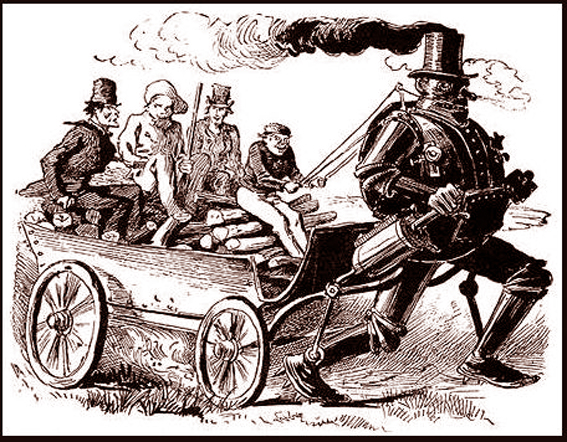 |
| An Artist's Representation of The Celebrated "Steam Man of the Prairies", From an illustration dated 1868 |
And so, in August 1868, would be born the celebrated "Steam Man of the Priaries", the construction of Edward Ellis based on but improving on Dederick's patent. Designed as a practical form of transport for the flat American prairie lands, it would also be unhindered by the restrictive and punative regulations which now applied to British forms of powered road transport. While no extant photographs appear to exist, we are very lucky to have a witness account which describes the "Steam Man" in very great detail. The workings of this wonderful machine were indeed a marvel of 19th century American engineering;
"It was about ten feet in height, measuring to the top of the 'stove-pipe hat,' which was fashioned after the common order of felt coverings, with a broad brim, all painted a shiny black. The face was made of iron, painted a black color, with a pair of fearful eyes, and a tremendous grinning mouth. A whistle-like contrivance was made to answer for the nose. The steam chest proper and boiler, were where the chest in a human being is generally supposed to be, extending also into a large knapsack arrangement over the shoulders and back. A pair of arms, like projections, held the shafts, and the broad flat feet were covered with sharp spikes, as though he were the monarch of baseball players. The legs were quite long, and the step was natural, except when running, at which time, the bolt uprightness in the figure showed differed from a human being.
"In the knapsack were the valves, by which the steam or water was examined. In front was a painted imitation of a vest, in which a door opened to receive the fuel, which, together with the water, was carried in the wagon, a pipe running along the shaft and connecting with the boiler.
"The lines which the driver held controlled the course of the steam man; thus, by pulling the strap on the right, a deflection was caused which turned it in that direction, and the same acted on the other side. A small rod, which ran along the right shaft, let out or shut off the steam, as was desired, while a cord, running along the left, controlled the whistle at the nose.
"The legs of this extraordinary mechanism were fully a yard apart, so as to avoid the danger of its upsetting, and at the same time, there was given more room for the play of the delicate machinery within. Long, sharp, spike-like projections adorned the soles of the immense foot, so that there was little danger of its slipping, while the length of the legs showed that, under favorable circumstances, the steam man must be capable of very great speed."
This unique form of transport would however be very short lived, not becoming a commercial success, and limited by cost, reliability, and the rapid development of technology, particularly through the 1870's. The invention by Serpollet of the 'flash steam boiler' would revolutionize the development of small steam powered passenger vehicles now making such means of transport a commercially viable proposition.
Sources :
- Various Internet Sources
Blog Published 1st April 2018


